Back in 2023, Gal*Gun received its first major spinoff in the form of Gal Guardians: Demon Purge. Going from a rail shooter to a Castlevania-inspired platformer was an interesting choice, but ultimately one I felt paid off. Though it had its issues, I still felt it was probably Inti Creates‘s best game for the whole Nintendo Switch era. After just two years, we’ve finally got a sequel to tackle, where demons will once again be purged… by demons. It’s time to reclaim the night in Gal Guardians: Servants of the Dark.
Bothersome Demons Shall Be Punished
Despite the shift from a classic platformer to Metroidvania, Gal Guardians: Servants of the Dark shares much of the same DNA as its predecessor. As in the first game, you’re going to barreling through some tricky level design as you make bloody gibs of your enemies as two contrastingly cute girls. If you want, you can bring a friend along and play the entire thing co-op, an option which even features online play this time around.
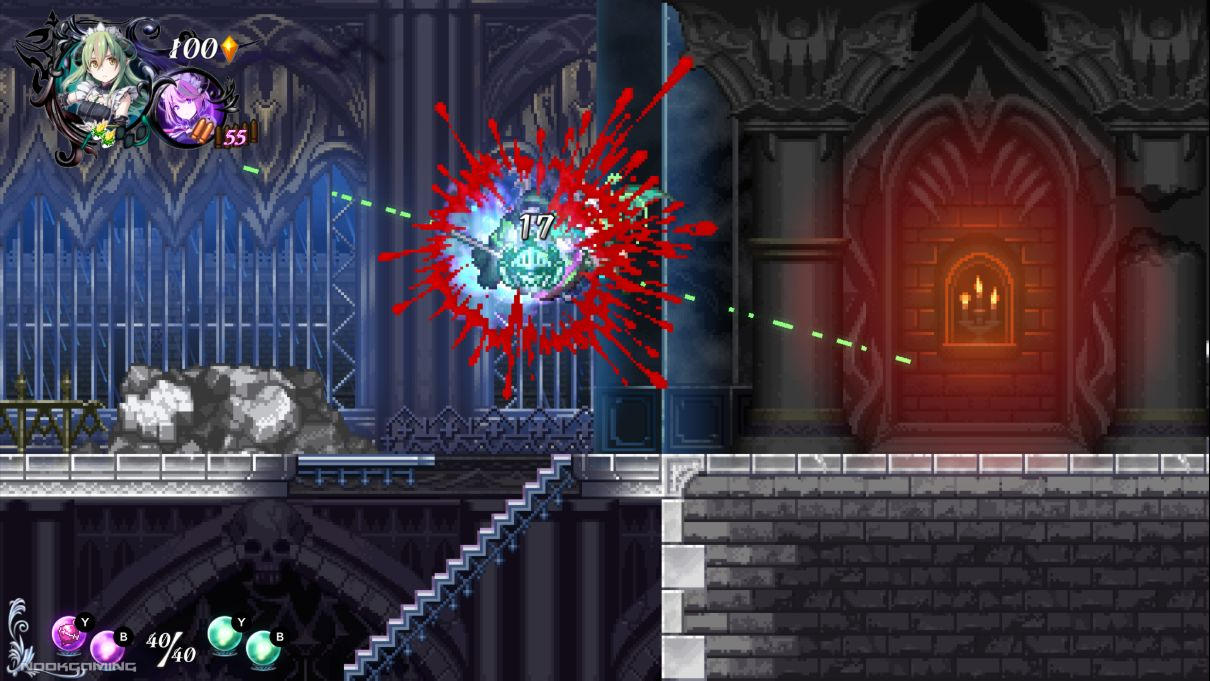
Like before, you’re playing as two sisters. Younger sister Masha is focused on quick melee attacks like Maya before her, and older sister Kirika is focused on ranged gunplay like Shinobu. Their kits have also been expanded. Both now also have a dash maneuver similar to the Gunvolt titles, allowing you to evade danger or get to other destinations more quickly—and Kirika even gets a powerful new shotgun attack when you time an attack and dash together. It completely shreds most of the normal enemies, though it is dangerous because of its long end lag.
Unlike before, where subweapons were doled out upon completion of each level, here they are instead dropped by enemies or crafted from materials you pick up. They can also be used by either sister, so any enemy that may need to be sliced in two can be done in by Kirika, provided she has the right sword subweapon. Likewise, Masha can pick enemies off from a distance with well-timed throwing knives. This makes them both highly versatile, so who you want to play as is entirely up to preference. This is also encouraged further by the removal of the obnoxious character specific areas of the first game.
I’m of two minds on this. On the one hand, I think the overall freedom of versatility fits the Metroidvania genre better than the more rigid systems of the last game. Yet I’m also left feeling like this was an overcorrection, with subweapons lacking the same sense of personality and impact as before. The aforementioned rigidity provided the older weapons a sense of creativity that I don’t feel is as strong here. I would still say what we have right now is better, primarily because of certain level design quirks that we’ll get into later, but it’s still not quite where I wish it was.
A Symphonic Night for Two
It isn’t just the cast or the change in setting, rather, it’s the fact that this game is a full-blown Metroidvania. Demon Purge could sort of be described as a “pseudo” Metroidvania. Levels were laid out in a linear order, but if you wanted to reach the best ending, you had to do a lot of backtracking and exploring. This created a fairly big issue where missing one little thing in a level caused a lot of time to be wasted getting back to that place, and it was impossible to know whether you could open the necessary doors until after you reached them. Found a cheeky way to clear a gap and reached a secret? Whoops, you need a power-up from six stages later and will have to do the whole thing again if you wanna open up the door.
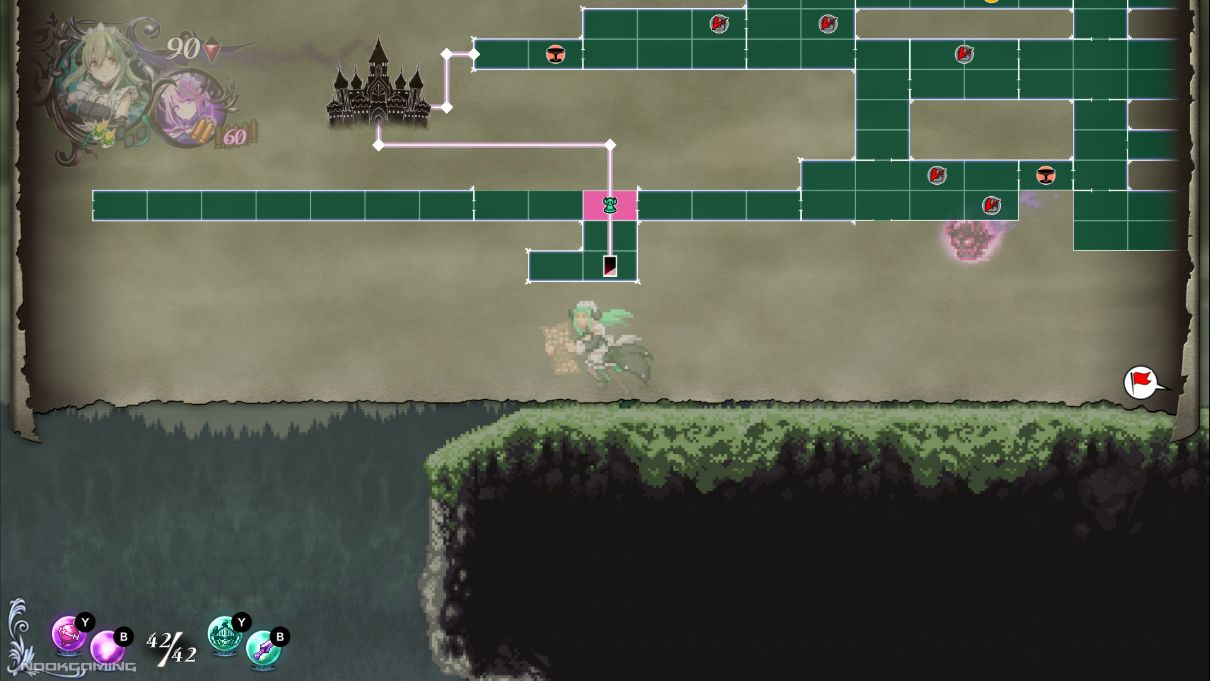
Since Gal Guardians: Servants of the Dark is a proper Metroidvania, this issue is effectively solved. On top of the level design being laid out in a way that is simply more brisk than before, there are also several fast travel points that will quickly get you where you need to go. There’s less meandering and more momentum, though it isn’t without its issues.
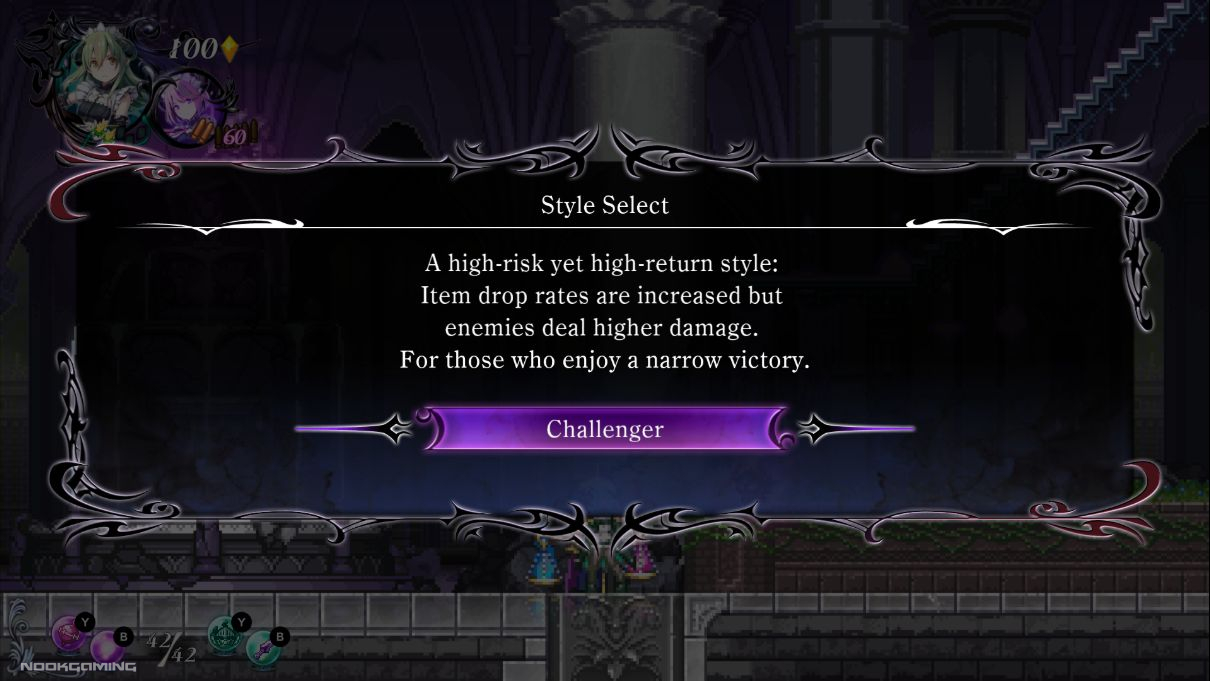
Dying is still unnecessarily obnoxious on Challenger difficulty. When one of the sisters goes down, the other sister spawns in the last place you saved and is given a chance to go back and try to revive them. I’d much prefer it if I switched to the other sister as soon as one of them is down. That’s how it is during boss fights, so I see no reason why exploration can’t be the same way. While some areas are brisk, others can be quite punishing or involve puzzles, making the walk back an exercise in patience. I normally don’t mind these “walks of shame” in games, but they’re typically augmented by something that Gal Guardians decidedly lacks. At the very least, lives are cut out of the equation entirely, so there’s no fearing a game over.
It is still a lot of fun thanks to most of the same qualities of Gal Guardians 1 being carried over, like great enemy design, hard-hitting enemies, and the bosses. Bosses in particular have received quite the upgrade. Not only are there just more of them than before, but they also have more interesting patterns that properly leverage Kirika and Masha’s expanded kits. Enemy design is broadly the same, with many enemies being carried over from the previous game. Given how much I enjoyed them there, this is totally fine.
Eyes on the Map
Being a Metroidvania often means getting lost in several distinct biomes that are precluded by challenges or obstacles that can’t be passed until you get the right upgrades, and Gal Guardians: Servants of the Dark is no different in this regard. With the defeat of most major bosses, you’ll be granted a power that will assist you in overcoming these obstacles. It starts off simply enough, with the tried-and-true double jump being your first unlock. Afterwards, you’ll unlock things like the ability to dash through otherwise impassable walls and such. It’s good fun, and it makes the inspired choice to have some of these abilities function with fighting game-like inputs. While I was at first horrified that the map was structured similarly to Mega Man ZX (where areas are more like miniaturized environments connected by a series of doors), I was thankfully relieved that its structure was easily readable and enjoyable.

Besides making progress, you’re also tasked with finding the souls of your fallen allies. These are usually hidden in plain sight, and require an ability you don’t have yet in order to reach. It’s essentially the same idea as rescuing students in the previous game, and is mostly optional unless you want the best ending. These characters provide new mechanics for you to toy with, such as increasing or decreasing the difficulty, and implementing shops to let you buy or exchange materials to craft subweapons. It’s fairly fun, and having a home base that steadily gets busier and busier helps give the sense that you’re really making progress.
Despite these qualities, I don’t think this game really even comes close to touching the best of the Metroidvanias. Really, it feels more like a typical Inti Creates game that’s bigger than normal. Maps rarely intersect meaningfully, and so everything comes across as bog standard platforming levels that get only somewhat more complex as you make your way through the game. This isn’t a bad thing or even much of an indictment towards how much I enjoyed myself, but it does feel like the Metroidvania genre wasn’t utilized to its fullest potential. The end result is less like Castlevania: Symphony of the Night and more like Blaster Master Zero.
Plight of the Dark Lord
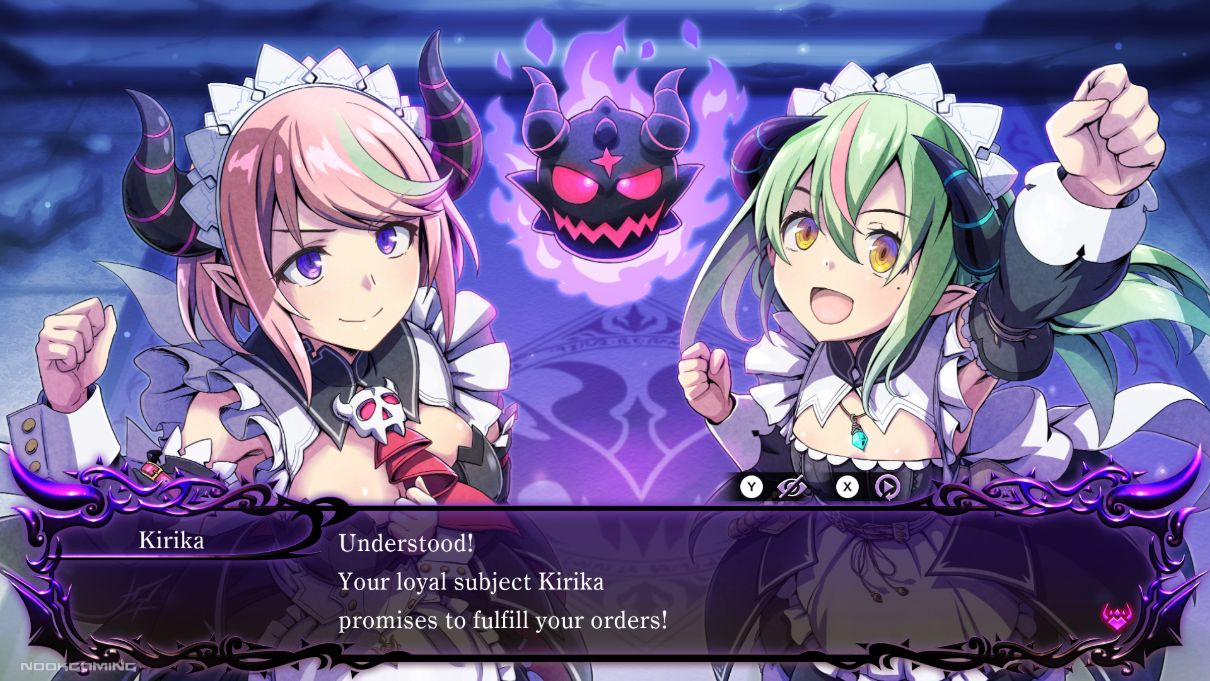
After returning from a vacation, demon maid sisters Kirika and Masha come home to the demon realm of the Gal*Gun world. All is not as it seems, however, as the castle of their Demon Lord, Maxim, is ransacked during a coup by rival demon lord Lyzenorg and his head maid. This assault leads to nearly everyone in the castle being killed, seemingly including Maxim himself. After fighting off Lyzenorg’s minions, Kirika and Masha find that Maxim has managed to just barely survive his would-be death. Instead, his body parts have been sent flying across various parts of the demon realm. If revenge is to be had, Maxim must regain his full strength with Kirika and Masha’s help in finding his scattered body parts.
Sounds like a serious story, right? Wrong, it’s Gal*Gun, after all. Just after Maxim reveals his weakened form (a pitiful floating skull), Kirika and Masha’s unhealthy…”servitude” towards him comes out, and the typical personality of this series follows suit. This bait and switch makes the opening hour a lot more effective than Demon Purge, and giving the sisters a foil to bounce off with Maxim makes the dialogue even more fun than before. There’s even some incidental dialogue that will play based on the new areas and secrets you find, for that slight splash of added flavor. Kirika and Masha themselves are like a reversal of Maya and Shinobu from the previous game. Little sister Masha is your energetic, strange girl who’s immature about romance, while older sister Kirika is more straight-laced, but shows shades of being a total deviant internally.
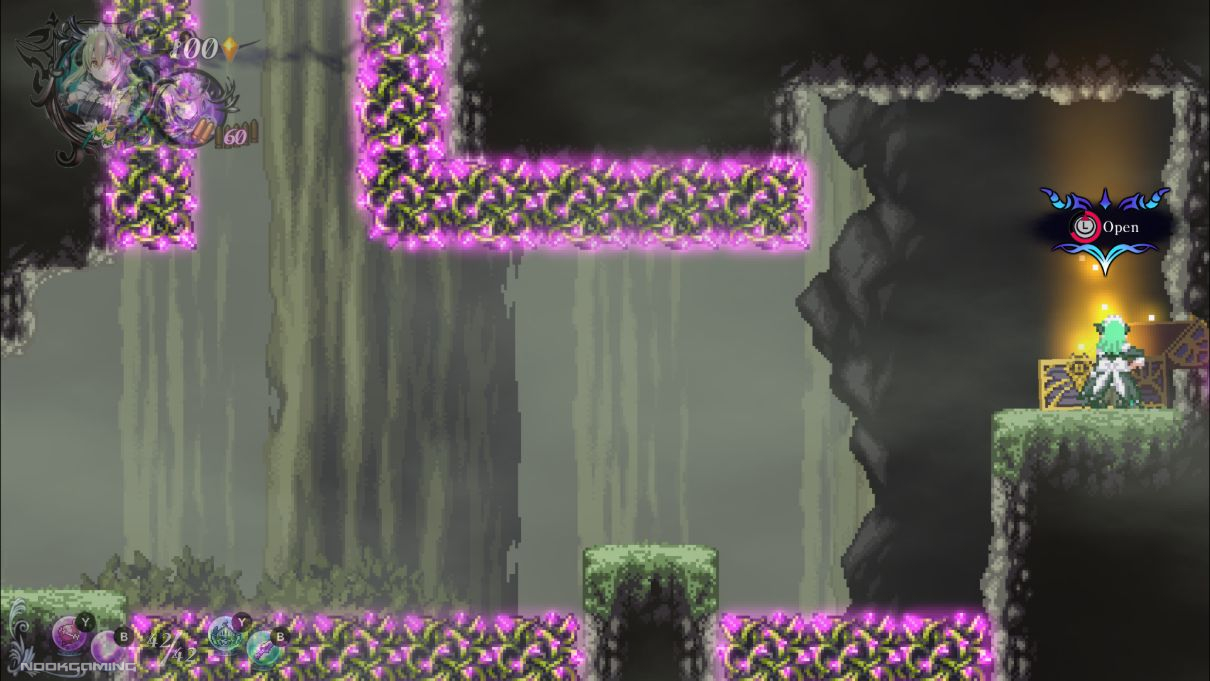
It’s not just them, however, Maxim’s other servants need to be rescued from the clutches of death. While they were killed, they can all be saved by finding their lingering souls across the game world. Once saved, they can be talked to at any point in Maxim’s castle, providing extra insight to the world and their personalities. Like the previous game, it’s never taken too seriously, but I appreciate the added effort in worldbuilding and organic conflict. It’s not winning any medals, but I did enjoy the writing this time around. I especially hope we get to see more of Maxim in a future mainline installment of Gal*Gun.
Visuals and Sound
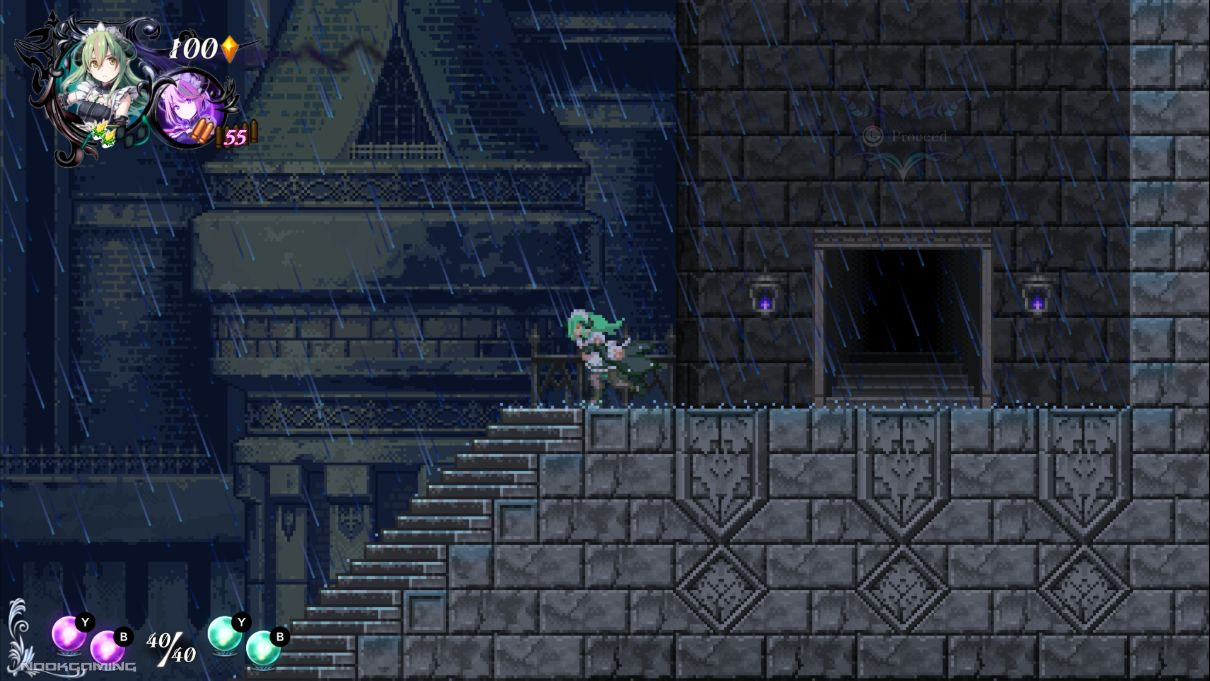
Gal Guardians: Servants of the Dark looks and sounds much the same as its predecessor, which isn’t a bad thing at all since I thought the original looked great. Once again, you’ll be traversing a series of biomes and locales styled after 16-bit Castlevania games. Enemies and characters are well drawn, the action is a smooth 60+ FPS, and the general feedback of play is as strong as you would expect for an Inti Creates game. It even has appreciable small details, like enemy death animations being different depending on what weapon you finish them off with. Dealing the final blow with a sword results in them being cut clean in two, and using an explosive will have them explode into hilariously exaggerated chunks of meat.
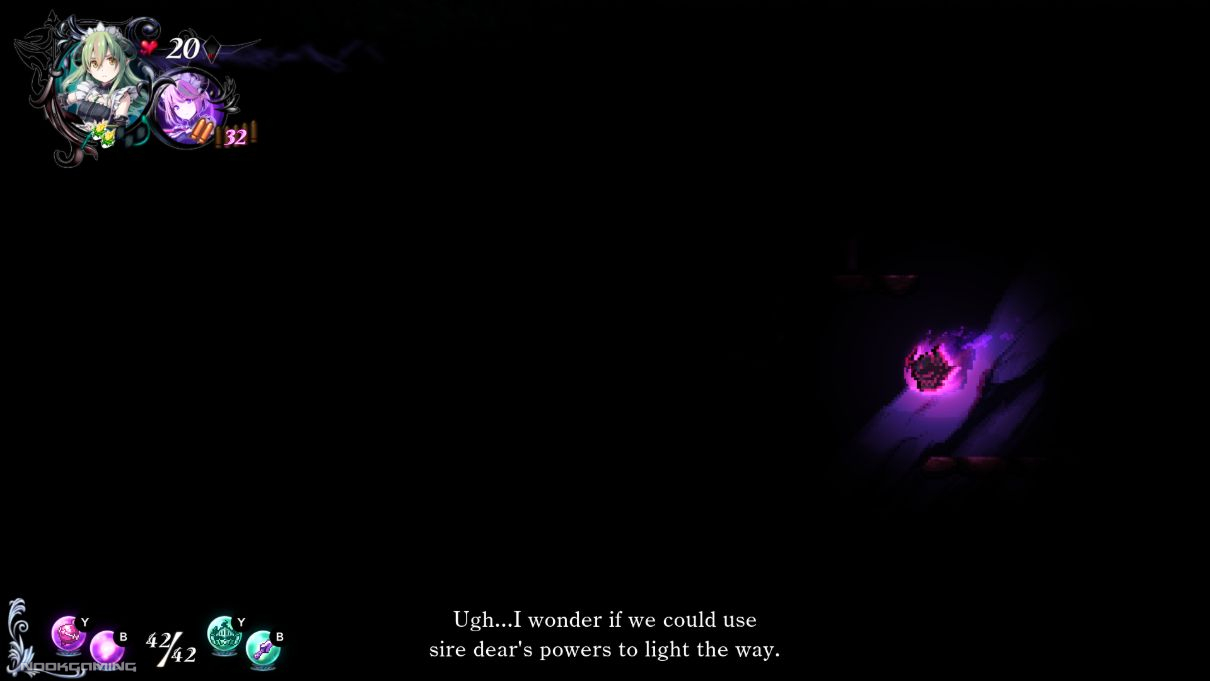
Stage details and biomes are also quite different this time around. While you might start in a more standard castle area, you move around a few different areas of the whole Demon Realm. Typical Castlevania hallmarks like clock towers and ballrooms are instead replaced with demon-infested forests and caverns, making this still a thematically distinct game from its predecessor. Story cutscenes are also regularly interspersed with drawn CGs that look just as refined as the artwork used in the packaging. They also have a lot more fanservice, which was notably lacking in Demon Purge. It doesn’t really make a difference for me one way or the other, but it’s there for fans who would hope for that kind of thing.
It’s also got some fairly charming voice acting (though sadly lacking an English dub) and generally great audio design like before. Tracks are slower and more atmospheric to fit the pace of the exploration you’ll be doing, and I broadly found the music here to be a bit better than before. It’s simply not as good as something like Castlevania, but it is perfectly hummable in the midst of play. Overall, I’m satisfied with the look, feel, and sound of Gal Guardians: Servants of the Dark. It’s not a massive improvement over its predecessor, but it also didn’t really need to be. If it looks great, there’s no need to fix what’s not broken.
Verdict
Gal Guardians: Servants of the Dark is a solid improvement over its predecessor, which I already thought was good. Previous frustrations are mitigated thanks to the shift from pure platformer to Metroidvania, while keeping and improving what worked before. That said, it definitely suffers from just not being a very elegantly made Metroidvania. The best of its genre are lifted by a layer of artistry and cleverness that I feel this game decidedly lacks, which is disappointing when I feel it still gets plenty right. It’s not the best you’ll ever play, but I’d recommend it quite easily.
GAL GUARDIANS: SERVANTS OF THE DARK IS RECOMMENDED

If you are looking for another pixel art 2D action platformer, you may be interested in checking out Blade Chimera.
Many thanks go to Inti Creates for a PC review code for Gal Guardians: Servants of the Dark.

A hobbyist who took up the pen to write about their favorite pastime: games. While a lover of many genres, Isaiah Parker specializes in Platformers, RPGs, and competitive multiplayer titles. The easiest way into his heart is to have great core gameplay mechanics. Self-proclaimed world’s biggest Sonic fan. Follow him @ZinogreVolt