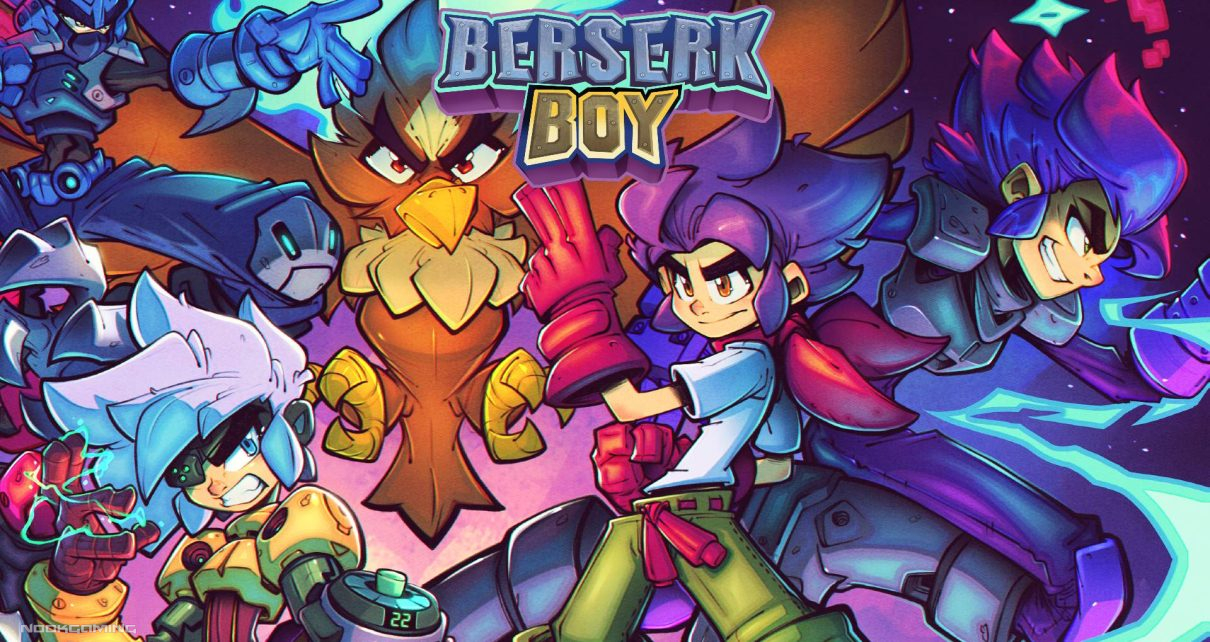
Berserk Boy is an indie 2D action-platformer influenced by many classic sidescrollers of the 16 and 32-bit eras. As a sucker for games with dynamic movement and sense of speed, the early trailers for this game caught my eye and piqued my interest. With the game out now on PC and Switch, I figured it’d be worth taking a look and giving my thoughts on the full game.

Going Slightly Mad
Berserk Boy is a relatively standard retro-style game in terms of concept and story. You play as a boy named Kei who is a part of a resistance against an evil mad scientist named Dr. Genos. During an encounter with Genos early on in the game, Kei takes possession of one of the game’s main plot devices, a Berserk Orb. It gives Kei an immense amount of power, turning him into the titular Berserk Boy. His end goal is to take down all of Genos’s minions, collect their Berserk Orbs, and stop Genos before he can use the Orbs for his evil ambitions.
Most of the game follows a fairly standard “do a series of missions, fight the big bad’s minions in boss battles, and get to the end” structure. The story is largely just there to give you a bit of context before letting the stages do most of the work. Some of the script feels awkward to read, and the use of voice lines is kind of superfluous at times in cutscenes, but ultimately this takes away little from the game given its focus is on action and cutscenes don’t take up much of its runtime.
Berserk Boy wears its inspirations on its sleeve (notably the likes of Mega Man X and Zero). While games of this ilk are fairly common, I wouldn’t say I ever felt quite like “I’ve already played this game” before. Though not particularly original in presentation, it’s not lacking in effort when it comes to gameplay sections.

Lightning Justice
Berserk Boy follows a tried and true formula for action platformers: run, jump, hit things, get power-ups. The first Berserk Orb power you obtain grants a lightning-based power-up, which I found made for the most engaging mechanics this game has to offer. It grants you the ability to quickly dash into any of the eight cardinal directions, damaging and bouncing off enemies you come into contact with. Dashing into enemies refreshes your dash and tags them, which you can follow up on by pressing a button to send an electrical charge to all tagged enemies for significant damage. A great many portions of this game are rewarding purely for how much fun it is to chain-bounce off of everything and clear out mobs with your charge attack.
While you get plenty of movement options throughout the game, stages feel just tight enough that I seldom found them too easy to circumvent and cheese. There’s just enough sense of freedom to move around levels without them feeling like I could circumvent things entirely. You’re required to find at least 50 medals total hidden across the many levels to unlock the final stage, incentivizing some amount of exploration over just blitzing through. Levels have just enough secrets to feel rewarding when you find something without getting so big that exploration disrupts pacing too much.

Power Up!
Berserk Boy divides its levels into groups of three, and you obtain a new Berserk Orb after the boss at the end of each triad of levels. Each new orb gives Kei an additional form and set of abilities. Sadly, multiple later power-ups are less broadly useful than previous ones.
Because lightning was by far the most versatile and fun to use Berserk Orb in most instances, I typically only really felt the rest worth using when the game required me to. You can upgrade them, but the upgrades are far from game-changers. Thankfully, lightning is pretty fun to use throughout the game and abilities can be quickly swapped between, at least preventing them from being burdensome. Though the ideas are there, most of Berserk Boy’s additional unlockable power-ups leave plenty to be desired, which is a problem when there are only five in total.

The Cracks
Rather than conventional difficulty options (easy/standard/hard), you’re given a choice between “modern” (infinite lives) and “retro” (limited lives). I’m not the biggest fan of lives systems in general, so I opted for modern for my full playthrough, but Berserk Boy feels like its difficulty is designed around retro. Most enemies and even bosses weren’t particularly threatening to me, and most of my deaths came from environmental hazards (pits and spikes). I did play around with retro some, and it felt like levels would have a bit more sense of attrition, but health refills and checkpoints are still rather abundant. The game also doesn’t particularly feel like it gets much harder as the game goes on, especially given one of the later power-ups makes bottomless pits less of a problem. Berserk Boy isn’t that difficult of a game, and while that’s fine for me, I was hoping for a bit more fight out of the later bosses at least.
Despite the game’s pace, it still has a bit of fat I wish had been trimmed. Between each set of levels, you’re forced to clear a set of enemies out of the hub area. While these typically involve some application of a new power-up to give you a first chance to use it, this purpose is redundant given the game also has tutorials in each new set of stages.
I don’t mind the idea behind the game’s requirement of 50 medals, but I didn’t realize I needed them until after reaching a rather anticlimactic dead end late in the game. Some medals are only available from backtracking to early levels with later power-ups, which made me not feel incentivized to try to explore too much on the first go, only for me to have to come back and do a bunch of it anyway. This led me to spend a bit more time scrounging around levels for medals near the end than I cared for.
I also really wish the game would let me access the options menu without having to back out to the title screen. If I need to adjust anything on the fly, or even just check what button does what when getting used to the controls, I can’t just do it in the game’s usual menu. There is the option to rebind the game’s controls, but you’re stuck with it unless you exit out of gameplay. This is further compounded by the game not adjusting its tutorial prompt to your key binds, meaning checking what does what or making adjustments is more frustrating than it needs to be.

Presentation
Berserk Boy looks and feels pretty nice. Most visual aspects of this are easily readable during fast-moving portions of levels, which is very welcome for a game that moves at this tempo. Movement and actions are nice and snappy. Most sprites animate pretty well too, though I can’t say I like the humanoid sprites all too much.
The soundtrack to the game is handled primarily by Tee Lopes (with a few guest collaborators), known for working on several newer Sonic games (e.g. Mania, Superstars) and titles like TMNT: Shredder’s Revenge. Many of Lopes’s signature sounds and favored synth instruments are all over the soundtrack to this game, providing plenty of upbeat and energetic tunes to match the game’s pace. Notably, each trio of levels has variants of the same theme rather than every single stage having a completely different tune. This helps each set of levels feel more connected and intertwined, rather than completely separate entities. While not exactly my favorite score of Lopes’s on the whole, it still features plenty of catchy hooks and toe-tapping beats to make the game that extra bit more enjoyable.

Verdict
Berserk Boy is a generally fun little retro-style indie action-platformer. The game is especially rewarding to play quickly due to how well-made its lightning power is. Alas, it peaks somewhat early and has its cracks. Several ideas after the first few sets of levels don’t build much upon the game’s solid foundation, which felt more like a missed opportunity. The game is presented well but doesn’t do a lot to truly stand out among its retro-style indie action-platformer peers in either novelty or consistency. Still, the fun mechanics it does have coupled with its solid soundtrack and visuals enabled me to get past some of its weaker aspects and enjoy my playthrough plenty enough.
BERSERK BOY IS RECOMMENDED

If you’re looking for another platformer, why not check out our review of Gravity Circuit?
Many thanks go to BerserkBoy Games for a PC review code for Berserk Boy.
Been playing games since my papa gave me an NES controller in the early 90’s. I play games of almost all genres, but especially focus role-playing, action, and puzzle-platform games. Also an enjoyer of many niche things ranging from speedrunning to obscure music from all over the world.