Today we’re taking a very early look at Die to Play, a dicebuilder from indie developer Kvinter Games that promises “the deeper you go, the more the game begins to spill beyond the pixelated screen.” Die to Play is slated for a 2026 release, so it’s still early, and this version doesn’t yet have all the features or the complete story. The premise and trailers gave me Inscryption vibes, and that’s a game I very much enjoyed, so I was eager to see what Die to Play had to offer so far.
Game Within A Game
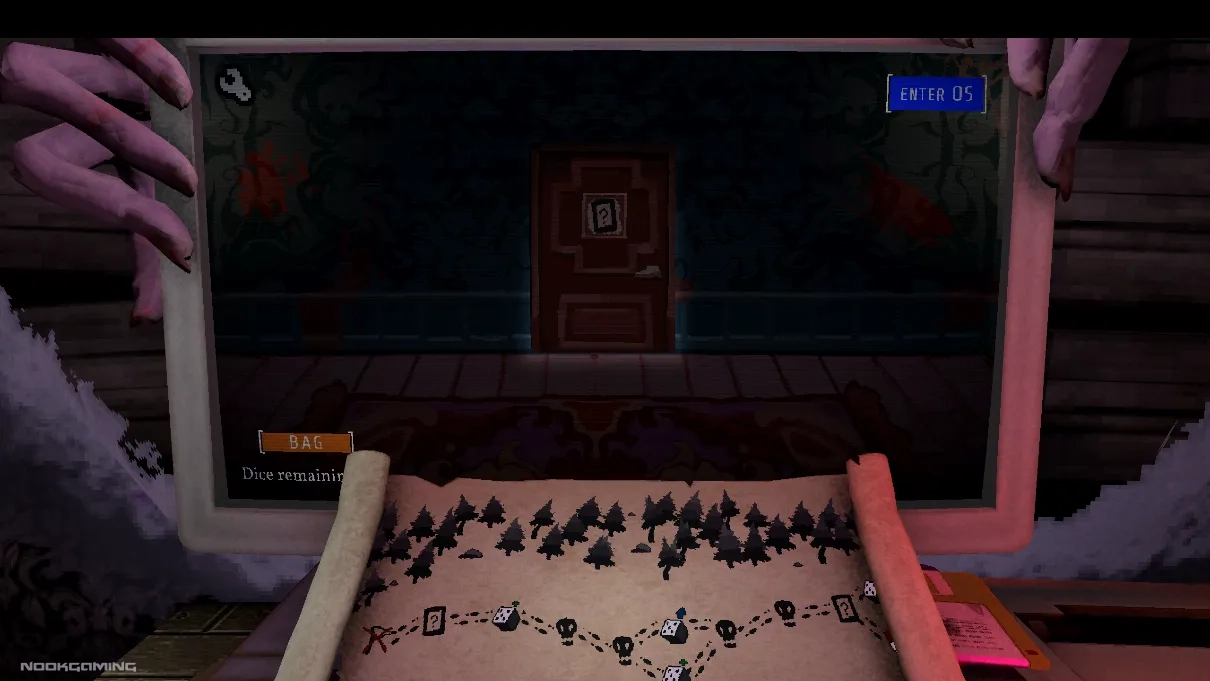
Upon booting up Die to Play, I was met with an old school PC complete with floppy drive sitting on a worn desk in a dimly lit room. On the invitation of a digital presence, I took a seat and booted up Die to Play, the game within the game. The character select screen featured one character, Lulu, with two more planned for the final release. Oh and an ominous message: “THE DOLL IS IN DANGER.” Cryptic, but for the moment there was nothing to do but push on, so I selected Lulu and began my run.
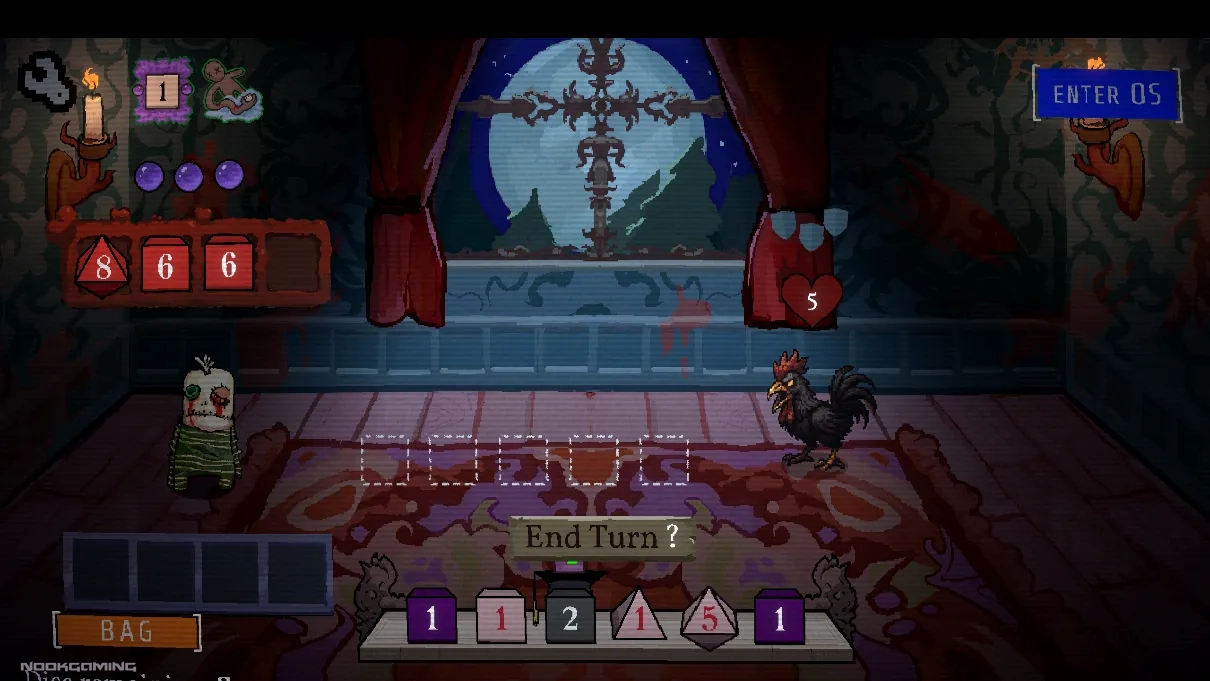
I then found myself traversing a digital mansion on the PC screen, following the sort of branching map popularized by games like Slay the Spire. Die to Play was kind enough to give me an artifact increasing the size of my pool of available dice each turn by one before thrusting me into my first battle against some sort of demonic chicken. Lulu’s health and possible actions were represented by dice, while the chicken’s displayed intent showed it planned to attack! A brief tutorial guided me through the first few turns, before setting me loose on my macabre adventure.
Swinging
The fundamentals of Die to Play’s combat are straightforward. Each turn, you play up to five dice, limited by your energy and a pool of available dice for the turn. Dice with more sides roll higher numbers on average but also cost more energy. Most of your starting dice serve basic purposes, for example red dice to attack and green dice to heal. The interesting twist is that some dice modify other dice. For example you get two purple d6s in your starting deck, and they add their value to the die immediately to their right. There isn’t a lot to do at first, but you can soon acquire dice that combine in interesting and potentially powerful ways. You might temporarily boost a die slot, put down a multiplier die, and apply it to another die that modifies every slot to the right, allowing for big damage or healing with humble d4s from your starting set. However, the most powerful dice come with the “glass” modifier, meaning they can only be played once per combat, so you’ll need to choose when to play them wisely. As a dice-based game, Die to Play has a degree of luck, but arranging your dice cleverly and knowing when to burn your glass dice make a huge difference in your results.
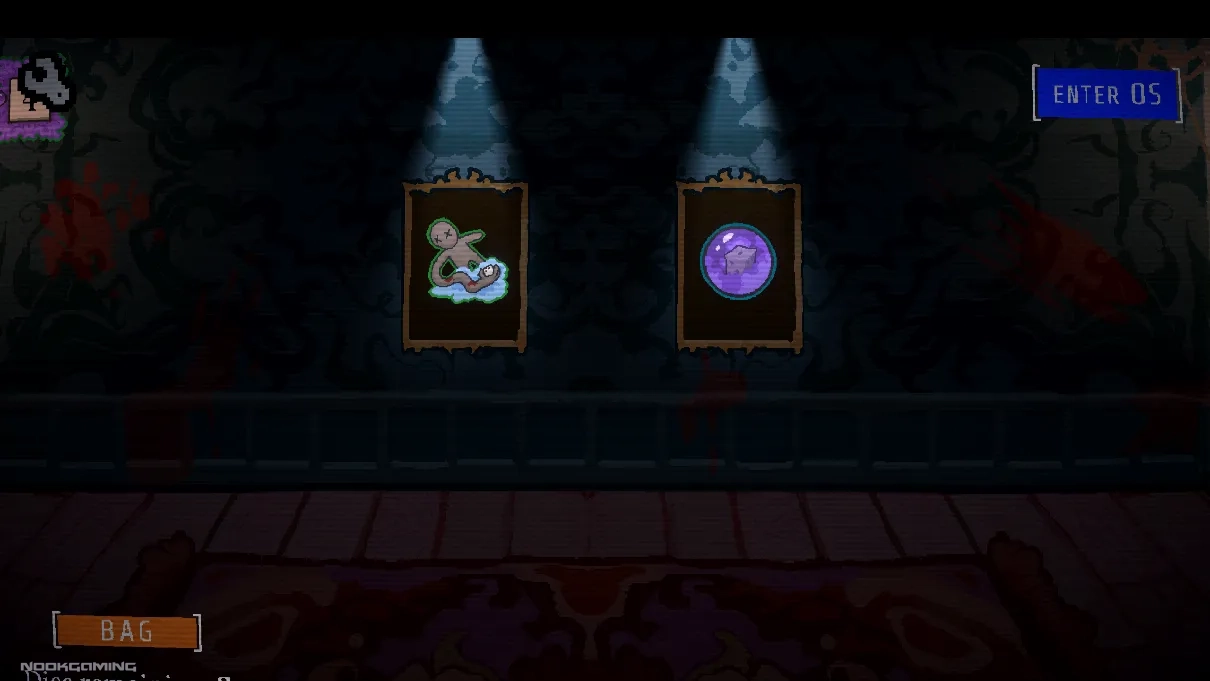
Between battles, Die to Play offers you choices to power up your dice pool. One way is by acquiring new dice. In my first run, I chose to acquire a spiky d4 that not only blocked incoming damage but reflected it back at my attacker. Other possibilities include removing dice, upgrading dice to have more high-numbered faces, and acquiring additional artifacts. Artifact nodes give you a choice between two random options, but some are quite interesting and open up intriguing possibilities for how you might build your dice. For example, one artifact boosts all your dice by one if they are all the same number. Might this suggest building into playing lots of d4s, knowing that limited spread of possible faces means hitting this bonus more often?
My first run ended in defeat, in large part because other than my spiky d4 and a green glass d4 that offered one opportunity to heal per combat, I had no way to mitigate incoming damage. But back at the starting screen, I learned from the mysterious digital narrator that my defense module was disabled. The narrator suggested searching the room for a missing disc, so I stood up from the PC and took a look around. I found the disc on a table with a red pentagram (blood?) and some dying candles. I also noticed the room also contained a locked safe, an upright piano, and a door that wouldn’t budge, no matter how many times I tried it. Everything was rendered in deliciously creepy pixel graphics and dripping with hints that the in-universe game Die to Play was in fact part of something larger and more sinister.
Sensing that I couldn’t yet escape the confines of my room, I sat back down and installed the defense module. Now, in my second run, my starting deck included two grey d6s that generated shielding against incoming damage, a welcome addition. Equipped with these new dice and the knowledge from my previous run, I was able to progress further this time, though victory still proved elusive. Though I was sure I could do even better next time, it seemed like I’d need to do more than simply win a run to solve Die to Play’s mysteries.
I don’t want to spoil any of Die to Play’s story or secrets, but as I progressed further, both in the in-universe Die to Play and in exploring my surroundings, I found clues that let me start to piece together answers to questions about my connection to this mysterious mansion and the nature of Die to Play. The current build only includes the first act of the story, so some mysteries remained unexplained. Fortunately, it also left off at a satisfying climax that laid to rest one of the main threads running through the clues I’d discovered so far.

Verdict
Though it’s still early in development, I found my 2 hour taste of Die to Play intriguing and deliciously sinister. I’ll be eager to see how the final product turns out, and you might be too, especially if you enjoy dice games, deckbuilders, or the meta horror storytelling of games like Inscryption.
DIE TO PLAY IS PROMISING
If you are looking for another neat indie game, check out our review of Blade Chimera.
Many thanks go to Kvinter Games for a PC review code for Die to Play.
A veteran of Oregon Trail and Battletoads, Wes has been playing and talking about games for as long as he can remember. He’s down to try almost anything, and he especially enjoys games with gripping narrative experiences.