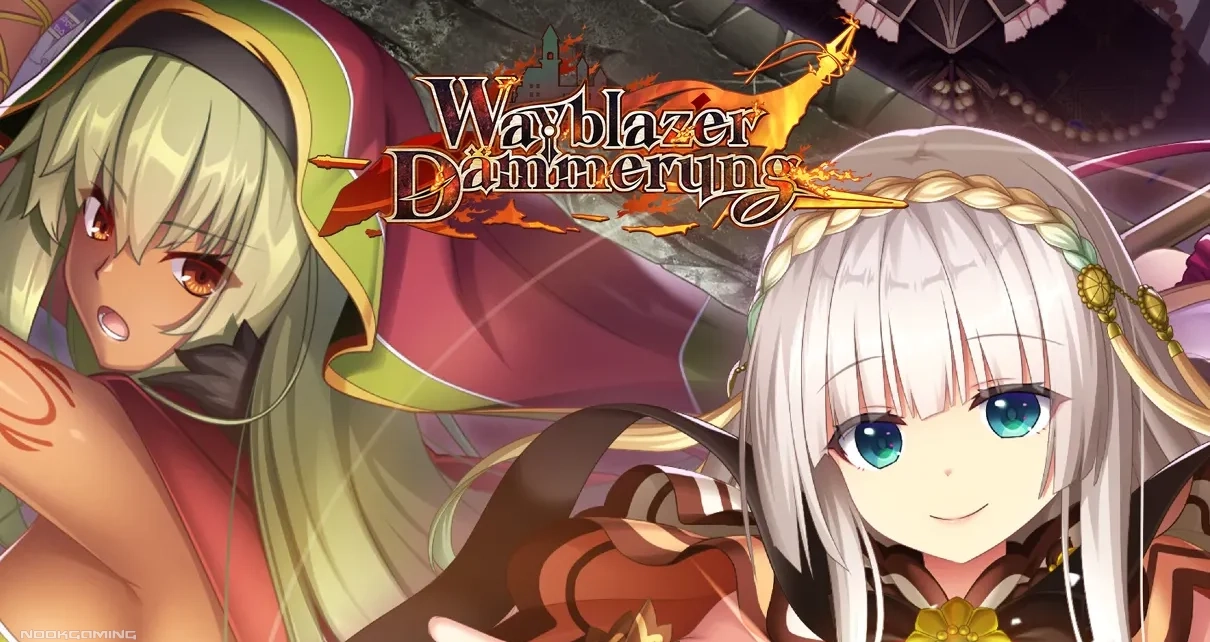
Wayblazer Dämmerung (Hyakusen no Jou ni Kawatareshi Toki) is an adult visual novel developed by Eushully, a company with a long history of developing visual novels that heavily feature standard JRPG elements. It centers around the journey of two young men as they gather like-minded individuals in a bid to cure the festering rot within the kingdom’s elite. The latest in Eushully’s line of gameplay-centered visual novels, the game boasts an incredibly long playtime, promising a non-linear story with a flexible event system, turn-based battles, and a unique supply-side equipment progression line. The 2024 title has since then been picked up by Shiravune to publish for international audiences, making it Eushully’s first ever game to be officially translated into English. The game is available to purchase on Steam and can be converted into the full version through the use of an adult patch.
Eushully is a name I’m very happy to hear participating in the global market. Several (many) years ago, when I was still new to the genre and all, I felt a bit frustrated that I wasn’t able to experience their expansive JRPG universe simply because I didn’t know a lick of Japanese. Fast forward a few (many) years into the future, despite having a degree in Japanese studies and all, I still haven’t read anything else from them! Regardless, now that they’ve put their foot forward and actually tried to publish something in English, I’m very hopeful that it’ll open up an opportunity for their other titles to gain worldwide exposure as well. It would be such a shame for all these related titles to never see the light of day outside of Japan.
With their first translated title being their latest release, what kind of impression will Eushully make on players who are both new and familiar with their works? It’s time to buckle up for a long ride as we blaze through a kingdom in crisis with Wayblazer Dämmerung!
The Smoldering Threads of Revolution
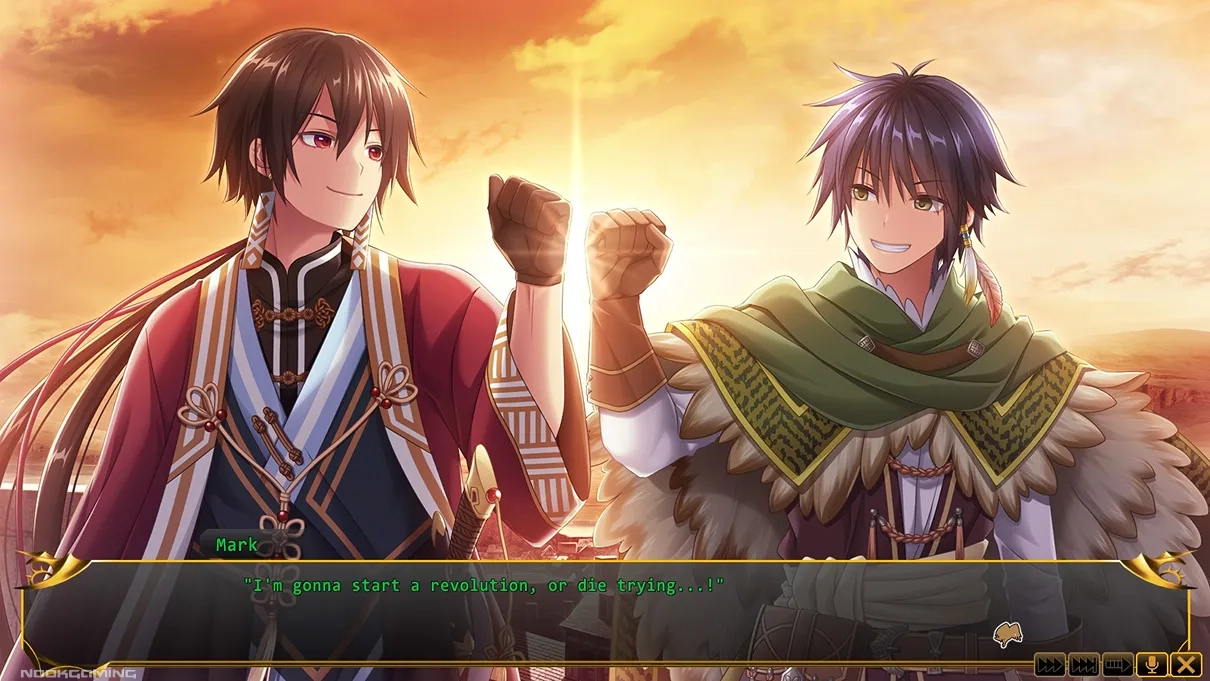
The story of Wayblazer Dämmerung takes place in the great continent of Raulchach, where the Kingdom of Mickelthy, once a prosperous nation with artisans of unmatched skill, is experiencing the effects of a collapsing economy. The ruling class, composed of the royal family and affiliated nobles, have forsaken their duties to the people. Instead of working on the development of the areas they govern, they have been taxing their people for exorbitant amounts of resources to continue funding their lavish lifestyles. However, with the Royal Guard beating down any signs of protest in the country, the people are left unable to defend themselves from the current king’s oppressive reign. They grit their teeth and go back to work, fully aware that it is only a matter of time until starvation stops their suffering for them.
Enter Mark, a forager who hunts monsters with his friend Ruili to satisfy their day-to-day needs. Although foraging is a dangerous occupation, the two men find satisfaction in being able to hone their survival skills while contributing to the development of the town they live in, Kothaerill. However, upon their return to the town, they witness firsthand the abuse the king’s knights inflict upon the people for refusing to comply with their unjust requests for the acquisition of resources. Despite their strength as fighters, they find themselves unable to take any meaningful actions to stop their aggressors. This causes Mark to realize how powerless they really are as citizens of the kingdom; although their work benefits the nation, the system that’s currently in place strips them of their basic rights to work towards a better life.
And so, with determination in his eyes, Mark approaches Ruili to express his dissatisfaction with the state of their country. Both of them realize that for people to live happy lives in the Kingdom of Mickelthy, something needs to change. And if no one was making this change for them, then it’s time for the people to take matters into their own hands. They must feed the smoldering threads of revolution inside the commonfolk’s hearts.
Tales of Companionship Amidst Adversity
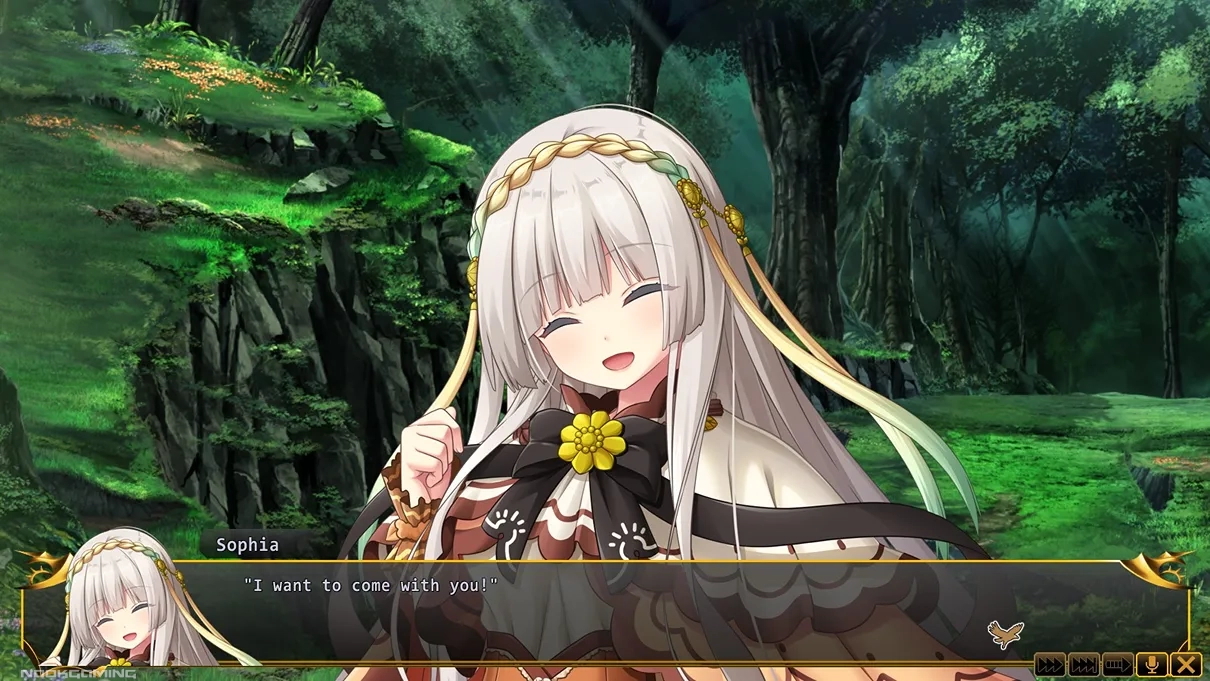
Wayblazer Dämmerung’s plot revolves around Mark and Ruili as they go around the Kingdom of Mickelthy to gather information and find allies that share the same desire as them to change the status quo. As they pay a visit to each major town in the country, they meet people who ultimately get them embroiled in a series of events related to issues born from the inequality between social classes. These miscellaneous events paint the overall struggle of the populace throughout the length of the narrative, eventually culminating in a clash of powers, the nature of which depending on the decisions the reader makes. This makes the plot follow a sort of slow-burn pacing that poises itself for an explosive climax near the ending. While that’s fine in a vacuum, there are a few things about the game’s story that made it a bit hard for me as a reader to be fully invested in the way it built up towards its conclusion.
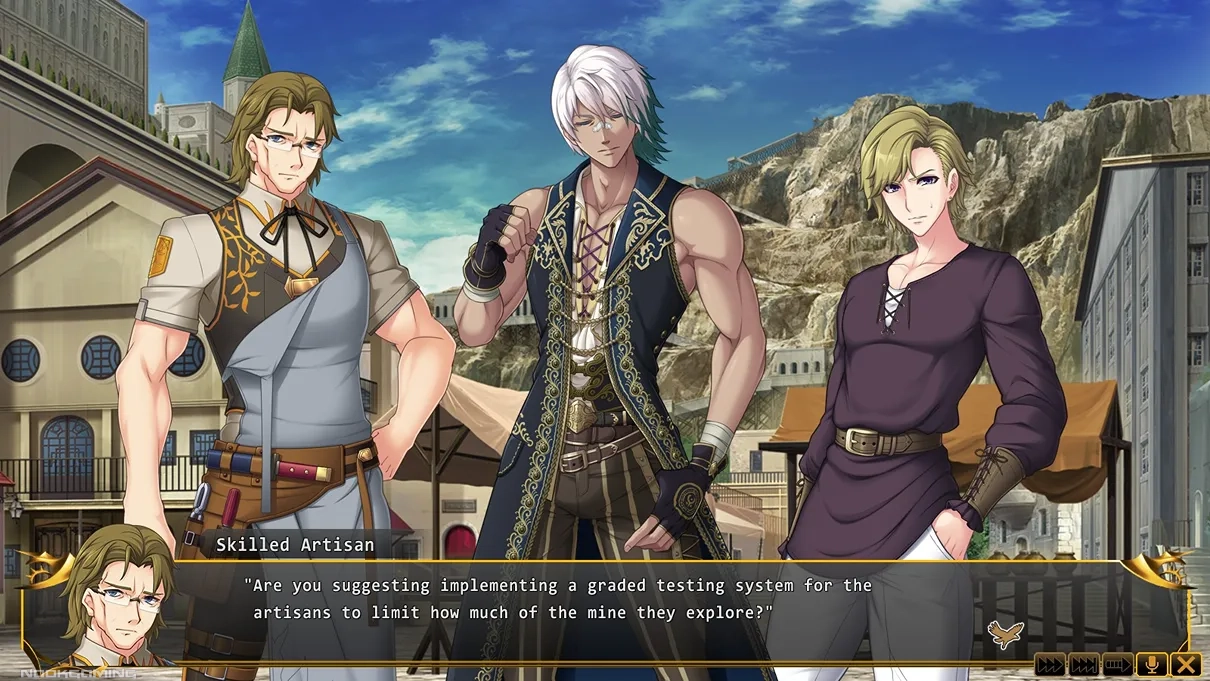
If we consider the overarching theme, Wayblazer Dämmerung’s focus on class struggle as its main source of conflict is honestly very interesting. It frequently talks about unjust taxation, the responsibilities of different social classes relative to a nation’s prosperity, nuances in governance, and other topics related to politics that provide a bit of denser meat to the game’s dialogue. The key players for the plot, their motivations, and their aspirations related to Mark’s goal of changing the status quo are all given rational arguments for and against; this makes the overall setting more immersive to read, despite some of their rationalizations unfortunately feeling shallow due to the intricate nature of the topic itself. The problem is that because of the game’s reliance on its JRPG mechanics to create padding to lengthen a playthrough, the momentum of the plot-relevant scenes tends to feel neutered compared to the continuity a traditional visual novel would be able to uphold.
To add to that, the flexible format they’ve implemented for engaging with the game’s story events ends up being a bit of a negative point for the cohesiveness of Wayblazer Dämmerung’s narrative. Since the game doesn’t enforce a strict order of actions to follow to progress the story, while the recruitment process for allies feels a lot more natural due to being a consequence of my decisions as a player, it also segments each character arc in a way that compromises the way their stories flow. Instead of a continuous storyline, it’s a random assortment of events with inconsistent stakes due to how different each arc’s featured conflict is from the others.
Because of this, Wayblazer Dämmerung feels closer to a standard JRPG in the way it is structured instead of a visual novel. Although the amount of reading isn’t anything to scoff at, the way it prioritizes ally recruitment and puts events relevant to the main plot into the background makes the tail end of the game feel densely packed with plot devices, revelations, and information dumping that would have been great for build-up early on. Everything that actually matters only happens at the end, and by that point, I was just hoping that the conclusion would actually make sense since they didn’t exactly give me a chance to think about how the sudden exposition made me feel.
Events Transcending Time and Space
Although I do find the plot a bit unsatisfying in the way it was handled, I still do think that Wayblazer Dämmerung had the potential to be a standout title. This is because despite its narrative shortcomings, the game is sufficiently able to capitalize on Eushully’s multi-title series strategy by presenting story elements that are solved by the characters within the current setting, but continue to be persistent issues in the overall worldbuilding. It’s similar to how you might address a problem on the micro-scale, but it doesn’t necessarily deal with the bigger picture. They’re not actually fully resolved, but because the character associated with the arc reaches a resolution related to their struggle, it stops being an immediate concern for the cast. These kinds of loose ends feel right at home with titles that have known sequels and/or prequels because they can feed additional context to that other game’s setting, creating a solid background for events in other installments, both existing and future ones.
As an example, Wayblazer Dämmerung is formally recognized as a prequel to Kamidori Alchemy Meister, another Eushully title released in Japan back in 2011. Despite sharing the overall setting with each other, there are various differences in the way common story elements (such as the kingdom and specific cities) are viewed across installments. This suggests major events happening in-between titles that caused something to change, which to me is honestly the most exciting part of playing a series with multiple entries. It doesn’t spoon-feed you the answer, but it gives hints that help you connect the dots together.
Monsters at Every Turn
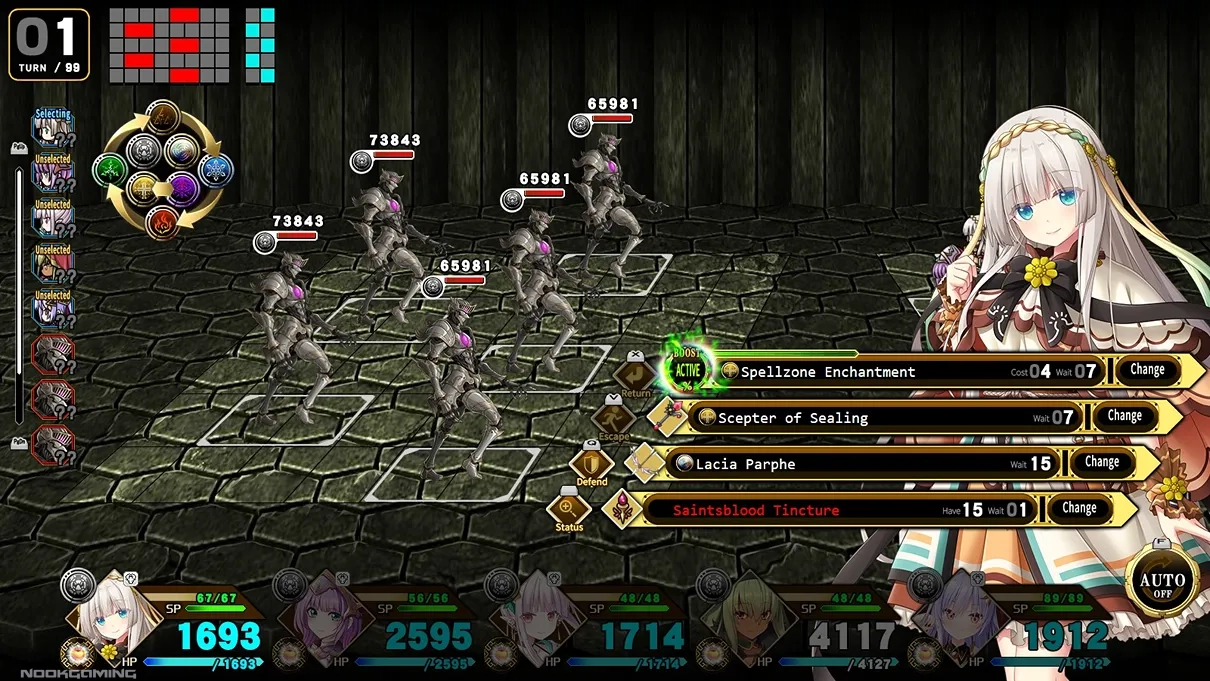
When it comes to the gameplay, Wayblazer Dämmerung’s spin on the concept of a dungeon crawler with turn-based battles is a very familiar one to fans of different JRPGs. Exploration in the game is separated into two parts; you can select a town or a dungeon via the world map, and then depending on what you choose, you will be presented with either options for interactions or utility (such as a shop) or a stage where you can move your character freely with either the mouse or the WASD keys. Both types of destinations can feature various minigames that reward additional items or resources, so players are actually incentivized to explore available options as much as they can.
You can encounter monsters or enemies in the game by either triggering a battle event or through random encounters on a dungeon stage and partake in turn-based battles. During the fight, the battle is split between the player’s forces and the enemies; there aren’t any actual movement options during these encounters, so the strategy mainly revolves around buffing your characters’ stats well enough that they can either outspeed the opponent and kill them before they make a move or live through a barrage of attacks. This is because while you’re limited to using only five characters at a time, the enemy can go upwards of eight at a time, which makes it relatively easy for them to overwhelm you if you lack preparation or are underleveled.
Foraging for Survival
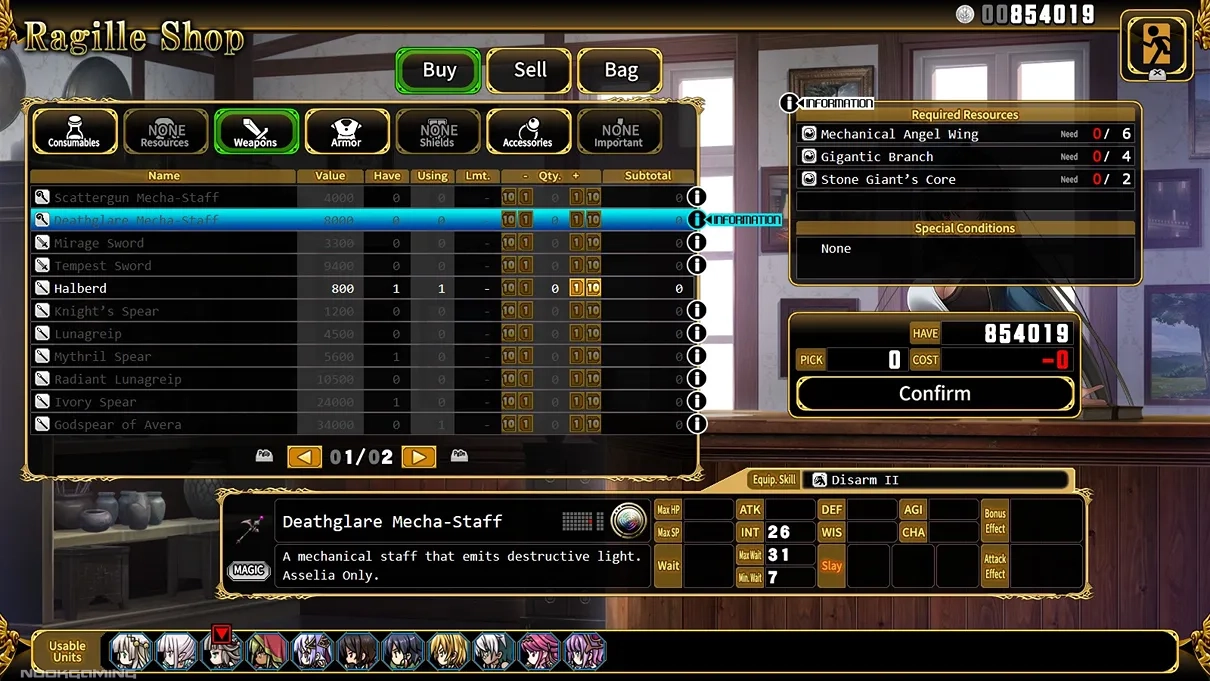
Going into the utility side of the gameplay loop, Wayblazer Dämmerung also has a healthy variety of equipment and items that players can buy with the in-game currency to make their lives easier as they traverse the dungeons in the Kingdom of Mickelthy. What makes this interesting though, is that the available stock isn’t only affected by story progression and overall level; instead, drawing inspiration from Mark’s characterization as a forager, you are required to sell specific items to the shop for them to produce stock of a desired item. This is what they call supply-side adventuring, as not only do you need gold, but you need to serve as their supplier for the materials as well. Thank god the Glossary and Unit List make this a lot more manageable to grind, although there are also shortcomings there; monster drops found in the Resources section of the Glossary do not cross-reference relevant entries in the Unit List.
Now taking into account that Waybringer Dämmerung is supposed to still be a visual novel, Eushully included multiple quality-of-life functions to help make sure that players still finish regardless of how deeply they engage its gameplay loop. Firstly, when dying in battle, players have the option to fully recover their party by paying half of their total money. This means that theoretically, as long as you don’t hit zero, it’s impossible for you to lose if you can take turns and damage the opponent before dying. Additionally, there are sites in dungeon stages that have rotating wing icons that fully heal you if you interact with them, which are easily abusable for grinding. Lastly, it’s very easy to escape difficult encounters (except story-relevant fights), either by clicking “Escape” as a unit’s action in a fight or by using the Earrings of Flight to leave a dungeon wherever you are. Since every unit’s attempt at escape counts as a team retreat if successful, you can easily just spam that as an option across all five for higher chances of success.
All of these options don’t really matter though if you find Eushully’s trademarked “Loser Labyrinth”, which provides easy ways to level up and options to further modify the difficulty of a playthrough. It can lower the difficulty all the way to “little baby”, which is 2 levels below normal. The downside is that it labels a lot of assets with the word “Loser” as punishment, but who’s going to judge you in a single-player game, am I right? Or you could just not follow my example of jumping straight into hard mode.
Romance and Intimacy as an Aside
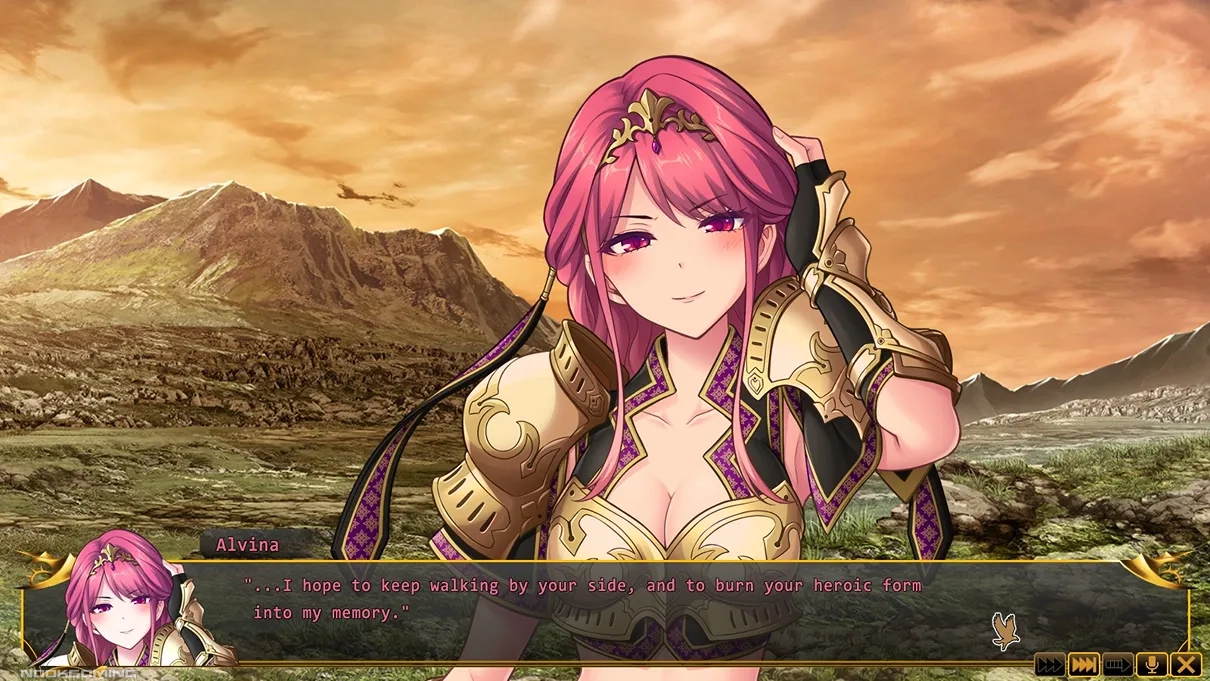
Finally, Wayblazer Dämmerung does feature romance between characters, but the scenes feel more like afterthoughts if anything. One of my pet peeves is an uninteresting protagonist, and despite having multiple opportunities to express his own agency, Mark as a main character feels largely empty because the way he acts is very similar to self-insert characters outside of his whole schtick as a smug and curt forager. This extends to his interactions with the seven heroines in the game, which honestly is quite a letdown. They have literal confession scenes where they share an intimate moment with each other, and all Mark responds with is a generic “thank you, I appreciate you as well” without any strong expression of commitment. Granted, monogamy isn’t necessary for adult games like this, but it cheapens the experience incredibly if none of the expression of romantic feelings are addressed by either the protagonist or the plot itself.
In a way, they treat adult scenes a little bit similarly in that these sultry mini-scenes are isolated within the gallery. They play absolutely no part in the main gameplay loop; they are instead unlockable by viewing certain events related to specific heroines, after which you can go and enjoy them at your own leisure. But again, considering this and Mark’s lack of actual participation as a romantic partner, these aspects of the game mostly feel irrelevant, bringing largely nothing to the overall experience while simply existing.
At least the adult scenes can be enjoyed as a short break between grindy segments. They also completely avoid the problem of overcrowding at certain points of the narrative, which a lot of eroge with linear stories that feature multiple heroines have.
Art and Music
As a visual novel with a long runtime, Wayblazer Dämmerung features an impressive amount of art assets. The gallery boasts a total of 138 unique CGs, 43 of which are HCGs. When considering their variants, the total amount of CGs used throughout the game is 1245, an impressive number overall. In contrast, while there are more H-scenes in the game than a person has fingers or toes, each of these H-scenes only features a single unique HCG each, making the experience feel pretty static instead of exciting. It feels like someone voiced over a gallery of adult images, alternating between variations here and there.
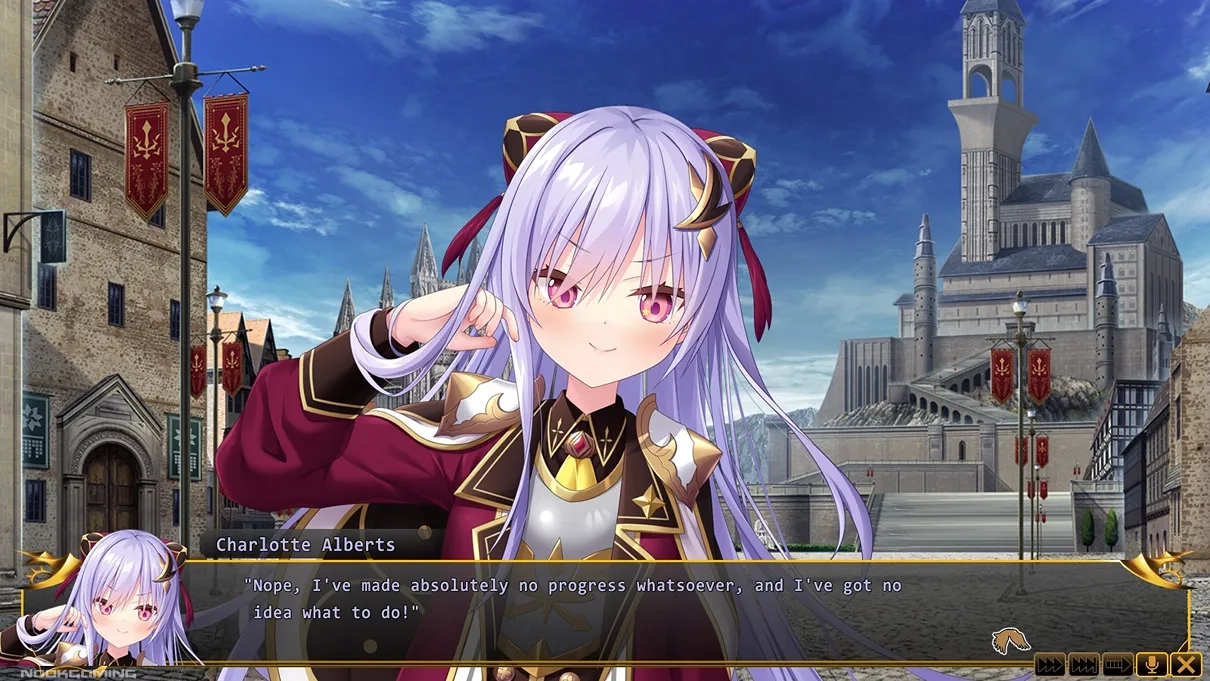
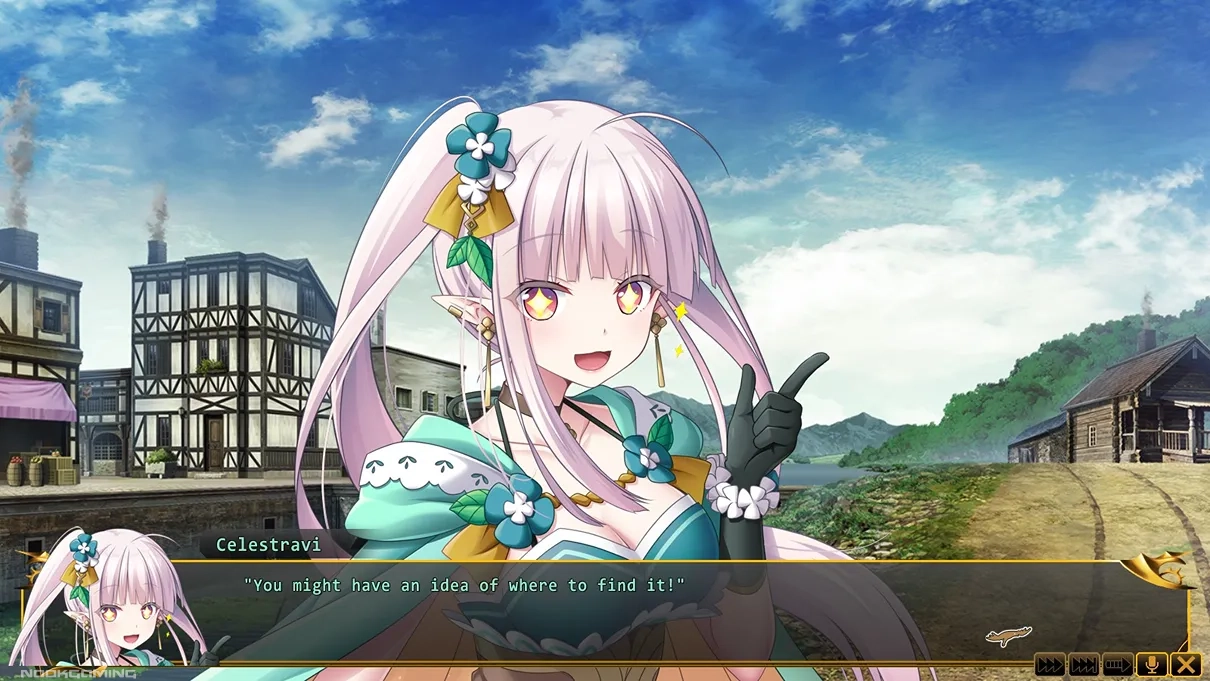
As for the art itself, there’s a bit of variation when it comes to the game’s aesthetic appeal because the staff opted to hire four artists to populate the game’s assets. All of them (Uro, Yakuri, Yano Mitsuki, and Yoshida Takuma) have been part of Eushully’s in-house art staff at some point in their careers, so long-time fans will find themselves at home with the design of the characters in Wayblazer Dämmerung. I personally love Yakuri’s work because of how they make the eyes all big and full of color, but Yano Mitsuki’s work on Charlotte also stands out in a good way because of their unique approach with her pupils and the stylishness of her outfit. I do feel that it’s a bit jarring at times because of how different some characters’ faces look when they’re put beside each other, but individually they all look alright. It’s just a matter of getting used to it.
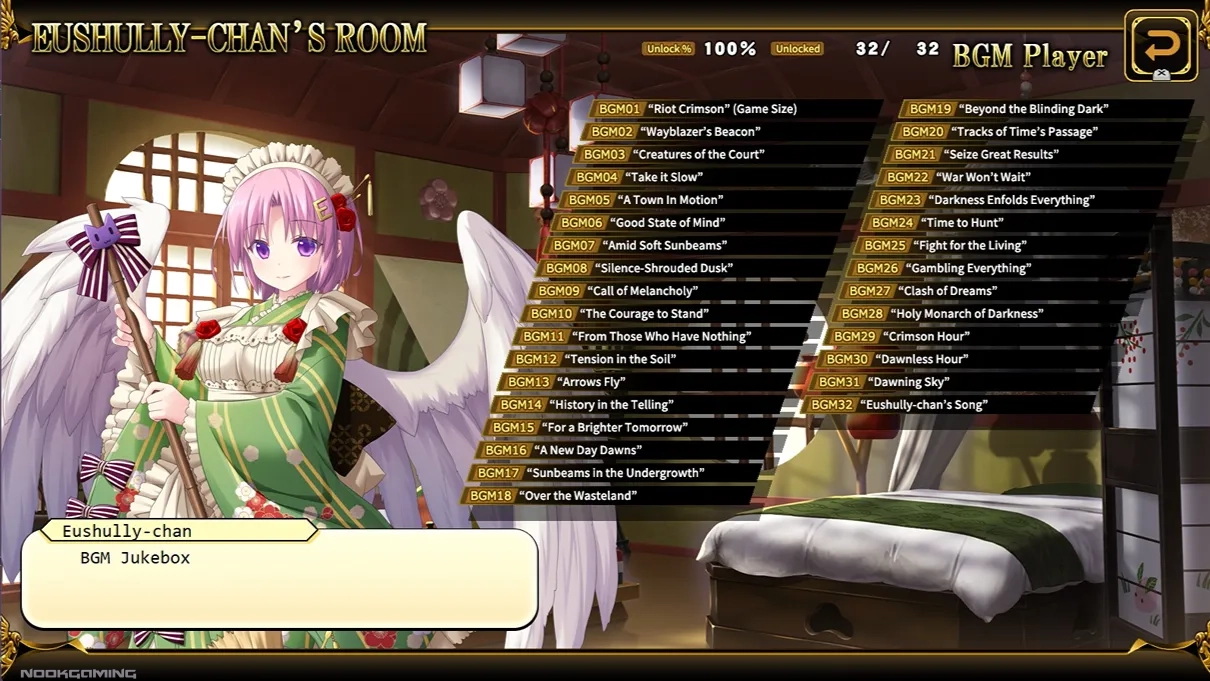
There are a total of 32 tracks of background music in Wayblazer Dämmerung, which is a respectable number. There’s a healthy variation of tracks dedicated to both dialogue events and dungeon stages, and if you listen to each of them, you can easily identify which is which because of the atmosphere they establish. It’s pretty nice, but I wish there were a bit more selection when it came to the battle tracks themselves since, not including story-related encounters, there are around three tracks that play during normal fights. It’s kind of a shame considering how long the game is. What I did find interesting, however, is Wayblazer Dämmerung’s use of some stock sounds in the RPG segments of the game. Perhaps due to it being a Japanese game, it makes use of sound assets that sound very similar to those being used by some famous indie games there. Perhaps pure orange juice can help you identify it, surely (100%)?
Verdict
Wayblazer Dämmerung is an adult visual novel that incorporates turn-based dungeon crawler gameplay to keep their audience engaged with the game for long amounts of time. With four veteran artists working at the helm, it offers an impressive set of visual assets that help bring to life its fantasy setting. Although its story has incredible potential as a worldbuilding piece, its execution is a bit unsatisfying because of its flexible approach to story progression, leaving the sequence of events mostly up to the reader’s discretion. As a result, the cohesiveness of the story is compromised, with overall momentum greatly being butchered by the segmentation and non-linearity of the common route’s events. The lack of character for Mark further compromises this, with romantic segments largely feeling like self-inserts instead of budding relationships between members of the team.
Despite these shortcomings, there’s still a lot to love with Wayblazer Dämmerung. For one thing, it establishes a pretty interesting setting that both old and new entries into the series can take advantage of. It does this through the partial resolution of some issues, where the relevant character’s arc finishes despite the persistence of the issue in the setting. Additionally, the healthy amount of equipment and items present in the game makes it actually plausible to build characters different from what you’d normally expect. Although there are stats that are glaringly more impactful than others, the numerous fallbacks present as quality-of-life functions in the game allow players to adjust the overall experience of the gameplay portion according to their own preferences. This extends to resources as well, where in-game references such as the glossary help with planning out your farming side trip. Except if you’re looking for a monster drop, which you’d have to sift the Unit List for because apparently they’re not included in the resource glossary as something that can be directly referred to.
If you’re looking for a timesink with a decent story and a grindy gameplay loop, Wayblazer Dämmerung fits the bill nicely as Eushully’s present-day entry point to their expansive visual novel-slash-RPG series. Although a bit on the pricier side, chasing full completion of the game will surely get you back that bang for your buck, especially if you play with the external adult patch distributed by Shiravune. There’s also a DLC available, adding an additional dungeon and a new recruitable character. Now the only question is, do you have enough time to do so?
WAYBLAZER DÄMMERUNG IS RECOMMENDED

If you’re interested in the latest of official visual novel releases in English, check out our review of Utawarerumono: Prelude to the Fallen. We have also covered a wide variety of visual novels both original to English and localized from Japanese, which you can check out here.
Many thanks go to Shiravune for a PC review code for Wayblazer Dämmerung.

Visual novel reader that wishes there were more than 24 hours in a day. Gacha victim, TCG enjoyer, and VTuber simp. Still trying to live happily.