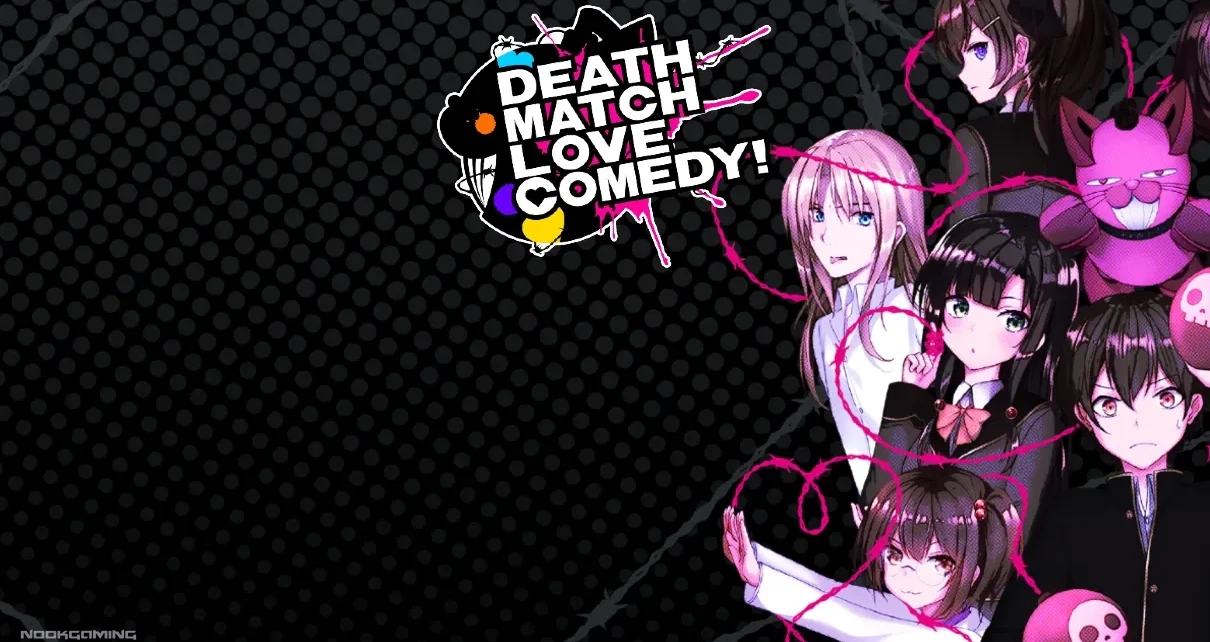
Death Match Love Comedy! (often shortened to DMLC!) is a visual novel by Kemco originally released all the way back in 2013. Billed as sort of antithetical to many visual novels, the story involves a mysterious phenomenon cursing a young boy not long after enrolling at a new school to prevent him from finding love. Localized by PQube in 2026, the concept sounded intriguing and potentially amusing to me, so I went ahead and took a look at it for review.
Getting It Out Of the Way…
There are two quick things I think that should be made clear about Death Match Love Comedy! before really diving into any sort of review of the title. The first of which is that it was originally made for Android and iOS phones. The filesize is relatively small, and its scope of production is rather limited, evident by the fact that there is no voice acting. As such, set expectations going in accordingly.
The second is that, despite the title of Death Match Love Comedy! effectively having three different genre descriptors in the name, I genuinely would not use any of them as the first tag with which I’d label what the story is about. While romance ties into its narrative, and there is both a good share of comedy and plenty of dying (mainly in bad ends, which are sometimes gag endings), the story is mainly a mystery/drama with a share of occult and supernatural elements and some coming-of-age aspects.
Bakuhatsu
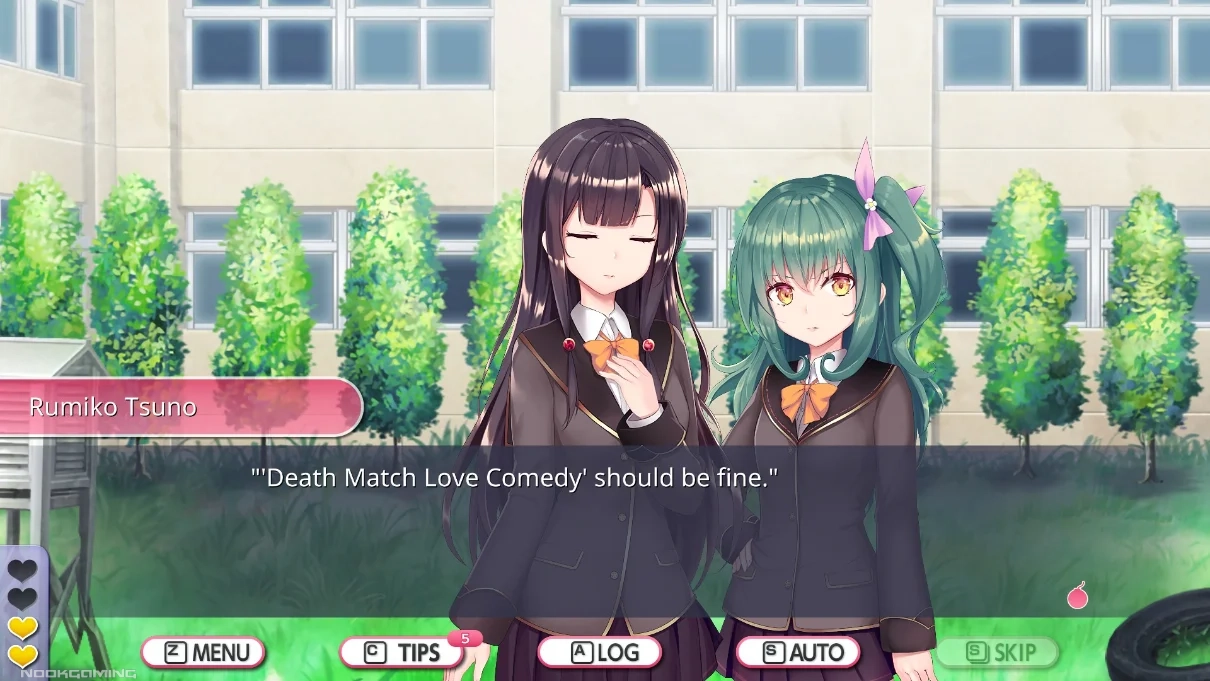
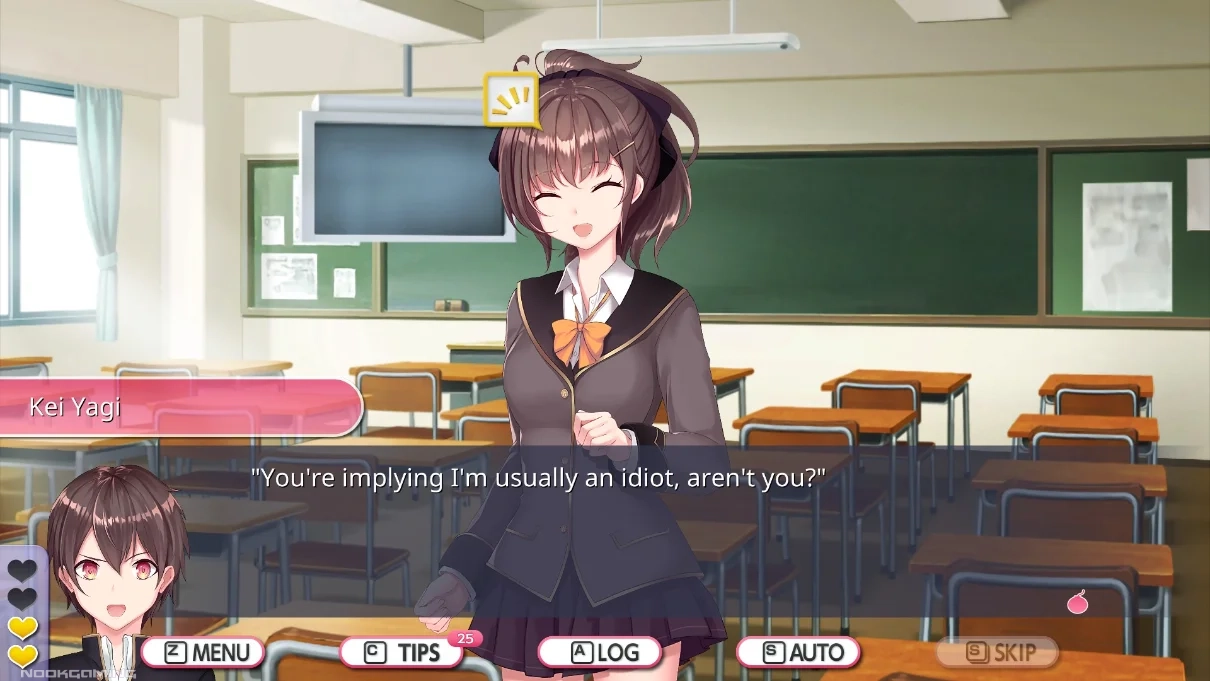
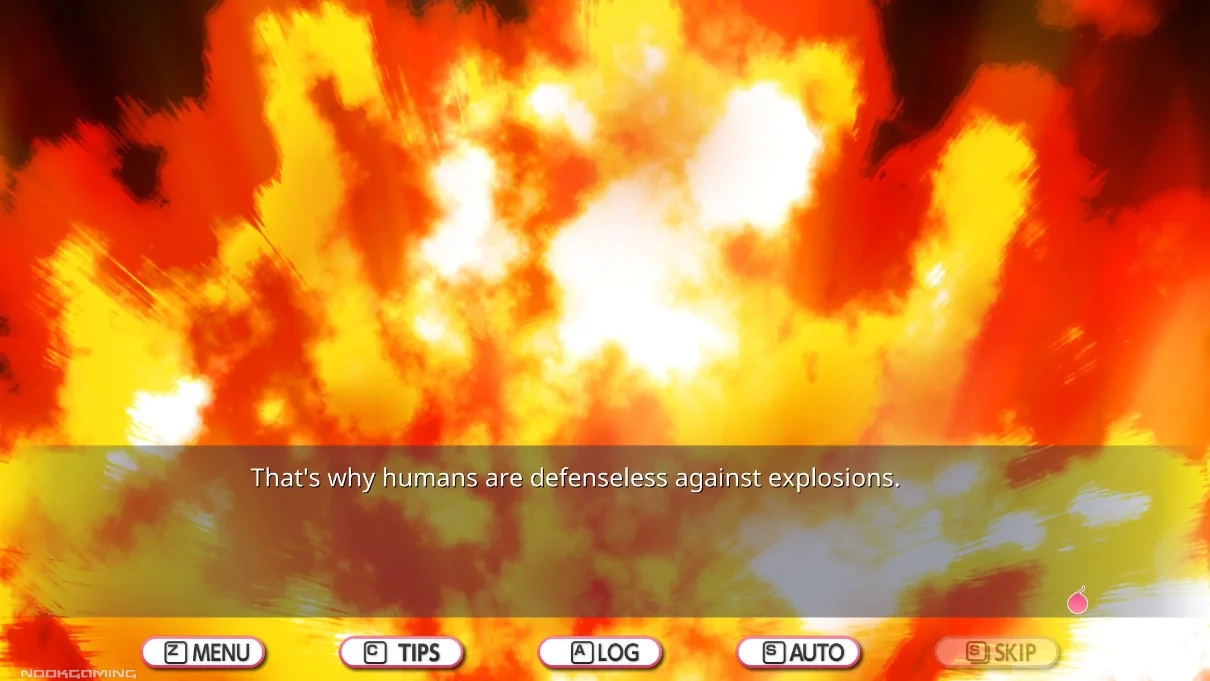
A month after enrolling at Misasagi High, Kei Yagi is acclimating to his new school. He’s made a couple of friends and generally gets along with his peers, though he’s not particularly standout in the size, athletics, or grades department. To his surprise, he gets asked to meet with two of his classmates after school one day: the somewhat airheaded pretty “princess” of the class Rumiko, and his tsundere (emphasis on tsun) childhood friend Otoba, whose temper is as short as her stature. However, the moment this obvious love triangle is supposed to be kickstarted with their simultaneous confession of love toward the lad, he explodes. As in, he literally goes off like a bomb.
Kei suddenly starts seeing a goofy-looking floating cat creature who tells him that the explosion was effectively a warning, and that next time, he will die for real. The trigger is simple: when a girl confesses their love for him, he (and likely anyone around them) will die, not in a blaze of passion but of (magic) gunpowder. To make matters worse, the two main love interests pining for his heart seem to “go berserk” from time to time, losing their self-control and seeking Kei out to mindlessly deliver the fatal words that doom them all. Rumiko coins the (admittedly awkward) name for this phenomenon, the titular “Death Match Love Comedy”.
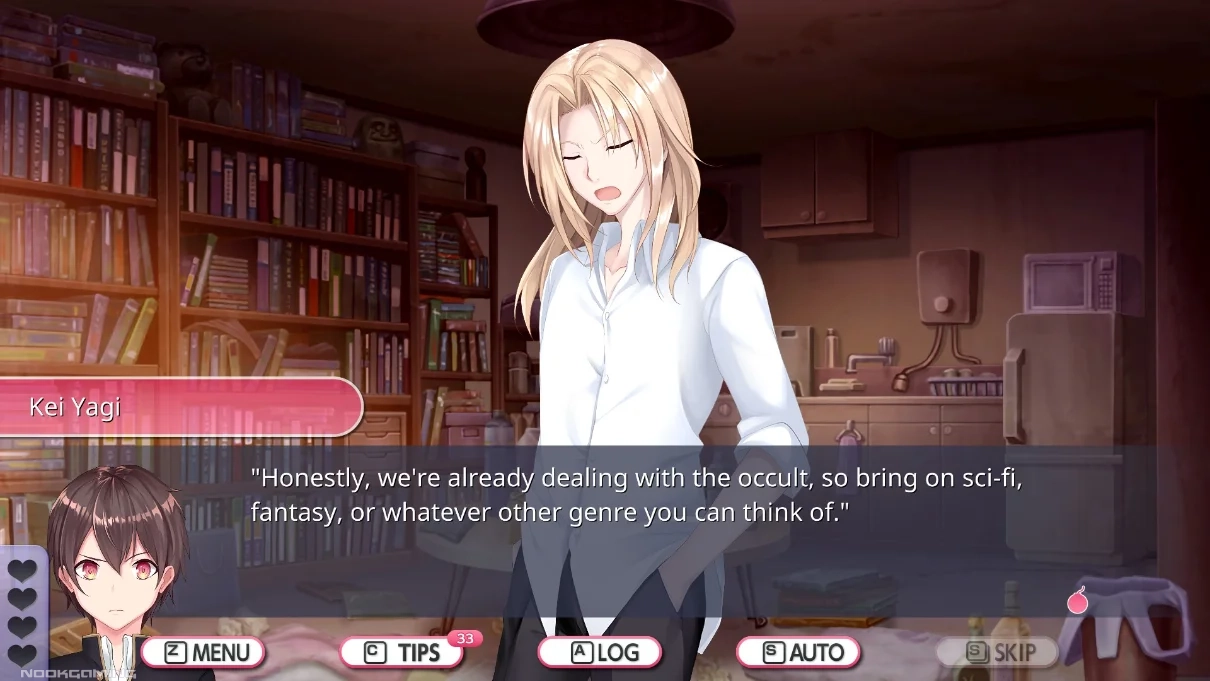
In essence, the story becomes about trying to figure out the deal behind this curse. Why is everything happening? Who is behind it? How can it be broken? And how can Kei make sure he doesn’t end up inadvertently reducing an entire building to ash? That said, he’s not alone in this endeavor. A sort of impromptu group of friends and mutual connections form a core of seven characters looking to figure out what’s going on and how to solve it while keeping everyone safe.
Of course, many curses are rooted in some sort of pain. As the story of Death Match Love Comedy! progresses, the story weaves a far more complicated web than a simple love triangle. The story focuses a lot on the interpersonal relationships of the main cast, the people in their lives, and in many cases, the often deeply-rooted traumas that got them to where they are.
Capra Chara
As the protagonist of Death Match Love Comedy!, Kei initially starts off like you might think a visual novel protagonist of a title with the word “love” in the name would. He’s relatively introspective, somewhat vulgar, has a selfless side, and is otherwise unremarkable on the surface to the point he’s genuinely surprised anyone would bear affection towards him. However, the layers of his character start to peel back more and more as time goes on. He begins to realize that not only is he really conflicted and unsure about what love even is and what it means to love others, but he’s got a lot of emotional baggage tied to that emotion that is rather painstaking to even begin to unravel.
Kei’s circumstances don’t exactly help the matter. He grew up under the foster care of his relative, Suzu Toro, a petite woman who works as a nurse at Misasagi High. Suzu hasn’t exactly had an easy time with the boy, given her tiring career in medical science, her lack of firsthand parenting experience, and their family effectively throwing her to the wolves with debts and the like, and Kei is unsure how to feel about his place in all of it. Much of Kei’s arc as a character involves him coming to terms with the many complicated and messed up circumstances that shaped his life and led him to where he is. Honestly, I found a surprising amount of it quite relatable. It helps that despite many of his traits of self-doubt stemming from his trauma, such as his occasional self-deprecation, he shows a wide array of character traits, including stubbornness, self-reflection, compassion, and even a cunning streak that allows him to sometimes get one up on others.
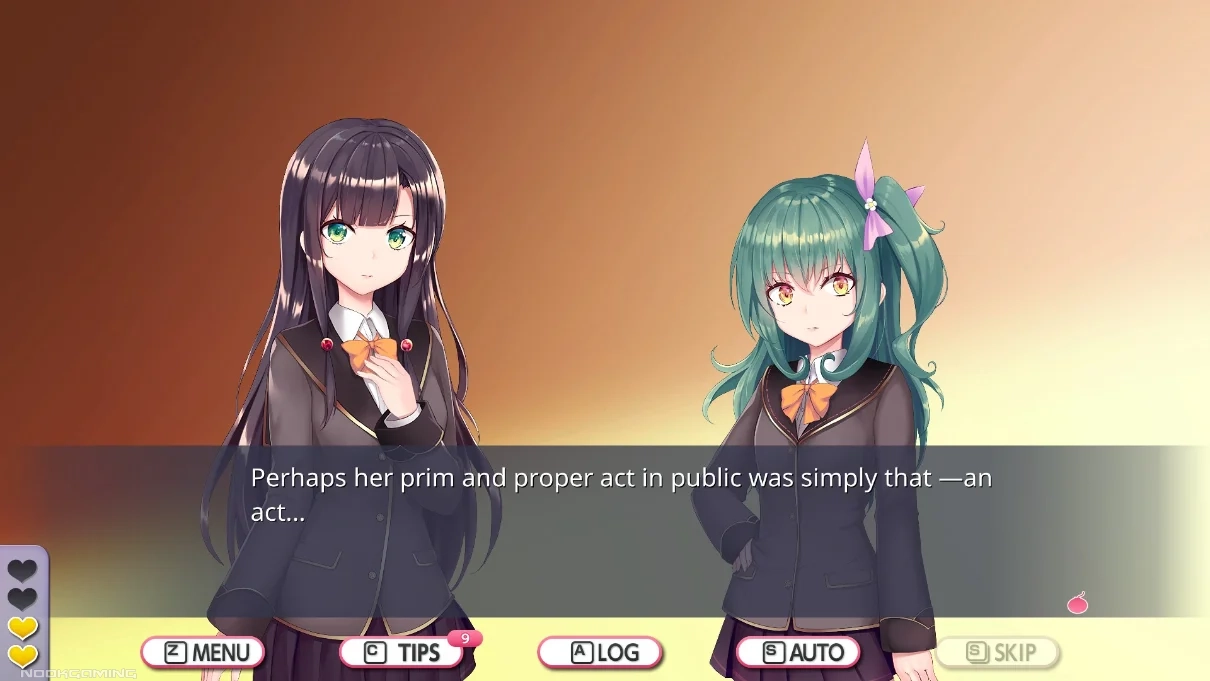
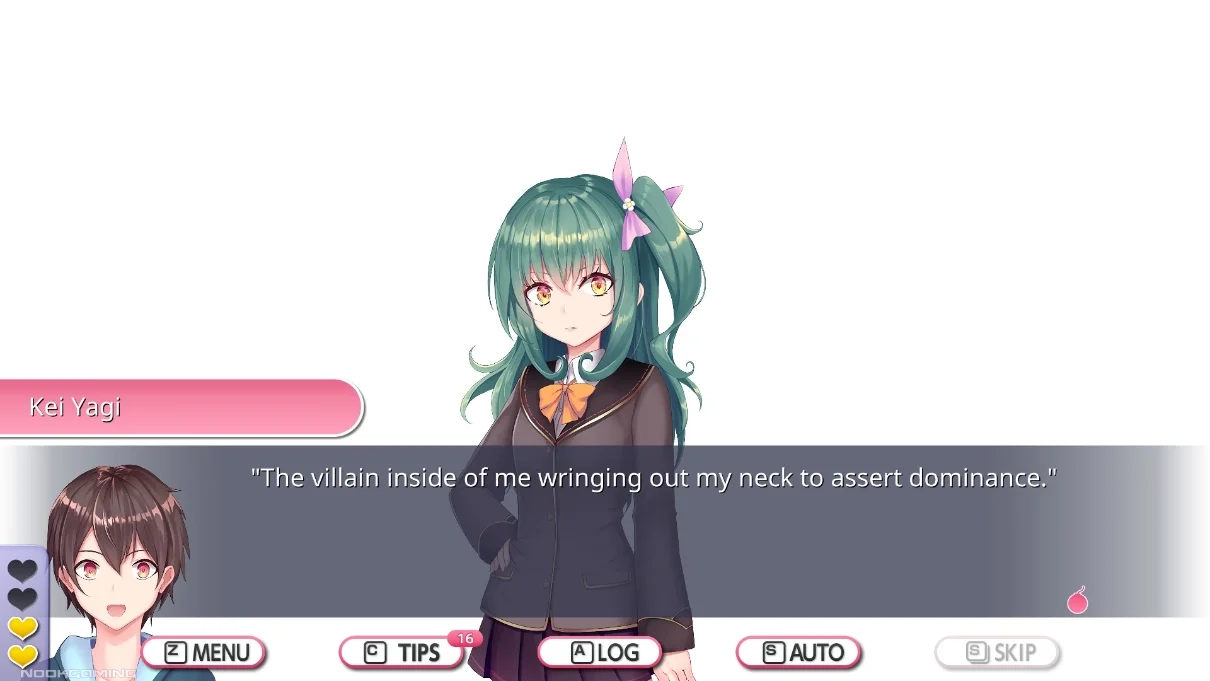
The two main love interests, Rumiko and Otoba, somewhat necessitate assessment in a roundabout way. Obviously, the inability to try to move forward with the boy they love is difficult in and of itself, but they also have considerable care and respect for one another as friends. Underneath this is their own shared complicated feelings about each of their own pasts and their perceived deficiencies. Otoba’s backstory in particular went in a direction I was not expecting, and it hits fairly hard. Because of the nature of the main curse driving the plot, effectively forcing the main character to flee from the two of them in many circumstances, their characters aren’t presented through Kei’s perspective as often as they otherwise might be. This pushes a lot of their developments towards later portions of the story, although I did generally like how things paid off for each of them.
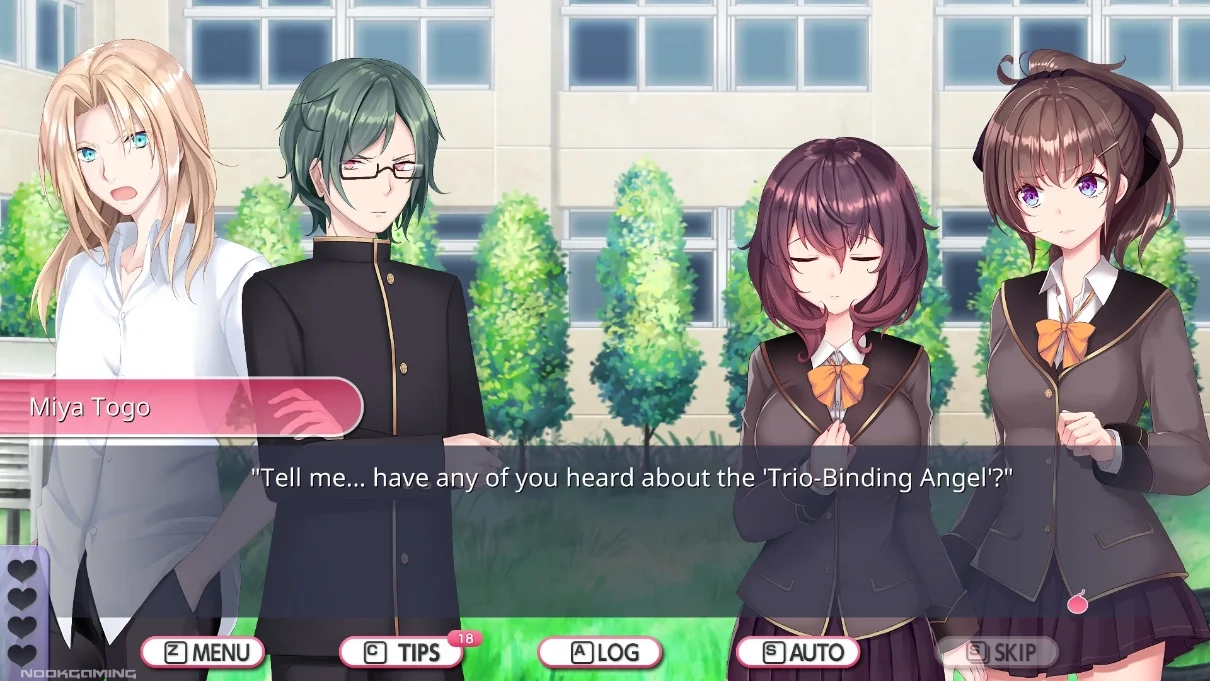
The rest of the main cast is rounded out by two more guys and two more girls. There’s Asuka, a blond boy who operates on a similar wavelength as Kei and is one of the first friends he makes at the high school, as well as Ryuto, the class know-it-all pain-in-the-ass Mister Logical, who nonetheless often demonstrates helpfulness despite his stoic exterior. The two guys are a bit less focal to the story, but they round things out pretty well. The two girls are the sorta fujoshi-like Miya and the upbeat Shinoka, who play a much more central role to the story than the other supporting characters, even at times eclipsing the main love interests in focus.
While they don’t exactly have equal screentime, all seven main cast members have a role in the story and a unique place they occupy in the group’s dynamic, and I appreciate the way things are handled surrounding both the platonic friendships and the romantic interests. They all have their own little bits of personality too, such as Otoba’s childish sense of humor, or Asuka’s western lineage and Christian background contrasting with the Shinto history of the town and Kei’s more secular belief system. Shinoka in particular, I felt to be a rather well-handled supporting character, one who is supportive of both the male and female members of the cast despite her own complex circumstances. And that’s not getting into Miya, who has a whole host of traits that are not what they might seem at first glance.
Production Woes
I have quite a lot I’d like to say about Death Match Love Comedy! as a whole, including the area I think it succeeds in most, but I’d like to get past the complaints I have first.
The most obvious issue with DMLC! outright is its noticeably weak production. I can deal with the lack of voice acting; it’s not a hard requirement for me, and I’d rather a story be without it if it means it can accomplish whatever else it was trying to do instead of potentially being kneecapped by the significant additional cost. However, it’s harder to excuse the weakness of the sound design on the whole. To use an example, the older Ace Attorney games didn’t have more than a handful of voice lines, but they had incredible sound design thanks to the highly expressive use of sound effects on key lines that augmented whatever comedy or drama was trying to be conveyed. Comparatively and in general, DMLC! unfortunately feels very muted, with very few sound effects at all, even on occasions when it feels like there should be some, and a relatively limited musical score which also loops awkwardly with many tracks. Oftentimes, the game becomes completely silent when the music cuts out (which happens fairly frequently, sometimes for effect, other times for no clear reason), and I would occasionally end up checking to see if I accidentally muted my laptop by mistake.
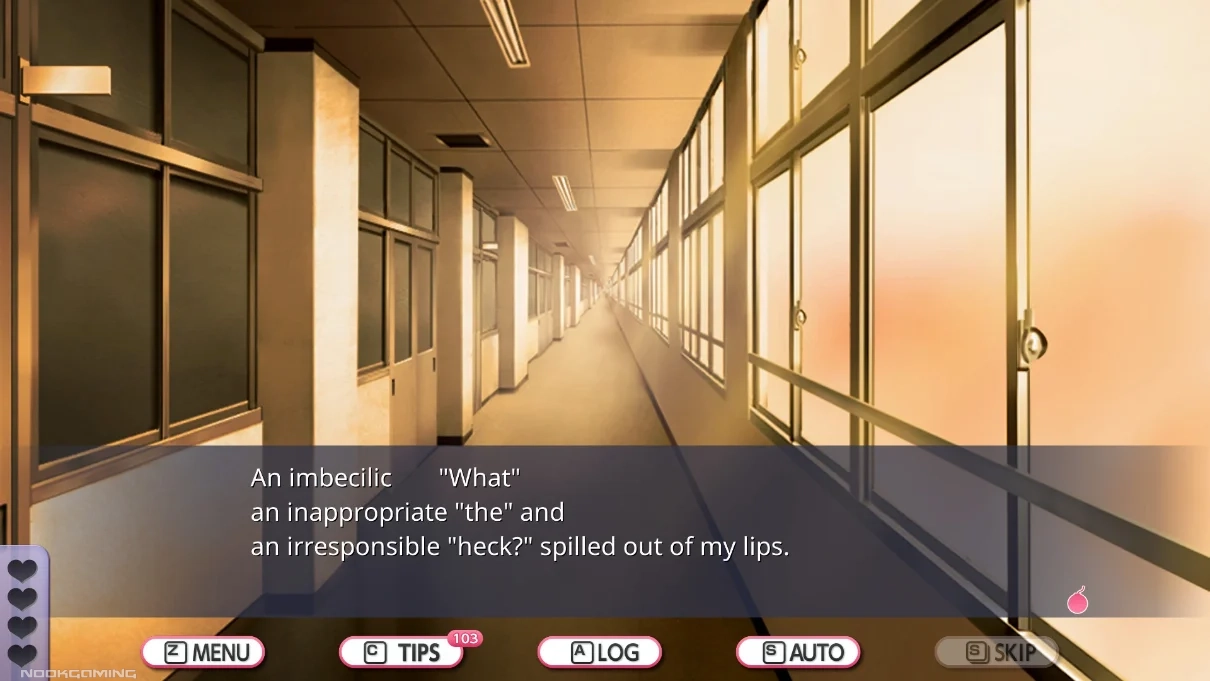
The character designs are fine, if a bit subdued in their range of emotional expression, and there’s a modest number of CGs. The bigger visual problem I have is regarding how many backgrounds are just relatively blank colors or gradients. Places like the classroom or Kei & Suzu’s apartment will look fine, but others like the school library will just be nothing, leaving more to the imagination than maybe should have been.
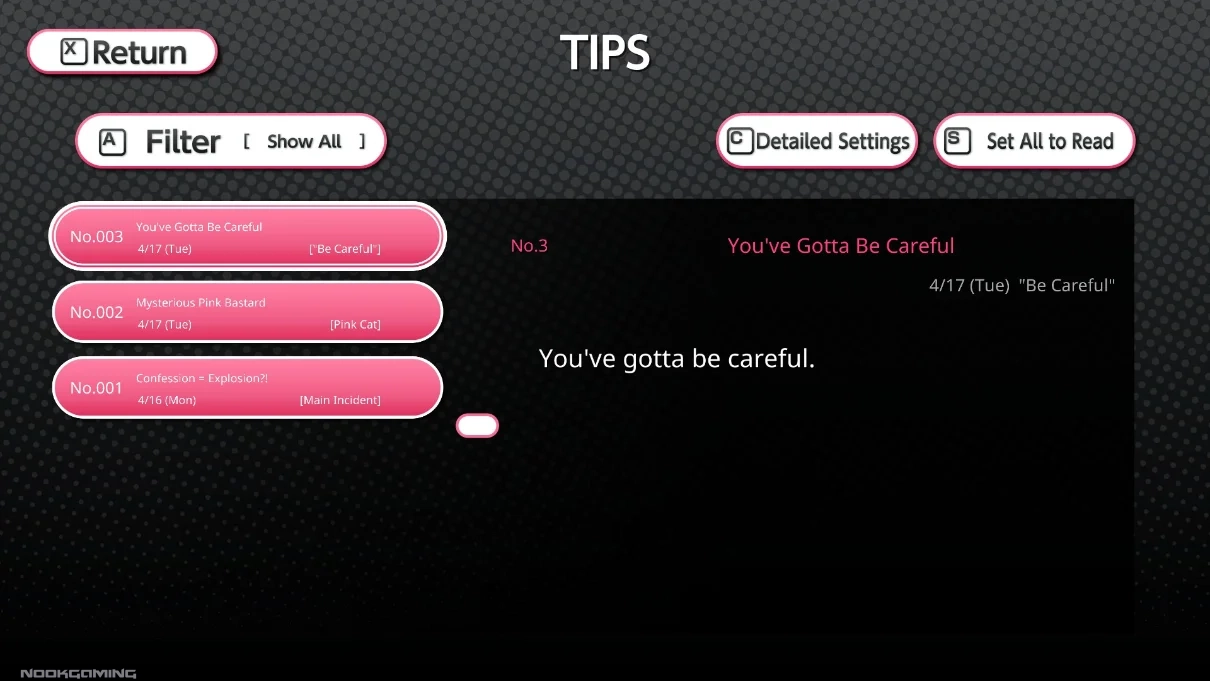
Death Match Love Comedy! Features a TIPS page and it honestly felt like a misuse of the feature. Typically, in visual novels, this section is where you might find either supplemental information explaining a concept that would disrupt the flow of the story, or at the very least you might fight optional insight or musings from characters. You occasionally see some supplementary thoughts from Kei about certain matters in the TIPS section, which is kinda nice, but the vast majority of the time it just gives a brief summation of something I just read with nothing really added.
Speaking of features that felt a bit excessive, after every ending there’s the option to go to “Tororin’s Nest”, in which you get some meta-commentary by Suzu about what transpired and a comment on what to do differently. These feel like copycats of Fate/stay night’s Tiger Dojo sections and have the same problem those sections even admitted to having, i.e. they’re goofy irrespective of the tone of whatever just transpired. They’re thankfully optional, and DMLC! has a route chart you can easily access at basically any time to change course and hunt for either the correct end or more bad ends, so the actual advice is borderline pointless. I personally avoided these for the most part until after I finished the game, although I found the last one unlocked from getting all the endings to be a bit overkill regardless.
At least the translation seemed pretty solid. Dialogue flows fine, and there’s not a lot of odd references or things that take me out of it. Typos are very rare for much of the visual novel, although there are noticeably more in the final act than in the earlier portions. Honorifics are kept pretty much in tact.
Structure
There are areas of the writing that can be a bit hit or miss. There are curses at play here, and the supernatural becomes the norm over time. At its most extreme, it gets over the top to the point of testing my suspension of disbelief out of its interest in grandiosity, and there can be some odd tonal shifts here and there as a result. The bad endings are often abrupt and have a joke inserted that feels a touch out of place in certain instances, and which sometimes took me out of the story. It’s a shame because I felt Death Match Love Comedy! had several other instances in which it was organically, legitimately funny. It isn’t afraid to be silly or even stupid at times, which is a virtue probably more often than it is a vice, but it isn’t always done the most tastefully.
Death Match Love Comedy! has shades of being a bit of a deconstruction narrative of genres like romcoms and love triangle stories. For the most part, it does a good job of keeping itself from being outright cynical despite its concept, as I do believe it’s mostly sincere in the emotions it’s trying to convey, despite occasionally leaning on popular anime and visual novel gags in places they aren’t the best fit for. That said, there are times where it feels compelled to call its own premise a bit stupid, particularly in some of the later portions, which puts just a bit of a damper on it for me. And speaking of the latter portions, a lot of plot developments are quite backloaded as you start to transition away from the basic bad endings and towards the main endings, several of which are complicated if not outright downers. The actual “true ending” route is…wild, and convoluted in a way that doesn’t resolve the climax quite as well as I would have hoped.
Still, the journey there has a lot of compelling elements.
Heart
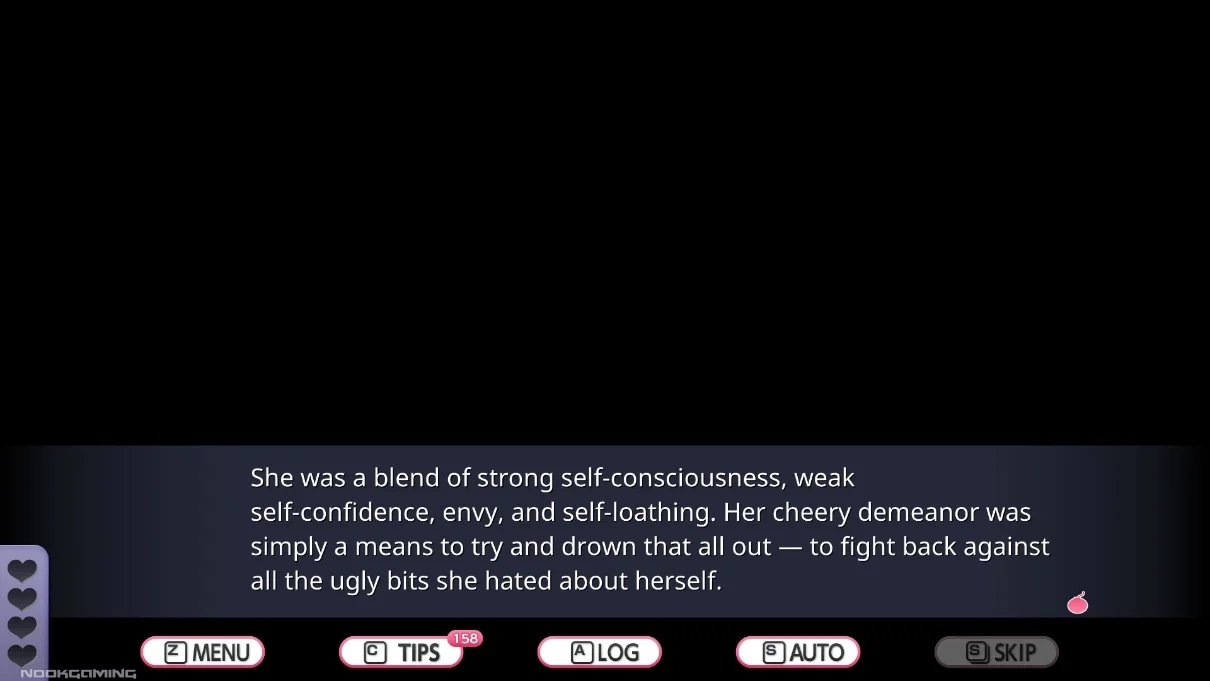
Death Match Love Comedy! covers a rather broad spectrum of personal trauma that ultimately binds its characters and story together. The classic types like tragedy, grief, and self-doubt are present, but there’s also considerable angst and turmoil spurred by generational trauma, guilt, body image woes, and more. While I have issues with certain aspects of how the story is told, it makes up for it in emotional breadth.
What I appreciate about the story over others that handle this subject is that it’s less afraid than many others to be kind of ugly about it. It presents the ways trauma leads people to make mistakes, rather than simply presenting the characters living with it as can-do-no-wrong people who simply got dealt a bad hand in life. It’s enough to make me feel for the characters and invested in their journeys, without being overly saccharine or sentimental. It also isn’t quite as inclined to shove its themes into your face directly as some other works.
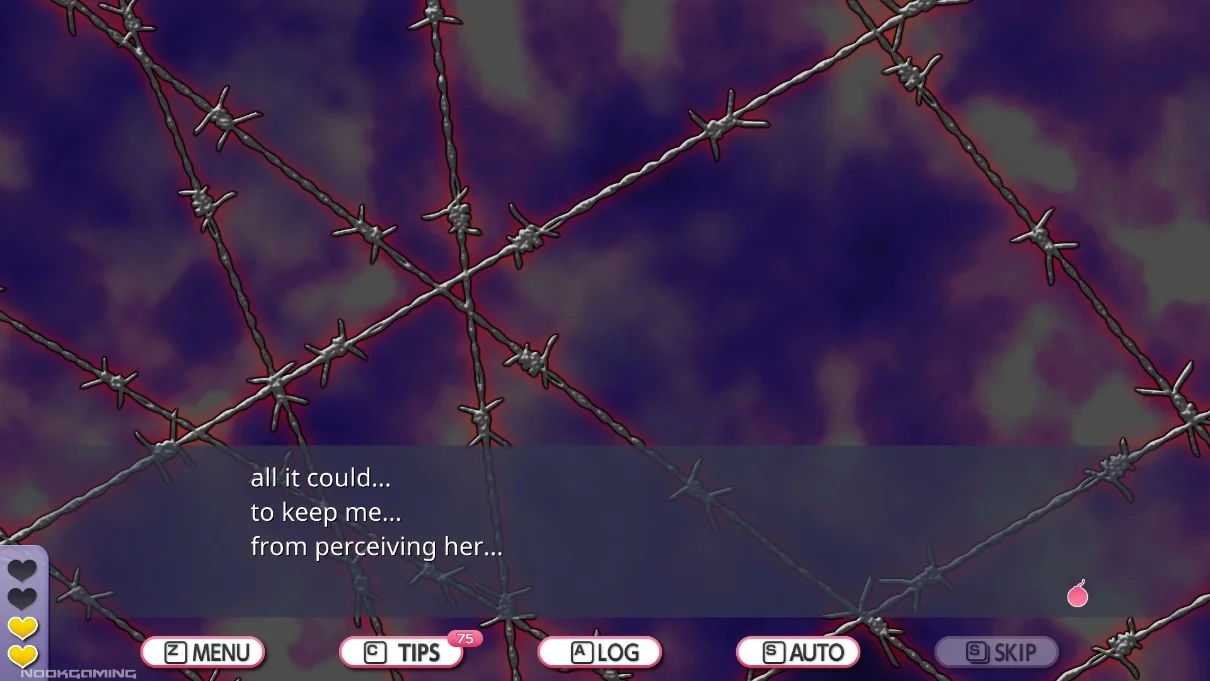
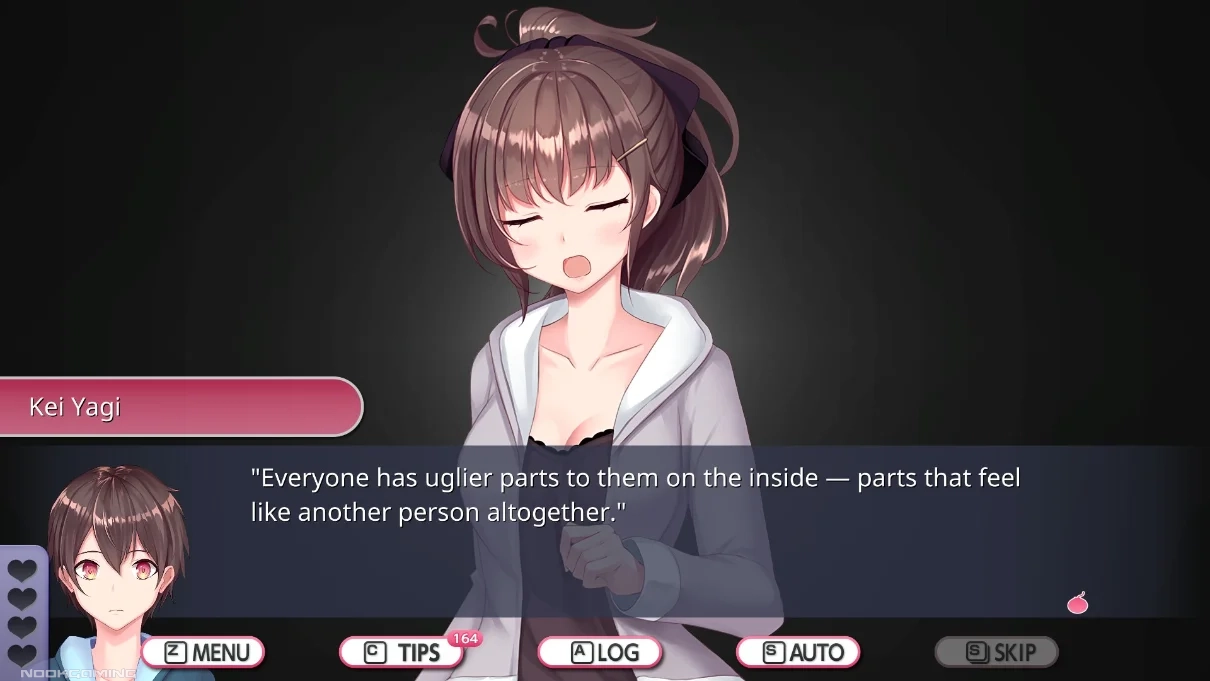
The characters are flawed, jagged, and you see a lot of their bad sides brought out because of their trauma. Obviously, the main trio is where you see much of this manifest, but Death Match Love Comedy! also spends a pretty fair amount of time on its supporting cast as well. A good amount of Shinoka’s personality is clearly altered by the strange circumstances of her upbringing, with a generations-long feud between her family and Rumiko’s. Suzu’s struggles with being a surrogate guardian for Kei and coming from a really toxic family shape several key events and some generally emotional scenes (which honestly made me wish Suzu had more screen time in the story proper). It’s hard to immediately like several characters, but DMLC! gives them rather believable, relatable qualities in spite of all the shenanigans and larger-than-life scenes.
Death Match Love Comedy! is inevitably going to require some suspension of disbelief. Some details occasionally feel glossed over or not handled as well as they could have been, and I’d be lying if I said I didn’t wish some areas went differently or would have been more elaborated on, even with its moderately long runtime. But the glue that holds it all together is the main cast. Each is given a pretty good degree of focus and development, with an emotional core around many different forms of love (romantic, platonic, familial) and the ways that deeply held trauma can impose upon that love and alter perceptions and experiences around it. DMLC! was a lot more effective at that than I expected, despite its many limitations.
Verdict
Works like Death Match Love Comedy! can serve to highlight why it’s often difficult for me to try to assess media on a linear, numerical scale. As I talked about in our list of “our favorite 7/10 visual novels“, there are several ways you can arrive at such a score: sometimes a work is solid if unspectacular all the way through, and others it’s an attempt to average out highly compelling strengths, pronounced flaws, and rather subjective qualities. DMLC! is far more of the latter for me.
Production limitations unfortunately lower the ceiling for DMLC! in a way that makes any recommendation have a blatant caveat, having left me really wishing it had a bit more budget and emphasis placed on its look and sound. Its writing can also be a touch convoluted at times. Not every character is easy to like, and the “main love interests” aren’t as focused on as some others. The mere concept of the story sounds somewhere between parody and a touch cynical, and you’re likely to come away saying “I expected something different” if you go into it blind.
However, I think there’s a lot of heart to the story it’s trying to tell. It features an initially wacky backdrop to initiate a story of several deeply troubled and flawed individuals struggling to come to terms with and move on from a wide variety of difficult circumstances, trying to grasp complicated emotions as they relate to those in their lives. The protagonist and several supporting characters have some great developments and character moments, and the story takes some wild and unexpectedly gripping turns. In some ways, DMLC! punched above its weight class, delivering something I enjoyed and liked more and more as it went on. Even if I didn’t entirely love its final conclusion.
DEATH MATCH LOVE COMEDY IS RECOMMENDED

If you’re interested in another visual novel which is little rough around the edges but definitely worth reading, check out our review of Love, Elections, and Chocolate. We have also covered a wide variety of visual novels both original to English and localized from Japanese, which you can check out here.
Many thanks go to PQube Games for a PC review code for Death Match Love Comedy!
Been playing games since my papa gave me an NES controller in the early 90’s. I play games of almost all genres, but especially focus role-playing, action, and puzzle-platform games. Also an enjoyer of many niche things ranging from speedrunning to obscure music from all over the world.