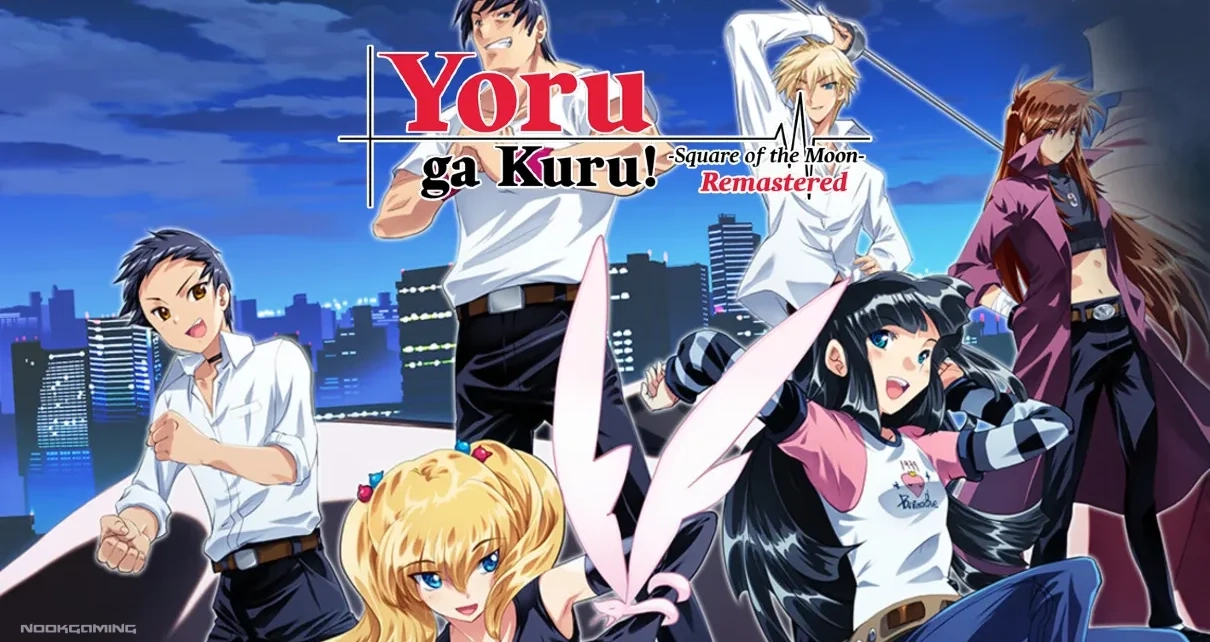
Yoru ga Kuru! -Square of the Moon- Remastered is a 2024 visual novel by AliceSoft, an eroge developer famous for releasing a large number of both traditional and gameplay visual novels that tackle topics ranging from lighthearted, comedic high school romance to cruel, violent displays of oppression and power. The game is a remastered version of their 2001 release of the same name, featuring upscaled graphics, a new cast of voice actors, and an updated gameplay system designed to make the experience more accessible and enjoyable. An English version of the game was released by Kagura Games on May 31, 2025. The story follows a group of students with special abilities as they fight against otherworldly enemies who plan to bring about an everlasting night.
Yoru ga Kuru! was definitely not a title I was expecting to see in English so soon after its remastered release. With numerous other recognizable titles in various AliceSoft series still lacking global releases (Dai series, Pastel Chime, Toushin Toushi), I thought they were going to get picked up first. It is, however, a welcome surprise. There’s a certain charm that old eroge have: an annoying gameplay loop, a wonkily structured story that’s equal parts confusing and epic, and characters sporting hairstyles with strands as thick as my fingers are some qualities that, while being relatively awkward by modern standards, are reminiscent of simpler, more comfy times. But are those sentiments enough to justify bringing back a title that might have been left behind by time? The clock is signaling the coming of the night; it’s time to dive headfirst into Yoru ga Kuru! -Square of the Moon- Remastered!
Is Two Really Better than One?
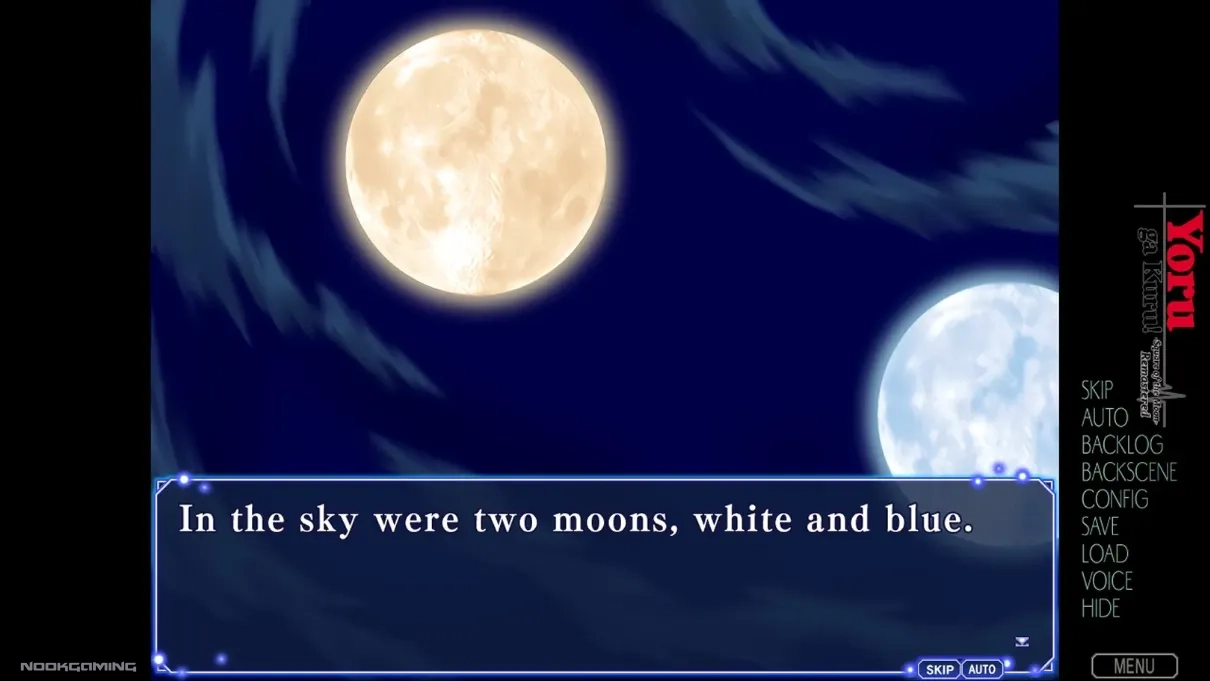
Three years prior to the story, the world was shaken by an unprecedented phenomenon. In the all-familiar night sky where the moon reigned supreme, a second cosmic body had claimed its own territory. Initially faintly similar to the moon, its appearance has since then slowly shifted towards a more otherworldly bluish glow. Dubbed by the people as the True Moon, no one knows why or when exactly it suddenly appeared. No manner of human instrument could detect it, but no one could deny that it was there. After some point in time, people just accepted that it was going to be in the sky regardless of whether humans could interact with it or not.
But with the True Moon’s appearance, a slew of weird occurrences started happening. People of various kinds all over the world started exhibiting weird behaviors on nights when the True Moon shone the brightest, causing chaos whenever it happened. Since then, these random incidents have been called the Lunacy, and it became common practice to stay indoors when the night sky was blue. Fast forward to the present, a student named Ryou Hamura finds himself in a dangerous situation: a man afflicted with Lunacy is violently pursuing him for what God knows is anything but a good reason. He runs through the blue-tinged streets hoping to lose his aggressor, but the man only keeps gaining on him. At his wit’s end, he finds himself running in the direction of a lone person. Although he warns them of the impending danger, their only response is to calmly look their way. Exhausted from the chase, Ryou starts losing consciousness. As the lunatic closes in on him, the last thing he sees is something shining red.
Saving the World at Fringe Time
Ryou wakes up during lunchtime in the campus of Oumidai Academy, the school where he studied after being left behind in town by his parents for work. Dismissing the chase as nothing more than a dream, he starts thinking about what to do for his second year in high school. This is cut short, however, as a girl brings him back from his daydreaming to tell him to step aside so she can go through the door. He initially complies, but as he’s struck with the feeling of something approaching fast with a little bit of force from behind, he shields the girl from the incoming projectile. It turns out Ryou has an innate ability to sense the presence of things as they approach him. After explaining this to the girl, they go their separate ways.
Shortly after, Ryou contemplates the idea of joining a club. Although initially disinterested in what he was able to explore, he was eventually invited by a girl named Kyouka to join her that evening and give the Astronomy Club’s activities a try. Despite being skeptical, he agrees to meet her in the school well past school hours. As they explore the empty school building, two masked men suddenly start attacking them. Fearing for their lives, they both start running towards the exit to ask for help. Kyouka, however, gets captured. As the men start threatening Kyouka, Ryou springs into action and knocks the two men down. He then turns to Kyouka to free her, but as it turns out, the entire thing was a setup by the Astronomy club members.
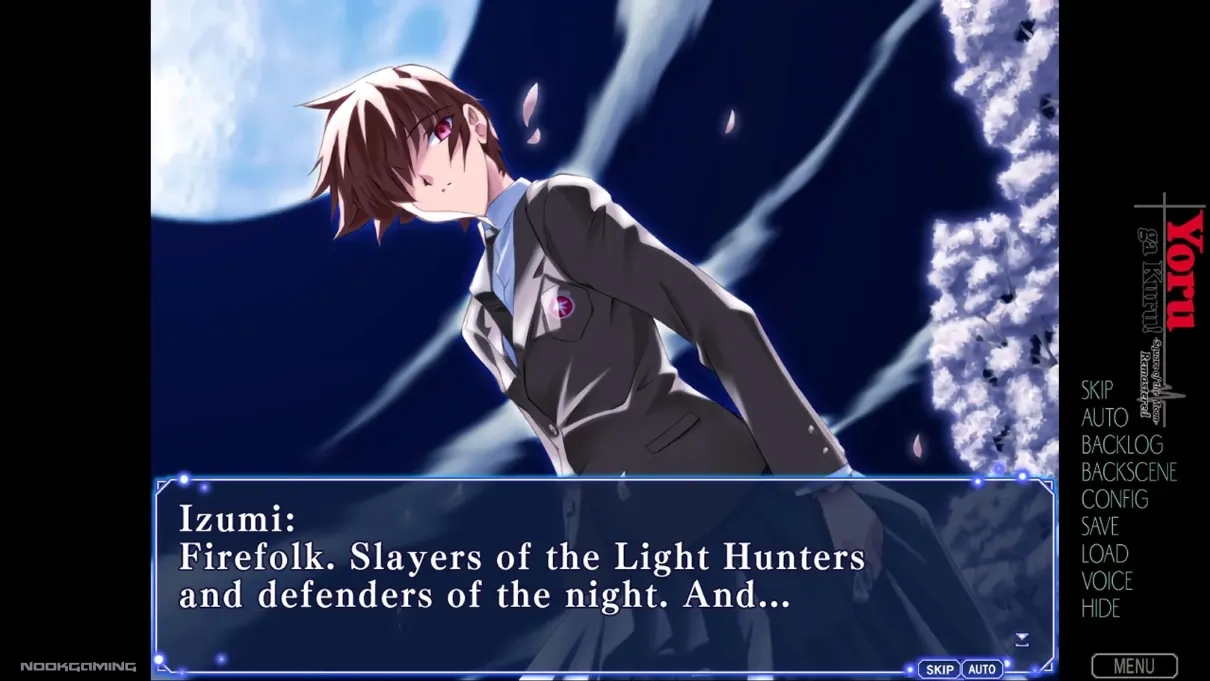
Feeling betrayed, he storms out of the school building to where the club president is waiting. Recognizing the president as the girl he met during lunch time, he asks her what the point of the entire thing was. Unfazed by Ryou’s rage, the girl introduces herself as Izumi Kagura, the leader of the Firefolk in their academy. She was the one who saved him the night prior, and now, she wants him to join them in the fight against the Cold Night.
One World, Many Paths
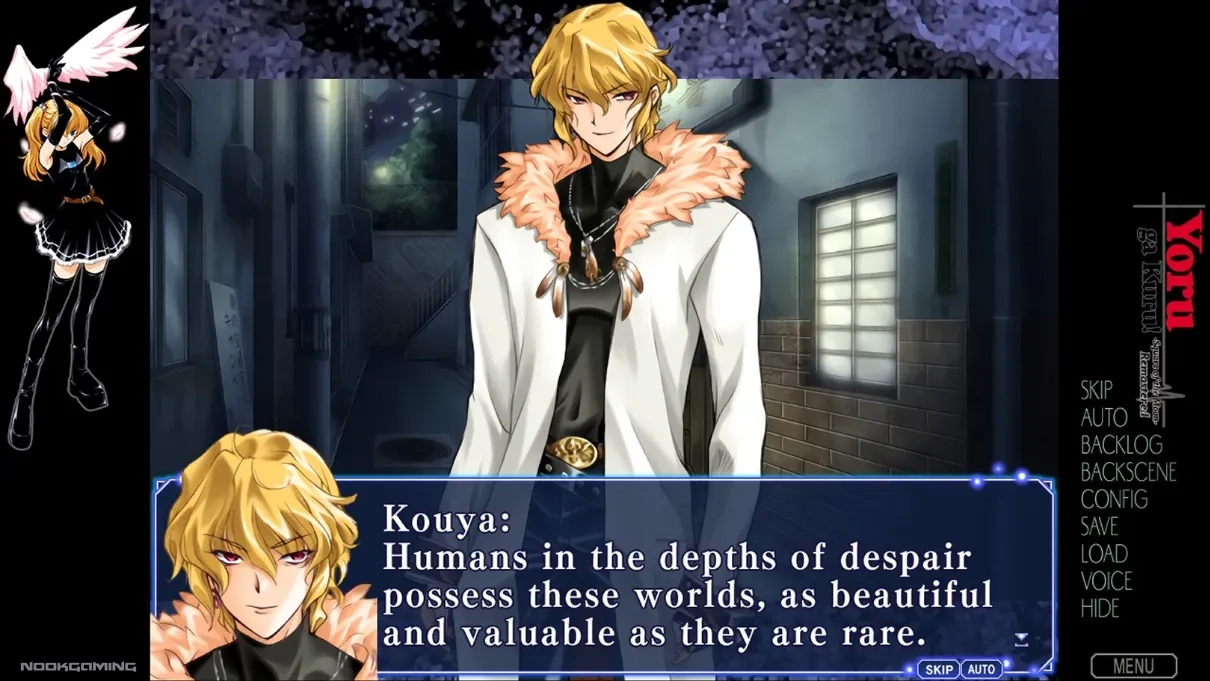
As a visual novel, Yoru ga Kuru! -Square of the Moon- Remastered isn’t very complicated to follow. The story is largely linear with variations in scenes depending on which character you decide to bond with throughout the length of a playthrough. These differences essentially function as the routes in the game, as they primarily feature romantic encounters with one of the four heroines of the main cast. In contrast, the main baddies, the encounters leading to the final confrontation, and the overall conflict remain largely the same no matter what choices you make. The formula of the plot is very traditional too; most of the opening scenes revolve around gathering your team of allies who will fight against the unknown enemy, and after that, you slowly unravel their identities and plans and head towards a final confrontation whilst also tackling individual character arcs for each cast member as they’re put in situations with increasingly higher stakes.
Overall, it’s a pretty light read. There’s nothing too unexpected or out of line in the story, and even during its most idle moments, Yoru ga Kuru! satisfactorily masquerades as a slice of life title. The action scenes are a little bit undertoned with not much to go with in terms of visuals and text length, but their twists and turns have enough impact to keep the story entertaining. I did feel, however, that a lot of characters were either underutilized or underdeveloped relative to their role in the story. A lot of them felt transient in terms of presence because of how the story was structured. There were too many lighthearted comedic scenes in comparison to high-stakes opportunities for character spotlights, making them feel rather surface-level. This could have been better if there were more enemies in between major scuffles, especially those specifically set to demonstrate a particular party member’s special qualities; it would have allowed their characters to shine in their own special ways.
Love that Outshines the Moonlight
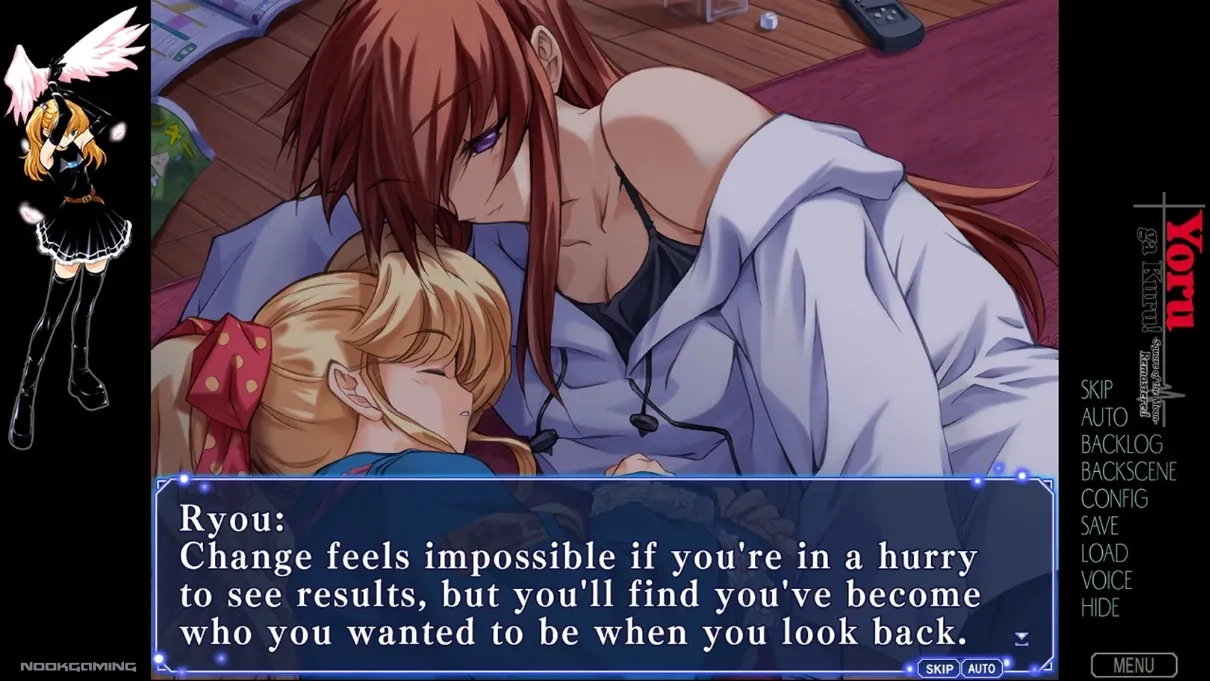
As mentioned, the heroine routes in Yoru ga Kuru! -Square of the Moon- Remastered follow the general pattern of the story very closely. While the main storyline doesn’t really change, Ryou’s involvement with a heroine changes the way he approaches the final confrontation. His motivations, the meaning behind confronting each antagonist, and their relationship with the True Moon phenomenon are all addressed by the heroines’ character arcs, making the overall progression of their romance feel well-handled. Despite this, I felt that their stories were too short. Maybe because half of the game was dedicated to establishing their dynamics as a team through slice-of-life content, but I feel like there were barely any opportunities outside of special Training events to actually grow Ryou’s relationship with his romantic interests. It’s a bit of wasted potential and something that I would have loved to see more of if given the chance.
Regardless of their length, the routes were mostly structured well. Each heroine had one specific issue that could only be addressed by engaging the main baddie of the game and the True Moon phenomenon, and the conclusions to their arcs were thematically satisfying as well. If anything, what Yoru ga Kuru! handles really nicely is its overall themes of dreams and nighttime. I felt like most of what was tackled through the story fell in line really nicely with the overall setting, even for the side characters. The main problem I felt was present in the narrative was that everything was too brief. The game doesn’t give its readers enough time to stew in the emotions that the text is supposed to evoke, making impactful scenes feel flimsy and shallow. Add this to the lack of opportunities to spotlight specific characters, and it makes for a pitch that the game swings for but ultimately misses because of their timing.
A Busy Week is a Normal Week
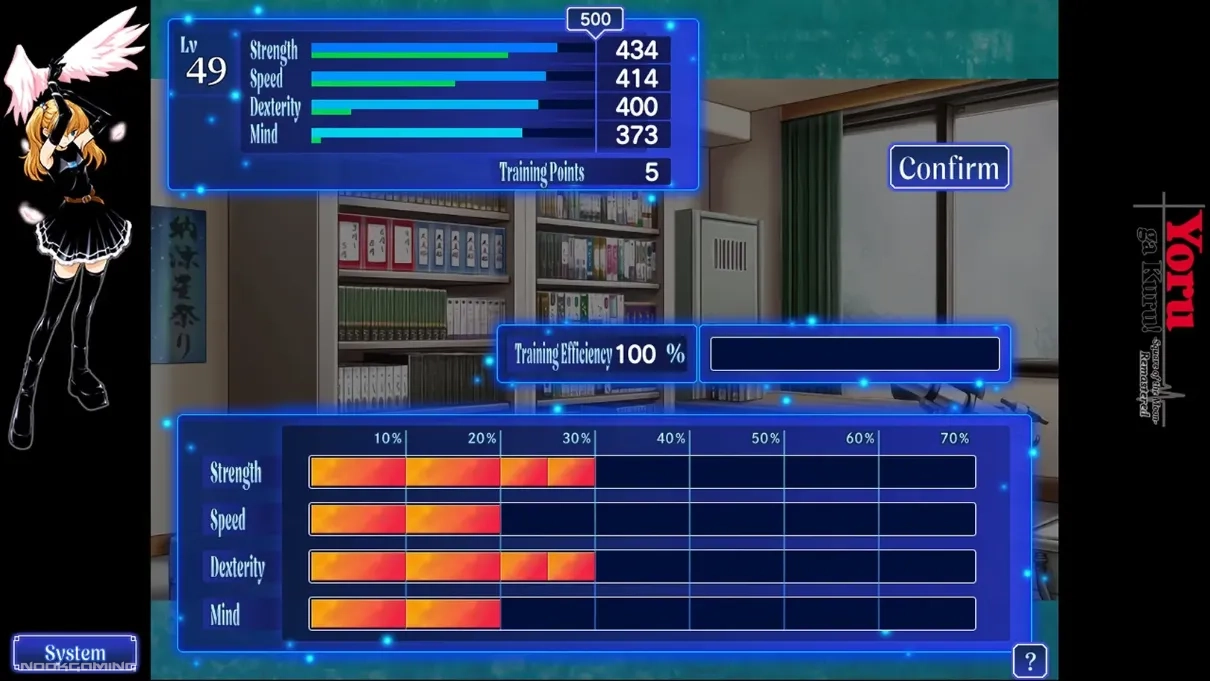
Yoru ga Kuru! -Square of the Moon- Remastered’s gameplay follows a strict format where you can only do certain actions based on the day of the week. It makes use of an in-game calendar to track your progress in the story while also dictating the pace at which your main character, Ryou, develops as a party member. At the start of a week, Monday, you are asked to distribute your 12 Training Efficiency (TE) points across four main stats. Leveling these stat points up requires the usage of Training Points (TP), which can be obtained by going through dungeons on Sundays. The amount of TP consumed per stat increase depends on how high the stats are in the first place; therefore, the game rates how well you’ve distributed the use of your TP points via the TE percentage.
During weekdays, Ryou will perform solo training exercises indicated by a set of animations that play during these intervals. This is when TP is consumed to raise his stats. Once it hits Saturday, you can then choose a training partner to practice with. Depending on your partner, your stats will be raised by a fixed amount and you will be able to view one of the training events in rotation for the character. In the case of the four main heroines, you will also increase your bond points with them. These bond points are important because a certain amount for each is necessary to enter their respective routes.
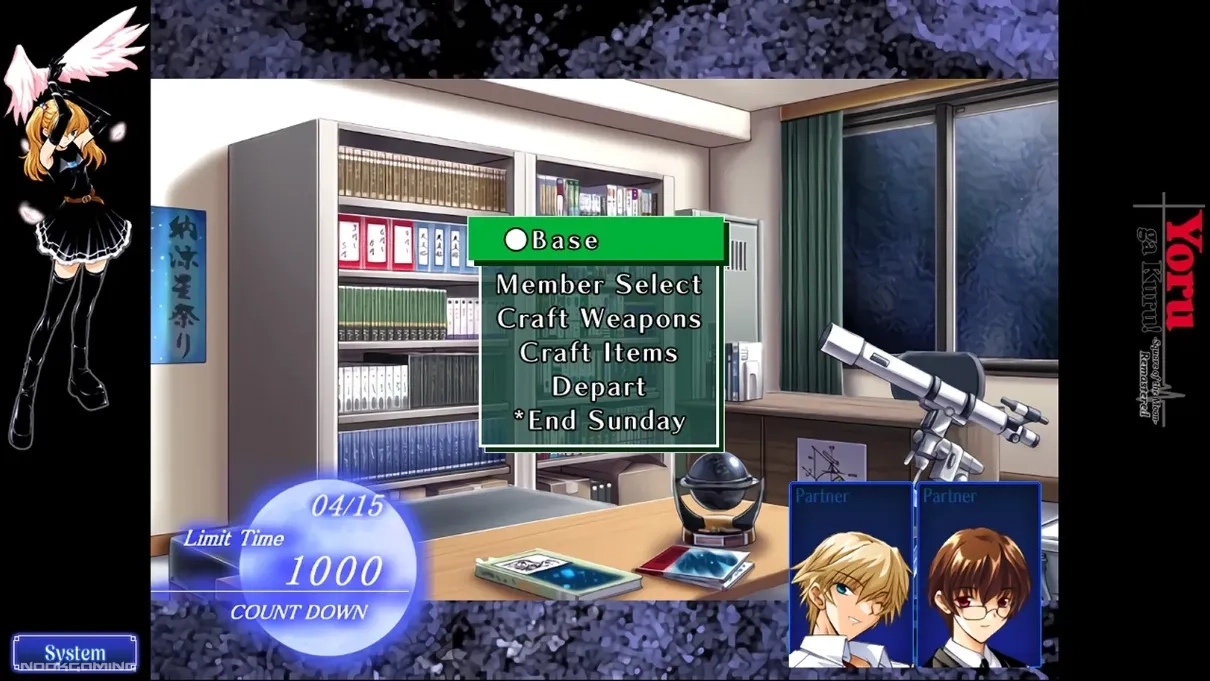
On Sundays, you can enter special dungeons where you can fight against Light Hunters, or what is equivalent to monsters in this specific title. You’ll be presented a number of options in the base before departing, such as selecting your two party members, crafting weapons to use for Ryou, crafting consumable items, and skipping the day (only available in New Game+). If you choose to depart, you’ll be transported to a world map that features at most two options to enter and grind in. This will be your general gameplay loop for the calendar dates.
Realistically, this first portion of the gameplay is a management simulator. You plan out your stat growth for the week, engage your character of choice for events and stats, and then grind either of the dungeons available to you. It has recommendations on how you should do it while also letting you explore by withholding specific information such as the possible results of crafting weapons. Overall, it’s an intuitive way of implementing a calendar-based gameplay loop. Its potential, however, is undermined by how limited the relevance of these functions are in the overall game. To explain it better, let’s introduce the dungeon crawler portion.
Ryou and the Maze of Hidden Treasures and Traps
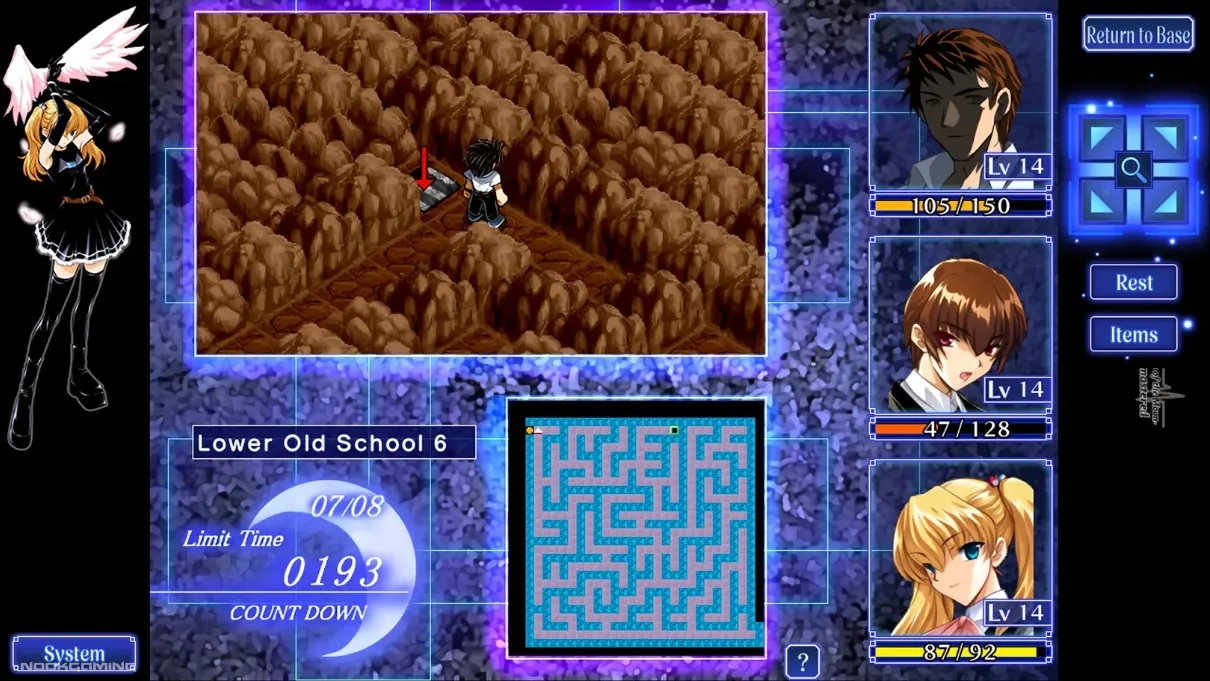
Dungeons in Yoru ga Kuru! contain four main interactable objects: the stairs going below and above the current floor, treasure chests, traps, and enemies. The stairs function as a stage’s entrance and exit points, while enemy icons are indicative of fights or encounters. Treasure chests, as expected, reward you with consumable items, such as heals and elemental stones for crafting weapons, and equipment that boosts a party member’s stats. Lastly, traps either affect your dungeon floor progress, inflict damage or status debuffs, or spawn more enemies or traps. During a dungeon run, you have a time limit of 1000, which means that your characters only have an equivalent of 1000 steps in terms of time to spend before the day ends. This time limit is shared with things such as Rest which spends an amount of time dependent on status effects and damage that the party currently has, and enemy encounters which consume a fixed amount of time.
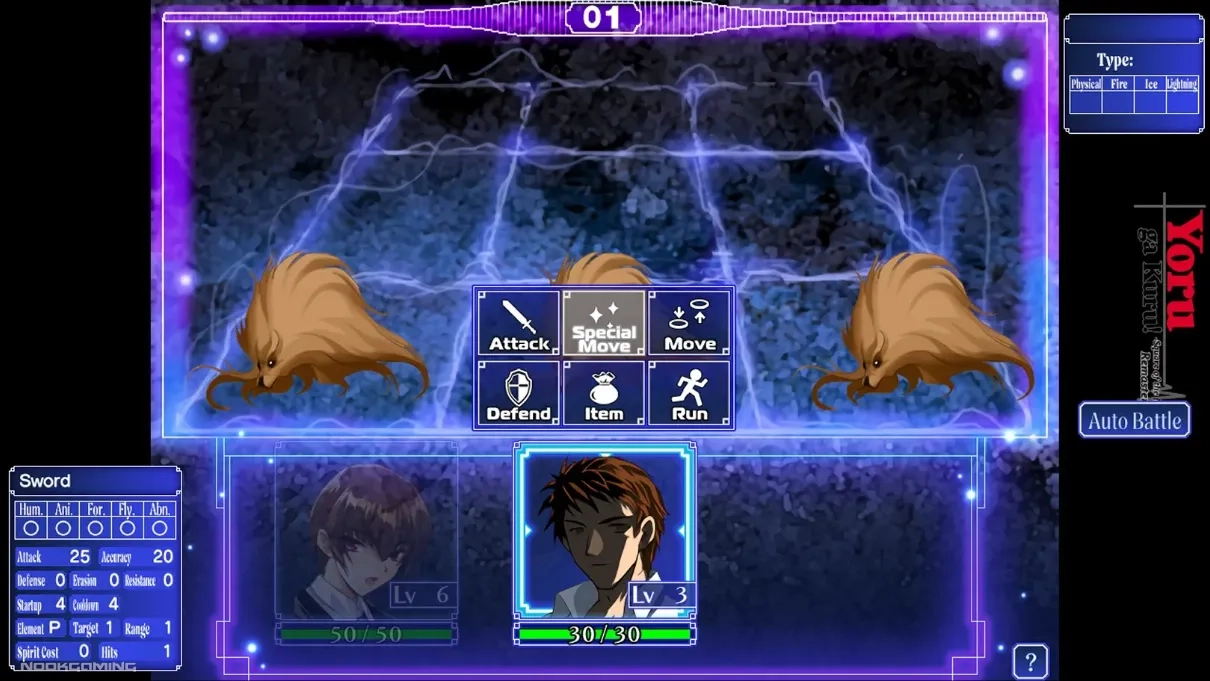
For enemy encounters, Yoru ga Kuru! implements a turn-based system that makes use of a universal timer to determine action order. Each character in the party has six actions they can take in a turn; most of them perform the usual actions associated with them, but in the case of Move here, it refers to your character moving from the front to the back and vice versa to adjust both their range and vulnerability to enemies’ attacks. Each action is associated with a Startup and Cooldown value, which refers to when the action is performed and how long it takes before the next action can be queued respectively. For example, if you have an attack with a Startup of 4 and a Cooldown of 4, it will take you 8 universal timer ticks in total before you queue your next action. These values differ across not only actions but skills as well, but in the case of Ryou, even his Attack can change depending on what he equips as his Main Weapon.
As expected from an RPG, the game also makes use of elemental affinities and attributes to implement strengths and weaknesses. Each enemy will be given an attribute (Beast, Flying, Human, etc.) and elemental affinities (fire, ice, electric) that either increase or decrease the damage they take from a specific attack. Playing around the universal timer and these affinities is what makes up your core strategy in Yoru ga Kuru! and by experimenting with your party setup and equipment, you can either make the game easier or unnecessarily harder.
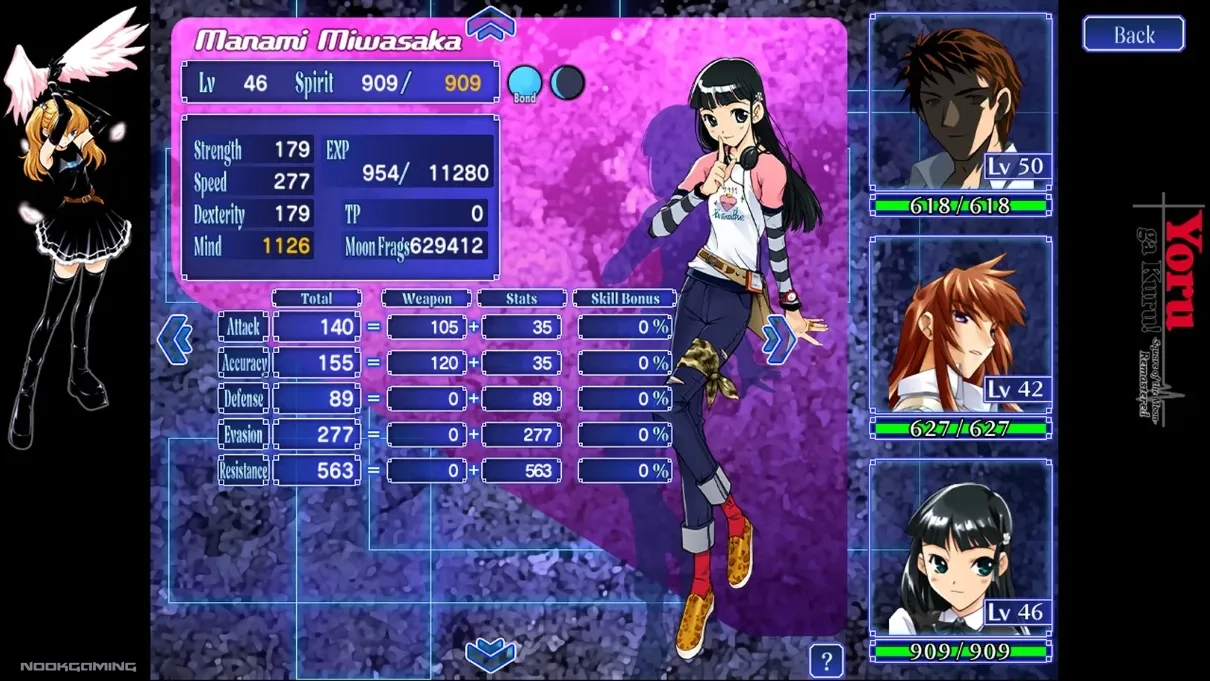
On the specifics of character building, with the exception of Ryou, each character has a specific stat lineup that they follow whenever they level up and get stronger. For example, in the case of Manami, as the mage of the cast, stat increases for her are bigger for Mind and Spirit, which are the modifier and cost values respectively for her skills. This makes leveling up characters rather streamlined and predetermined; the only influence a player has on character builds outside of Ryou is the items they equip to them. Depending on the item, they can either give passive skills useful for battle or dungeon exploration or attach a flat or % increase in their five battle stat lines, which are determined by the four stat values affected by training.
Consolidating all of these gameplay mechanics, you have a turn-based dungeon crawler RPG that has management elements that run based on an in-game calendar system. Naturally, this means that besides progressing the story, players will have to grind appropriately relative to the current date in-game to avoid being under-leveled or missing out on events that can only be triggered by raising bond points with specific heroines. It might seem a bit too much, but once you get the hang of the game’s tempo, Yoru ga Kuru! will start feeling a lot more comfortable to play.
The only problem is that it’s a little bit too comfortable.
Remastered for a More Casual Experience
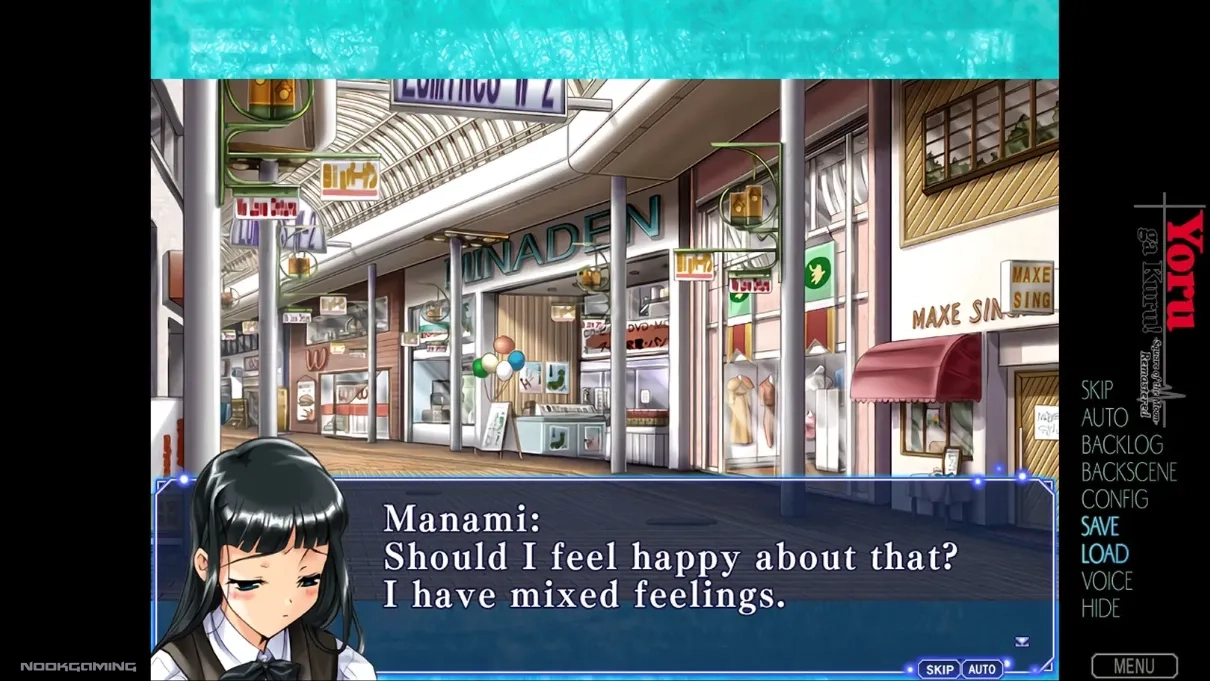
Despite all the elements implemented in its battle system, Yoru ga Kuru! -Square of the Moon- Remastered’s first few playthroughs felt a bit tiresome to play. Not because it’s too complicated, but because the game ended up being too easy. For context, the Remastered version implements a few extra modifications to the game to make it a lot more friendly for the general visual novel fanbase; it has a 2x mode for EXP, TP, fragments (equivalent of gold in this game), and ally TP to help players go through the game a lot easier compared to how it was in the original. These settings are available on the Modern version of a playthrough, which you can only select when starting a New Game from scratch. Add an Auto-Battle option, and now you have what is basically an auto clicker with an added dungeon exploration feature.
Granted, you can avoid this by simply turning off the modifiers in the game’s settings to experience its original pacing, but because the default is that they’re all active, people will naturally assume that they’re the recommended settings. This doesn’t take into account the fact that even if you stomp through the enemies, you’ll have to manually do the dungeon exploration part anyway, so it basically still takes the same amount of time to clear. The problem persists when you look at the majority of items that you get from treasure chests as well, which are healing items. If you never get close to dying, then there’s almost no point in hoarding or crafting these kinds of items. Heck, I was able to get through my first playthrough of the game by just crafting two weapons for Ryou. A lot of what the system has to offer is pretty much irrelevant if you remove the natural difficulty scaling of the game via these Remaster features. This doesn’t even take into consideration the Rest option in dungeons, which trivializes damage management by eliminating the need to use items by literally just healing you in exchange for time.
Expanding on the Auto-Battle system, clicking that option in-game allows the game to automatically press Attack for you on a default target in range. Because it only chooses Attack, however, characters like Manami who are highly dependent on their skills are basically useless because you can’t build them towards having higher auto attack values due to how raising party members works in the game. That’s why if you want to do the Manami route, which makes bringing her mandatory, you have to actually manually play the game. It’s not an inherently bad thing per se, but it sure makes the presence of an auto-battle option moot for that specific scenario.
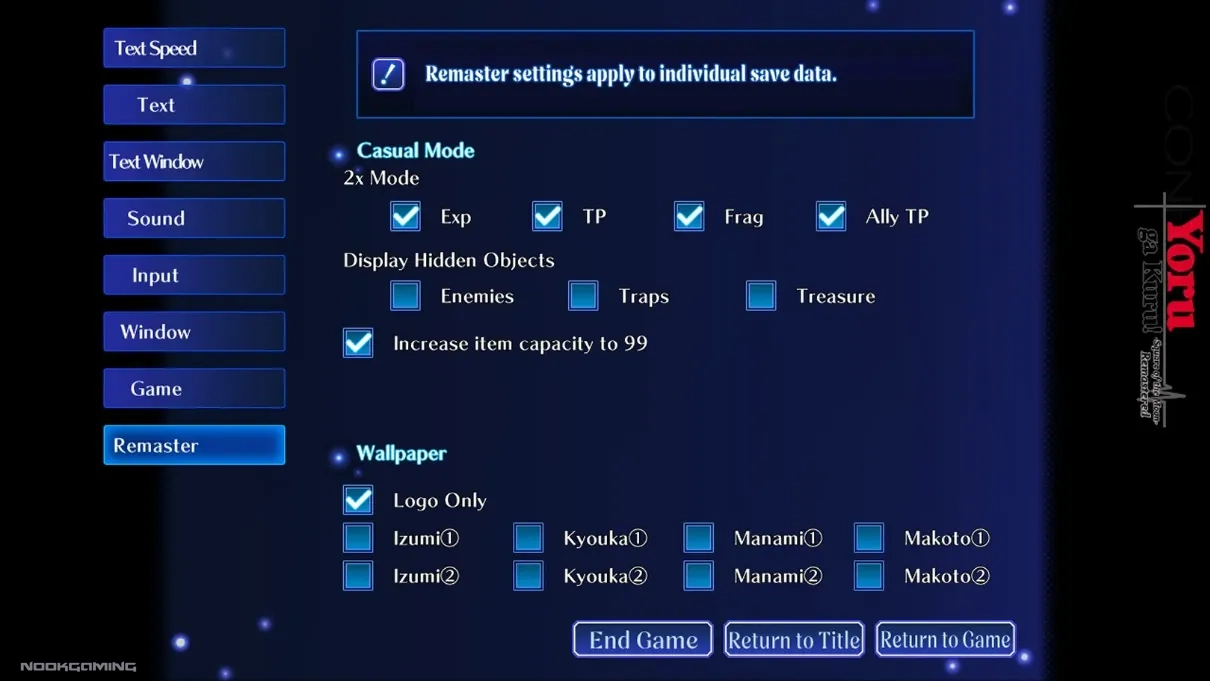
If you want to enjoy the gameplay portion of Yoru ga Kuru! and most of what it has to offer, I highly recommend turning these features off instead. Otherwise, you’ll barely have to interact with the battle system because you basically stomp all your enemies, making it feel more like a chore to do rather than a fun game. That’s why in my experience, I only really felt the point of its strategy when I reached Lv30 and unlocked the next difficulty level when I started my New Game+. Suddenly, I have to think about my actions and manage my sequencing better to not instantly die against the enemies. It was suddenly fun and a little bit more rewarding to do my best in the dungeon crawler portion, although not by much since the spawn rate of healing items still greatly outweighed elemental stones and equipable items, both loot that are relevant to creating that feeling of progression for the player.
On the flip side, the Remaster features make the game a lot more accessible to people who do not want to spend tons of time interacting with an RPG-esque system. In that case, however, it would probably be better to search for something else to read instead as one of Yoru ga Kuru!’s main charm comes from the specific retro feel its gameplay has.
Baring the Heart and Body
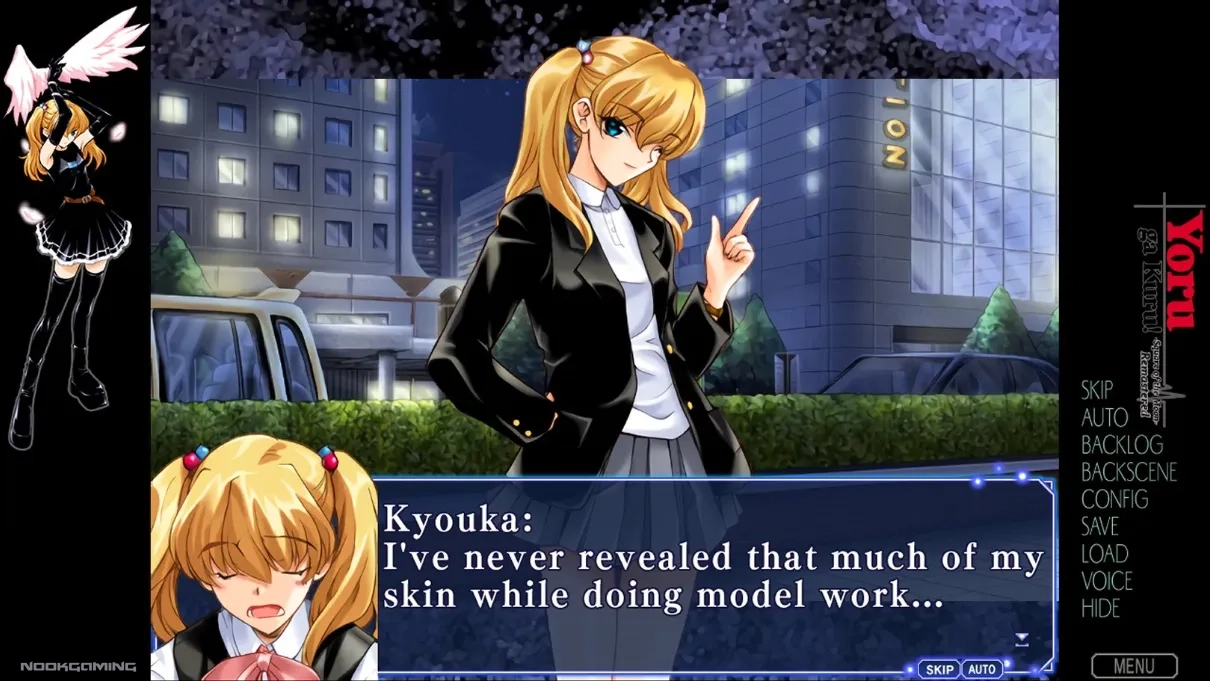
Surprisingly, compared to other titles by AliceSoft, Yoru ga Kuru! doesn’t feature a lot of adult content. They’re relatively scarce compared to the average playtime, and even then, they don’t last long or have a major impact on the story. During my time testing the game, I tried playing without the adult content and barely noticed the difference. That means that the impact of the adult patch when it comes to gameplay experience and the general storyline is relatively minor compared to other titles, which makes me inclined to say that it might be okay to play the game even without the adult patch.
I still recommend getting the patch, however, as it’s free and readily available anyway. Yoru ga Kuru! is still technically a romance-focused gameplay visual novel, and removing the adult scenes might make the development of Ryou’s relationship with the heroines a little bit weird with how they’re placed just before the final chapter. If you really must avoid the adult content, then the game should still be playable even without the patch, albeit with occasional weird missing lines here and there that make particular scenes feel off.
Art and Music
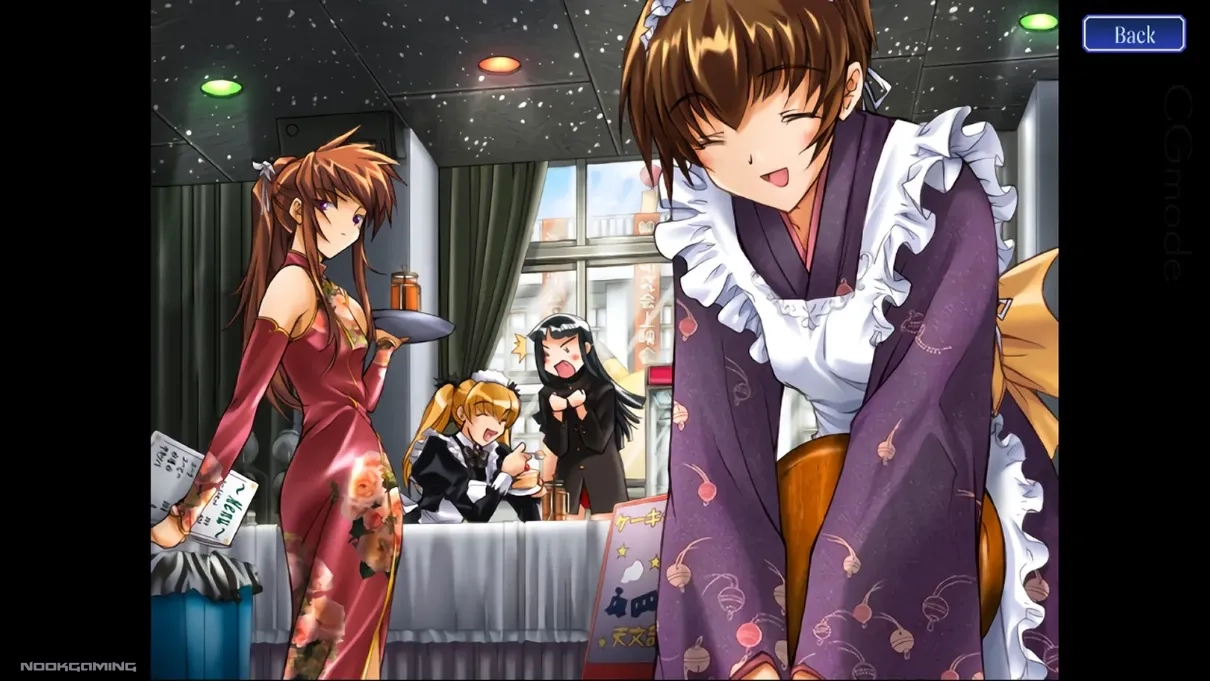
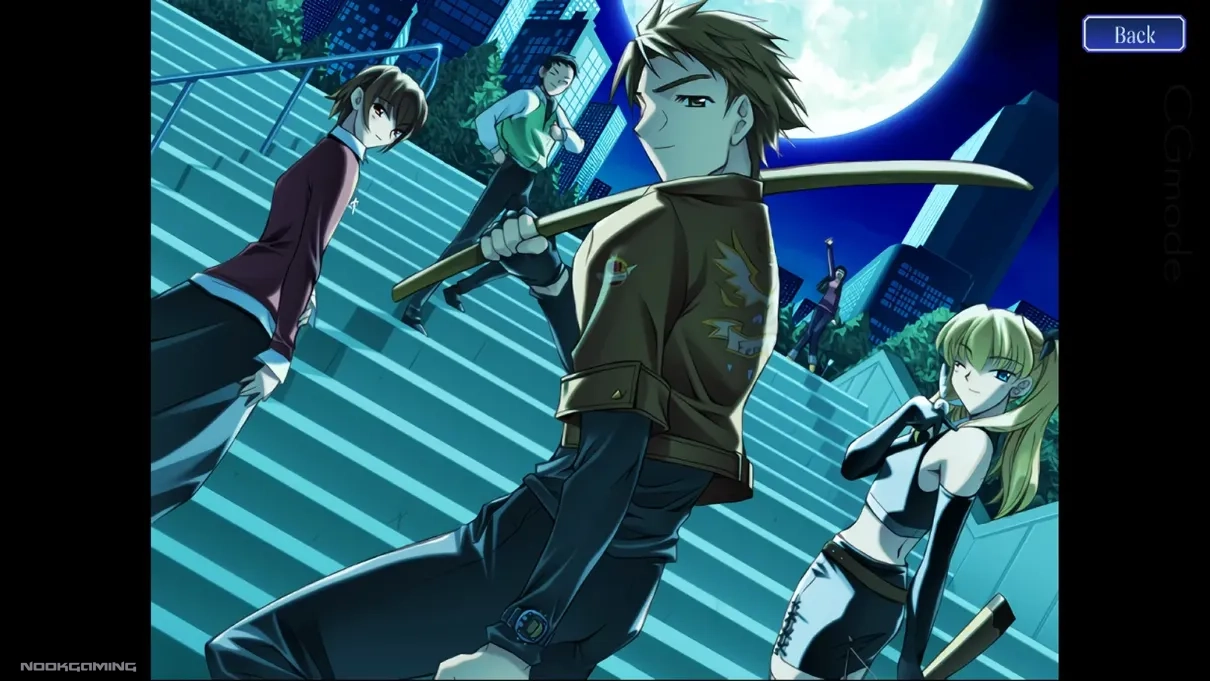
Yoru ga Kuru! -Square of the Moon- Remastered features a total of 60 unique CGs in the gallery, not including variations. Of these, there are 20 HCGs in total, creating a healthy 1:2 ratio of adult and all-ages graphics. The HCGs in the game are spread across 12 H-scenes in the gallery, although I’d argue that one more scene should have been part of that list, making 13 in total. Alongside the standard CG gallery feature, the game also offers a scene selector, highlighting parts of the story that were either intimate with the heroines or important in the general sense. The art for the game was done by the team of Karen and Kirishima Sen’ya Naosada, both artists featured in classic AliceSoft titles such as Kichikuou Rance, Only You (1996 release), and the Beat Blades series. Although usually credited for shading and doing the enemies and monsters, their expertise with the prevalent art style during the late 1990s to the early 2000s translated really well into Yoru ga Kuru!, implementing bold colors, sharp chins, and expressive faces that fans of early moe culture are very familiar with.
The monsters, on the other hand, felt a little bit silly in terms of concept and style. This, however, is pretty in line with how AliceSoft usually draw their monsters—weird caricatures of existing animals, people, or monsters that are common in various RPGs. It just looks even more janky because they lack a lot of features on the surface, perhaps because of the low resolution the game was originally made for.
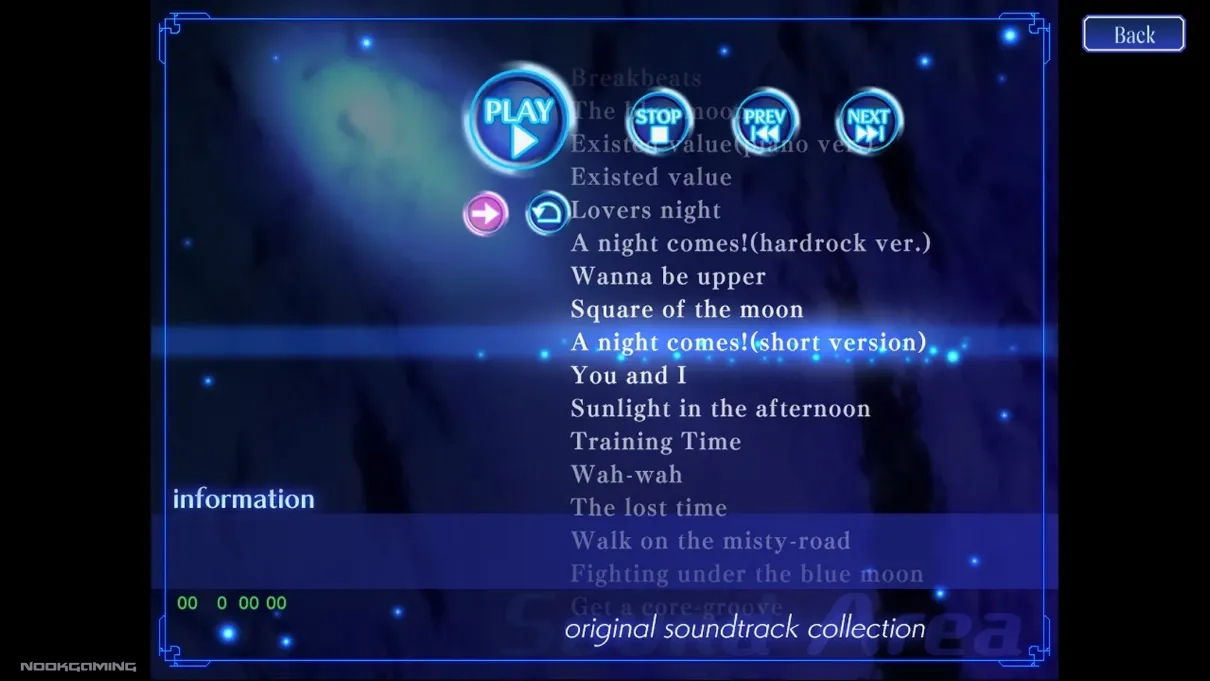
Yoru ga Kuru! also sports a moderate amount of music tracks, totaling 18 in the gallery. The tracks are by Shade, a prominent composer who used to work for AliceSoft and created a lot of the tracks that fans now know and love from the company. My personal favorite from his works here is definitely “A night comes!”; I love how he makes use of the relatively calmer tunes of the opening and implements it into the high-stakes fights by rendering it into hard rock. Besides that, the tunes “Training Time”, “Walk on the misty-road”, and “Fighting under the blue moon”, although quite possibly the tracks that you’ll hear the most, aren’t ones that you just get tired of. They mesh really well with the segment they play in and create their own distinct moods that I feel helped me slog through the grind.
To close off this section, I’d like to mention the voice acting in the game. The voice actors portrayed the characters really well, and honestly, I had no doubt they would, given the experience most of them have in the eroge space. But because the game is a remaster, there will be portions where voice lines aren’t implemented. Do not be surprised when they suddenly go silent even if there’s dialogue, as it was a standard way of doing it in the past. If anything, the presence of voices will instead tell you what scenes are actually important to both your progress and the story, which is another fun thing to look forward to in a way.
Thank God for Manami skills being voiced, despite having silly names.
Verdict
Yoru ga Kuru! -Square of the Moon- Remastered is a visual novel with RPG elements featuring a group of students as they fight against those who want to create an unending night. Simple and straight to the point, it employs consistent themes of hopes and dreams to create a story that is fantastically but relatable. With remastered assets and accessible features, it makes an attempt to appeal to audiences both young and old by reconciling its slow-paced retro gameplay with a faster progression system but falls short of effectively balancing the early game experience around its new tempo.
Although clear in what it wants to establish as a story, Yoru ga Kuru! feels like it lacks slightly in character impact due to the minimal buildup of tension in the story. While its various character arcs have clear conflicts that head towards their own resolutions, it hardly feels like a proper payoff because of how short their spotlights are. The way they structured the spread and concentration of important, relevant story events taking place within only a few in-game months undermined the game’s potential by withholding opportunities for the reader to become invested in the cast early on in a playthrough.
As a visual novel with gameplay elements, Yoru ga Kuru! -Square of the Moon- Remastered is able to put its own spin on the classic RPG formula without being too overwhelming for players not used to the genre. Despite its flaws, it’s a pretty solid game as long as you take the time to tailor it to your own preferences. If you’re a visual novel fan looking for something to shake up the monotony of clicking through dialogue, Yoru ga Kuru! isn’t a bad pickup. Just make sure you’re not looking for a title that’ll change your life.
WAIT FOR SALE ON YORU GA KURU! -SQUARE OF THE MOON- REMASTERED

If you are looking for another AliceSoft visual novel/RPG hybrid, you might want to check out our reviews of the Rance series, starting with Rance 01: Quest for Hikari. We have also covered a wide variety of visual novels both those originally in English and localized from Japanese, which you can check out here.
Many thanks go to Kagura Games for a PC review code for Yoru ga Kuru! -Square of the Moon- Remastered.

Visual novel reader that wishes there were more than 24 hours in a day. Gacha victim, TCG enjoyer, and VTuber simp. Still trying to live happily.