
Advent: Dawn is the third visual novel from independent developer Spire Games. Though it is a standalone story that can be read in isolation, Advent: Dawn is also a sequel to their 2022 visual novel The VII Enigma, and is second in a planned trilogy of sci-fi mysteries. Spire Games cite famous sci-fi mystery visual novels Ever17, Steins;Gate, and Zero Escape among their influences, and so I was interested to see what Advent: Dawn had to offer.
Caution: Falling Rocks
Advent: Dawn opens with neuroscientist Atlas Every en route to a mysterious island cave in the South Pacific at the invitation of an eccentric billionaire. Atlas doesn’t know exactly what he’s going there to do, only that all information about the cave is closely guarded and the pay is too good to ask questions. Just as Atlas arrives and starts to settle in with his coworkers, a sudden cave-in leaves everyone trapped underground on the remote island with little hope of rescue. Even worse, death strikes, possibly a murderer? A string of strange symbols and cryptic messages seem to suggest some mastermind at play. And the very walls of the cave echo with whispers of madness. Atlas knows that unless he and his comrades can find a way out, they are all doomed. But who can he trust? And what is the nature of this mysterious cave that he came to research?
The developer notes that while Advent: Dawn is a sequel to The VII Enigma and does share both its world and a few characters, it’s a standalone story that can be read without having read The VII Enigma first. Being in this boat myself, I would say I largely agree. There were a few references I didn’t get and one subplot where I think the stakes would have felt higher if I were familiar with the events of The VII Enigma, but I had no trouble following Advent: Dawn’s plot and never felt it was subservient to outside events.
A Web of Deceit
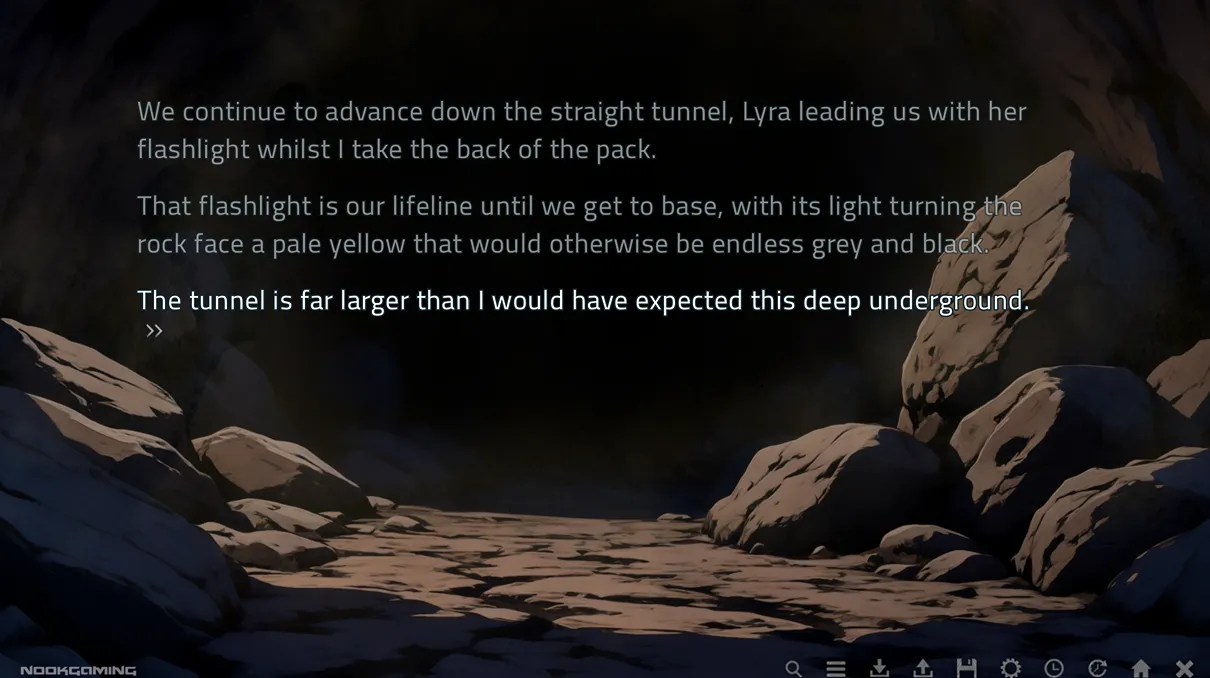
Perhaps the best compliment I can give Advent: Dawn is that I found it difficult to put down. The story wastes no time in ratcheting up the stakes and tension and succeeds in keeping the weight of the situation palpable throughout. Advent: Dawn is a slow burn at first, but makes it work by hitting on the right balance of action, atmosphere, and characterization. After the initial cave-in, claustrophobia and paranoia set in, supported by atmospheric descriptions of the cave and stark examinations of the characters’ situation and mental states. It helps greatly that the prose is sharp and evocative, so even when it gets highly descriptive or introspective, the writing never feels wasteful. There are also moments where other characters open up to Atlas and reveal more about their backgrounds and motivations. There’s enough to them that they feel meaningful, while they avoid falling into excessive flashbacks that sidetrack the main story.
I’m not quite as high on the construction of Advent: Dawn’s central mystery. The story unfolds across five branching routes and culminates in a true route. I found the true route and culmination of the mystery both interesting and satisfying, but the threads of the earlier routes could be too disparate. There are two main facets to the mystery: the culprit behind the ominous messages and the truth behind the cave and expedition. However, it’s unclear until the true route if or how these are connected, and so it’s difficult to contextualize how the discoveries you make in the other routes fit into the bigger picture. I prefer when I feel like each route gives me at least some piece of the puzzle I can slot in immediately as I build toward the big payoff. And speaking of payoff, while the climax is exciting and the ending effective, Advent: Dawn doesn’t quite reach that level of “wow!” at the big reveal that I got from its famous influences. I think it aspires to pack a punch, and admittedly this is a comparison to some of the great multiple route mysteries of the visual novel medium, but it goes back to my previous critique. A reveal pops when the mystery seems inscrutable up until the final piece falls into place, at which point it seems almost obvious. While I enjoyed the direction the last act of Advent: Dawn took, even in retrospect I didn’t think there were many decisive clues that it would go the way it did.
Navigating Advent: Dawn is a breeze thanks to a handy map/flowchart. The route you end up on depends on earning affection points with various characters via several choices in the short common route that opens the story. There’s immediate feedback on the effects of your choices, and the map shows both where the routes branch and gives hints about what is required to unlock each route. Should things not go as planned and you hit a dead end, you can easily jump back to earlier scenes and try again. And framing it as an electronic map of the game is a delightfully immersive way to incorporate this convenient quality of life feature.
A Wolf Among Us?
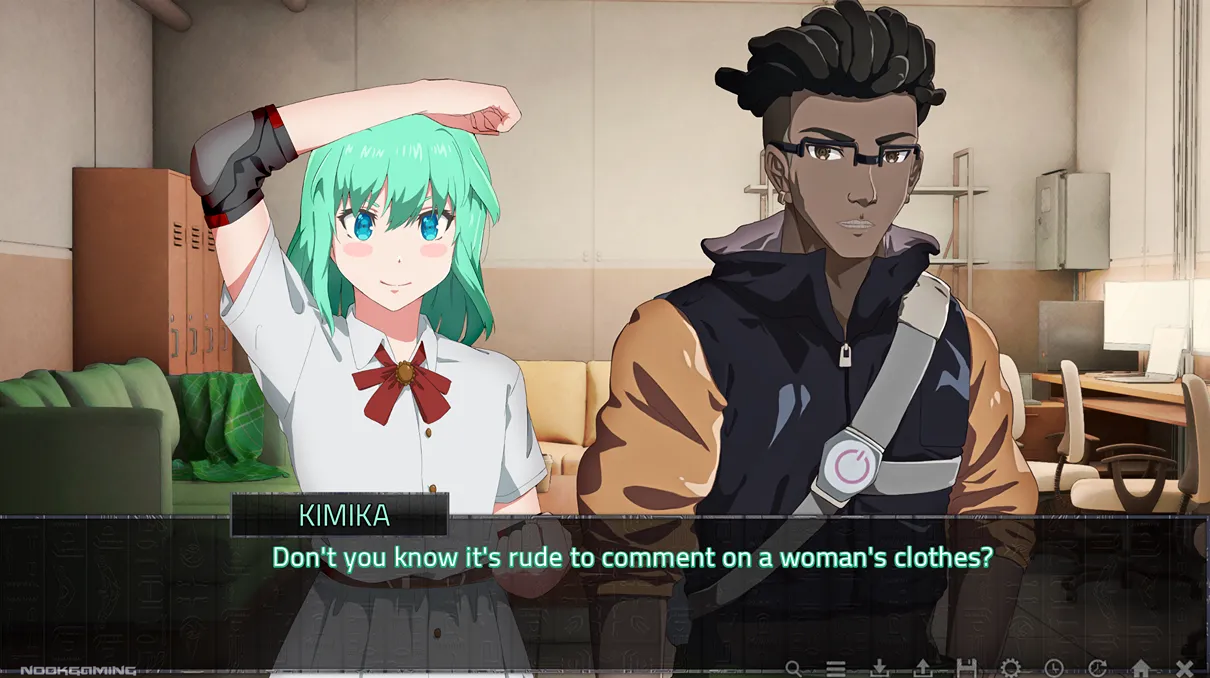
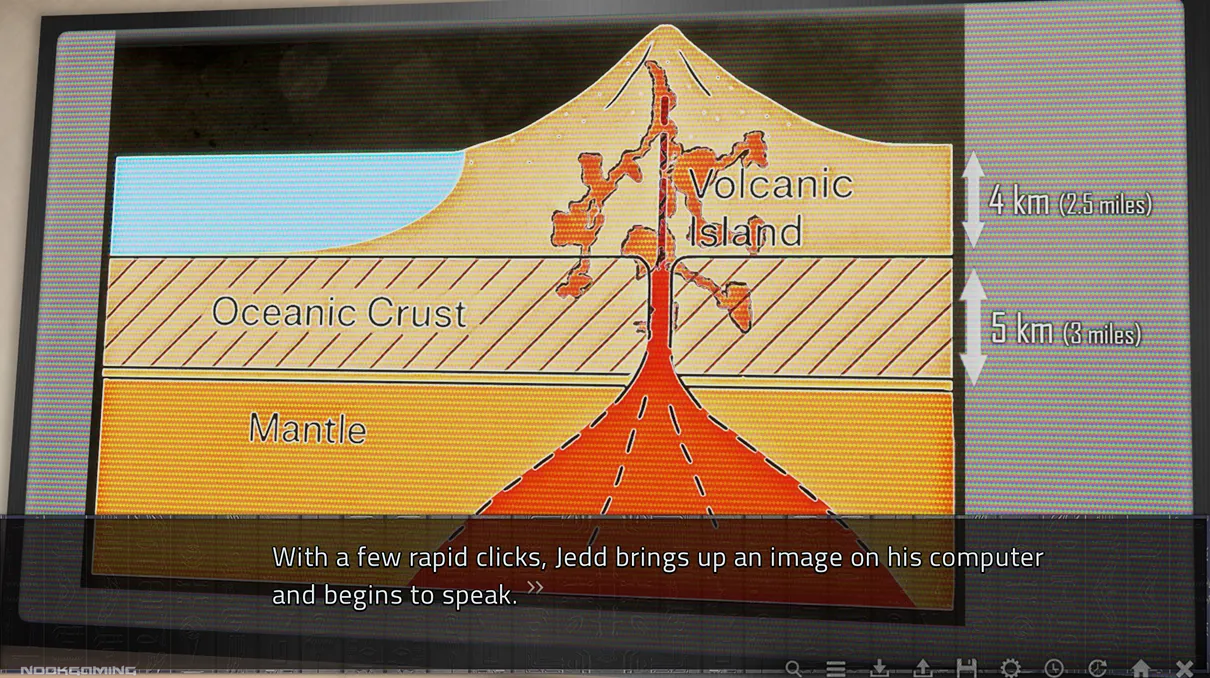
So who are these possibly murderous individuals Atlas finds himself trapped with? There’s his “assistant” Amelia, one he doesn’t remember hiring. His new boss Fabian is exactly the kind of smarmy rich guy you love to see get punched in the face, but does that mean he’s evil? In contrast, his new coworkers, IT pro Lyra and geologist Jedd, seem competent and well-adjusted, though surprisingly young. Lyra is earnest and kind while Jedd has a bit of dad energy. Jedd also brought along an intern named Kimika whose first impression is that of a tropey mascot character. Rounding out the group is Izak, who claims to have lost his memory after a head injury. Given his military clothing and gear, his claim seems rather suspicious.
I overall liked characters, though the female characters are the focuses of the routes and thus receive more development than the male characters. Atlas is a mature and competent protagonist, but also has a touch of youthful rashness and insecurity that makes him relatable. Amelia loves to joke around, but it’s clear there’s something darker beneath the facade. Lyra is positioned as the potential romantic interest. While I found that aspect of her character unconvincing and the romance doesn’t go anywhere, I did enjoy learning more about her quiet resolve. Kimika’s first impression feels like an anime cliche, so I was surprised to find that she became my favorite supporting character in the end. She has a touching backstory and reveals herself to be much more mature and insightful than I initially expected. It’s hard to say much about Izak without spoilers, but he has his role in the story. Meanwhile Jedd gets the short end of the stick. He does have a subplot, but it’s ultimately not that important and he isn’t the focus of any of the routes.
Inner Light
A major reason the characters work is that the writer excels at writing inner conflict. Events are set up so as to pull the characters between different objectives, and rather than cartoonish caricatures the result is characters with the kinds of flaws and contradictions we so often find in our own lives. As a result, the cast largely feel both human and relatable. The mythology of the cave is similarly thoughtful, with characters considering different perspectives and philosophies that might arise from their limited window into the history of this ancient place, and the writing brings this to the fore without becoming mired in infodumps or sophomoric philosophy lectures.
On the other hand, I question Advent: Dawn’s decision to sometimes cut to slice of life scenes with generic anime tropes. I think it’s an intentional choice to include these scenes, and one could argue including them is true to Advent: Dawn’s influences. Who doesn’t (perhaps not so fondly) remember eating chicken sandwiches and playing kick the can with the gang in Ever17? But it’s jarring when Atlas suddenly goes from a mature and thoughtful protagonist with a scientific mind to a dense romcom lead while his erstwhile tough and serious companion acts like a cutesy romcom heroine. Plus, I just don’t think the writer is particularly good at writing generic anime tropes, and so these scenes come off as forced. That the character writing is much stronger when taking things seriously also makes these scenes look worse in comparison.
Art, Sound, and Extras
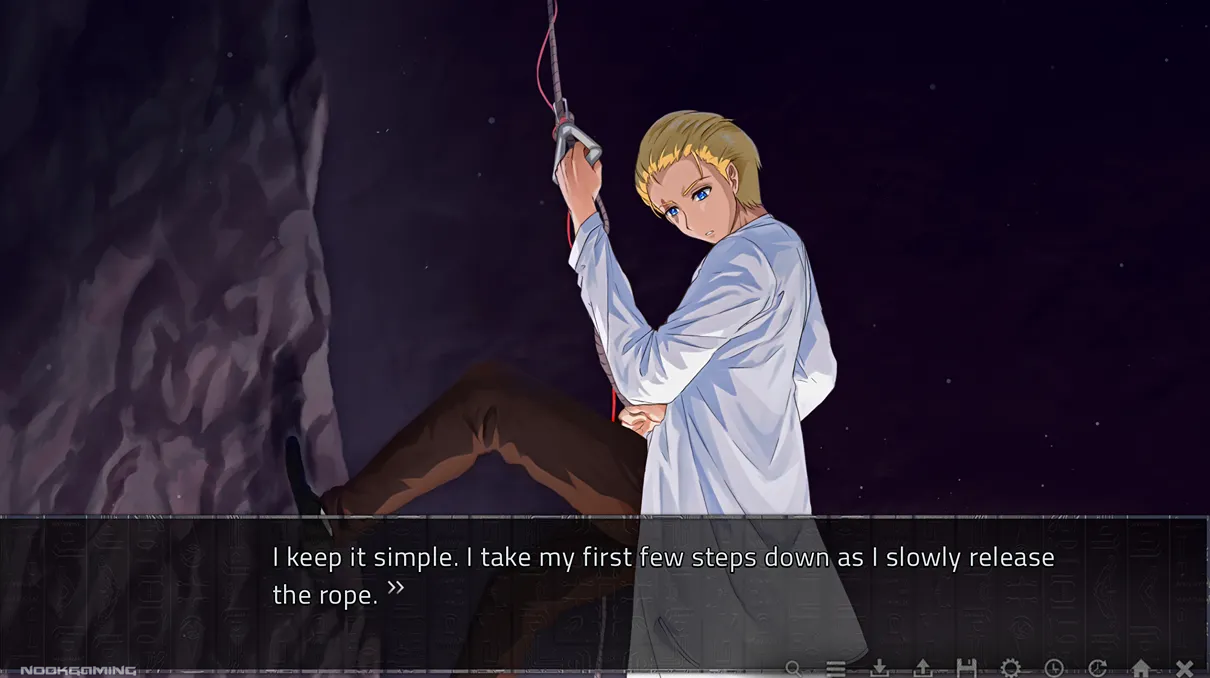
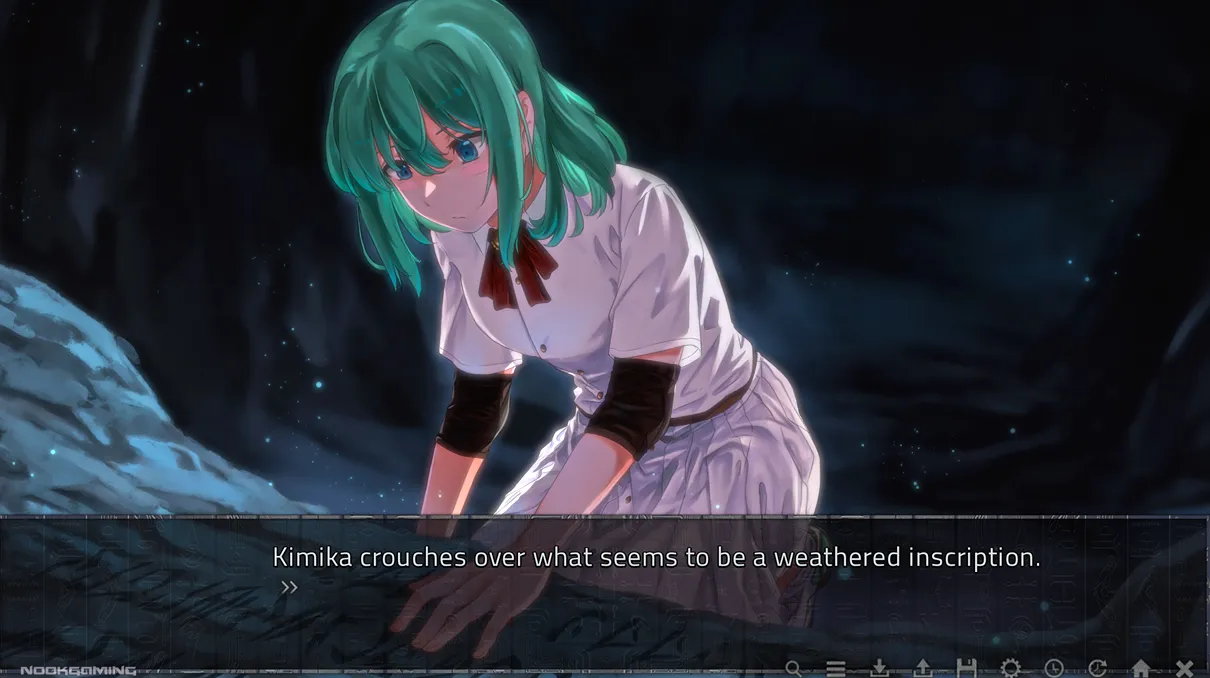
I criticized Spire Games’ previous work SYNESTHESIA for having an inconsistent look, and I was happy to see Advent: Dawn is better in this respect. The character art follows a standard anime aesthetic, but is effective at using build and body shape in addition to hairstyle and color to differentiate characters. While the character art is fine, I was quite impressed by the backgrounds. It would have been easy to set everything against a generic cave background and call it day, but instead different sections of the cave have unique characteristics and details that create distinct atmospheres, while pans and zooms contribute to a sense of momentum and exploration.
Advent: Dawn features partial voiceovers for key scenes. The store page notes that these key scenes are voiced using a combination of voice actors and speech synthesis, but it all sounded rather flat and robotic, and I was unable to distinguish which were the human voices. While it is not very good, you can disable it. Given the financial realities of voice acting for independent visual novels, I can’t really fault Spire Games for choosing to rely on speech synthesis.
The music is a nice mix of ominous and mysterious, though I did find it occasionally to be a little too bombastic to the point where it distracted from the simmering tension. And while there’s not a ton to explore once you’ve finished the main story, earning 100% completion unlocks a secret epilogue that provides additional context to the planned trilogy of which Advent: Dawn is a part.
Verdict
With an exciting story and enjoyable characters, Advent: Dawn is a solid entry into the annals of mystery visual novels. It might not blow your mind, but it’s well worth a read.
ADVENT: DAWN IS RECOMMENDED

If you are looking for another visual novel, you may enjoy A Maiden’s Serenade. We have covered a wide variety of visual novels both original to English and localized from Japanese, which you can check out here.
Thank you to Spire Games for providing a PC review code for Advent: Dawn.
A veteran of Oregon Trail and Battletoads, Wes has been playing and talking about games for as long as he can remember. He’s down to try almost anything, and he especially enjoys games with gripping narrative experiences.