Announced in June of 2025, Lumines Arise is the next installment of the classic puzzle game series Lumines (pronounced like “luminous”). While the series has largely been dormant since its heyday, it looks to return with a bang on Arise’s announced release date of November 11, 2025. The game is brought to you by Enhance and Monstars, the former being the studio founded and headed by Lumines series creator and director Tetsuya Mizuguchi. The game seeks to bring the synesthesia-heavy sensory experience they brought to Tetris Effect over to this square-stacking, music-driven series in style.
Lumines Arise is a title I’ve been quite enthusiastic to talk about. I’ve made no secret that I think block puzzle/tile-matching puzzle games don’t get as much love as I feel they should, and that I want to see more games of this genre come out. So seeing a childhood favorite of mine return with some new ideas and a fresh coat of everything inspires a fair share of glee and excitement in me. A demo for the game has been released, offering a taste of what’s to come in November. The demo will only be available until September 3rd, 2025, so now would be the best time to try it for yourself. As a fan of the originals, I thought I’d share some thoughts about this little teaser.
The New Do
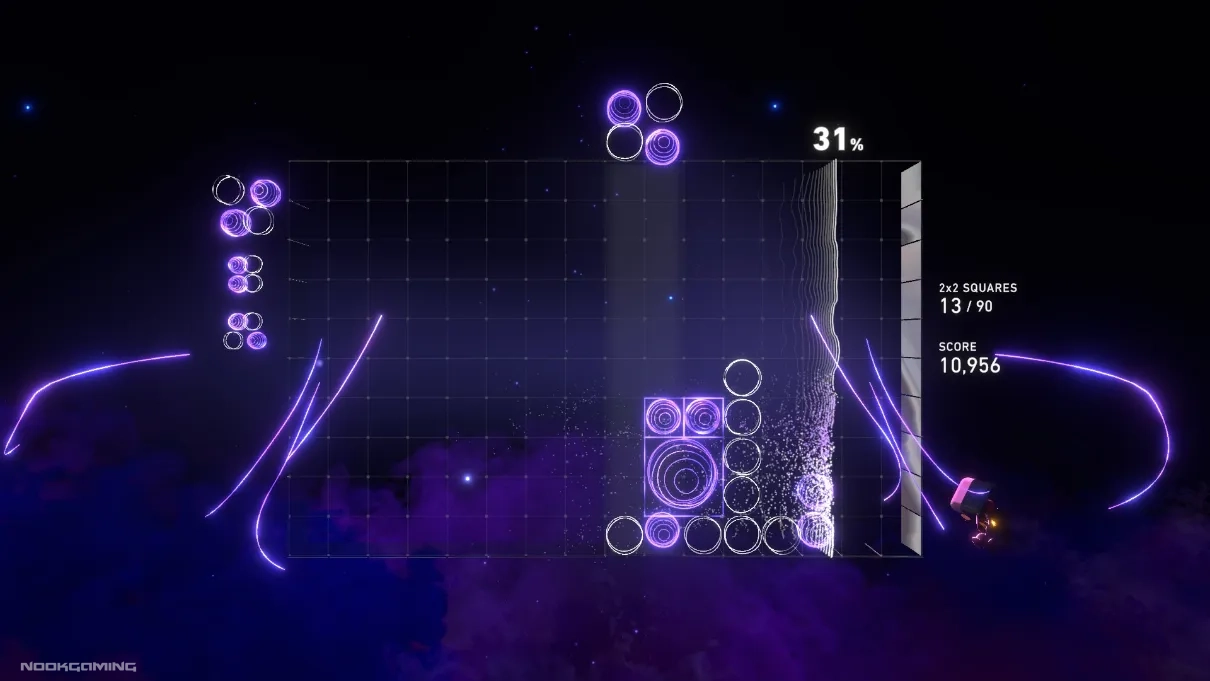
Lumines games have always been driven by their dynamic and flashy color palettes and the way the gameplay syncs with the music. That being said, many of the games look extremely alike. Arise is perhaps the most that any one game in this series has done to actually look and feel truly separate from its predecessors. While the game still feels like Lumines at its core, it’s a lot more…trippy, for lack of a better word. It’s clear that Enhance knew how much the synesthetic approach to Tetris Effect brought to that game’s identity, and Lumines is a perfect fit with how its gameplay is so heavily tied to the pace of the music.
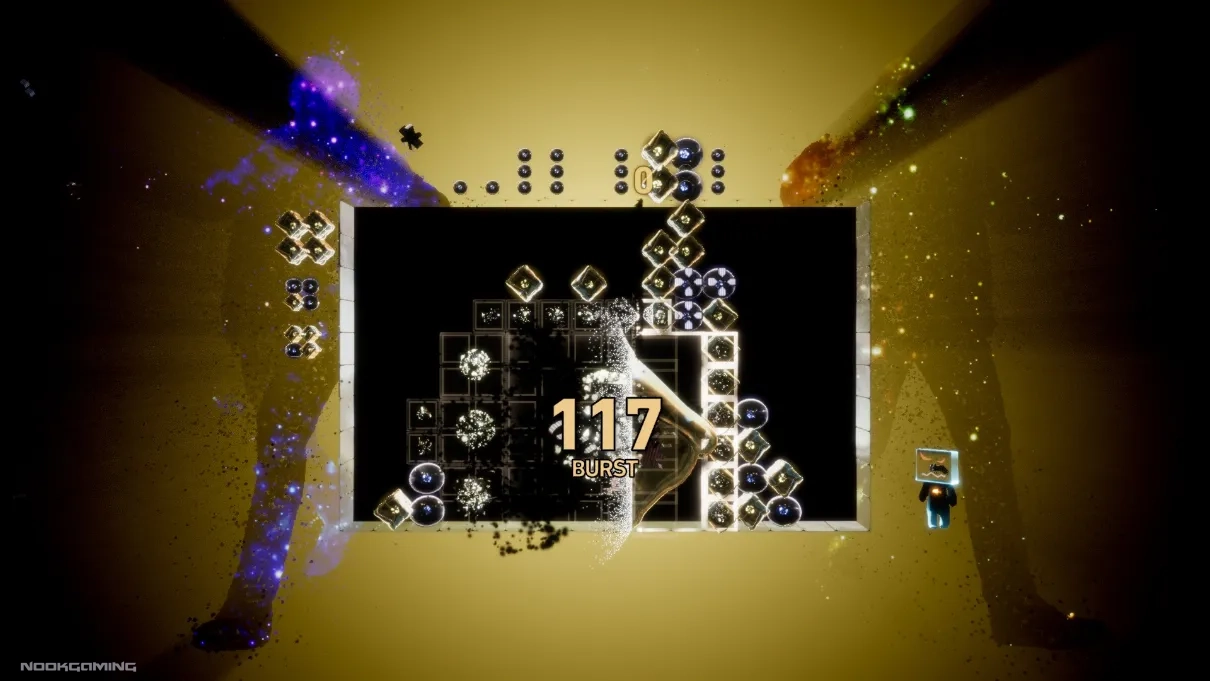
Arise is full of flashy visual effects and plenty of neon in its colors. And while there’s always been dynamic backgrounds, there’s a sort of “virtual reality” abstract aesthetic on top of it all now (fitting given the full game is set to also be compatible with VR). Even the tiles are more dynamic and animated, going beyond just flat squares and circles with a more 3D appearance to the board.
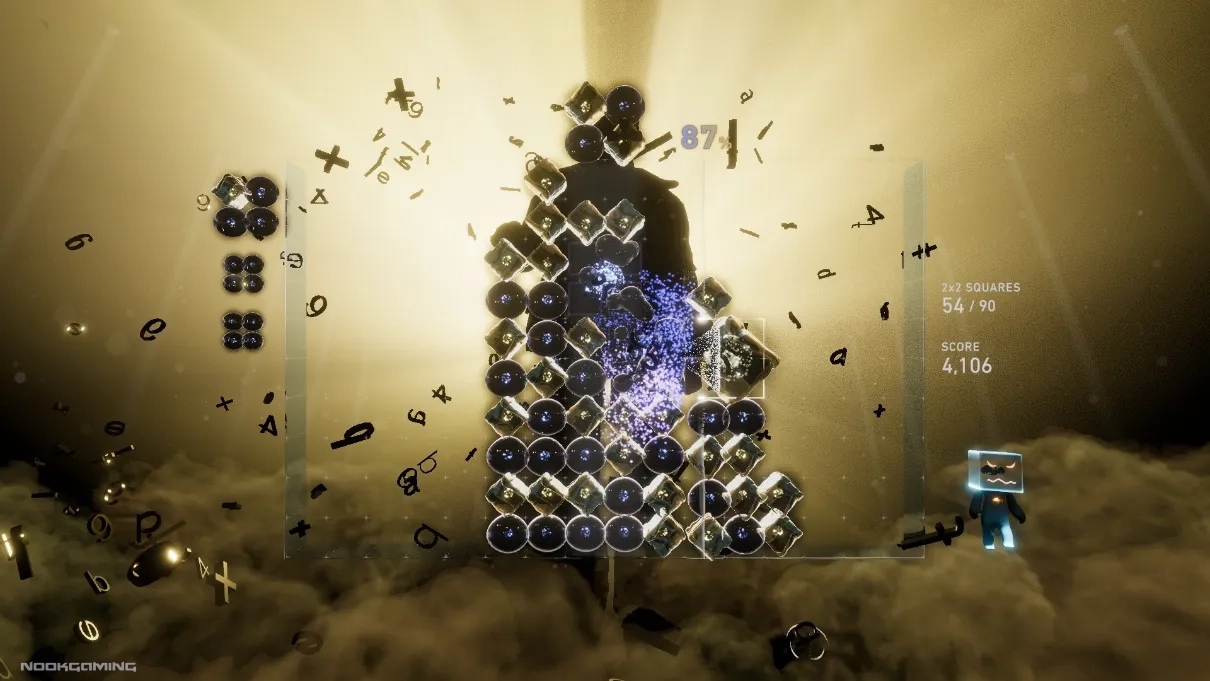
At present, we only have three level palettes (called Skins) in the demo. The new look can take a bit of getting used to for series fans more used to the more brightly colored aesthetic of most Skins that populated older installments. That said, Lumines has never been a stranger to weird color palettes that already take adjusting to anyways, so it’s relatively par for the course. One other notable visual change is how when you form proper squares that the shapes merge into bigger ones rather than just lighting up.
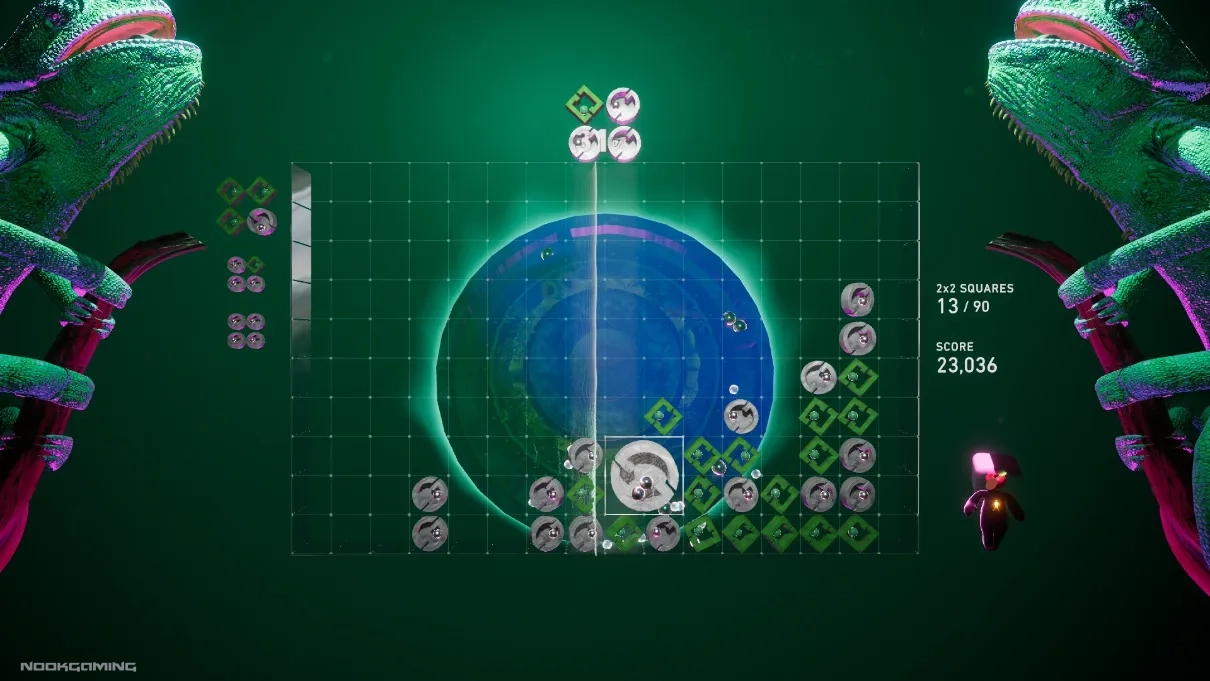
Ordinarily, visual aesthetics are fairly low on my list of priorities for a game, but for an experience designed to immerse you in a “flow state” like Lumines Arise is going for, nailing the visual design is an important aspect. For the most part, I quite like the visual direction of this game. My one complaint has to do with the way the backgrounds sometimes operate; the Chameleon Groove Skin for example has a pair of large chameleons in the background that sometimes move in sync with the music in a way that can be just a touch distracting, something most Skins in Lumines are careful to avoid being. There are a lot of accessibility settings in the options menu that really enhance the experience to set to your own tastes, but even turning all of them down/setting them to “subtle” doesn’t stop all of the potentially distracting animations. It wasn’t enough to cause me to make many mistakes, but it can inhibit that sense of “flow state” to the immersion a tad. Still, whether you play with softer or more aggressive visual effects on, the game is gorgeous, and I came away from the demo hopeful for what’s in store come release.
Bang Bang
The music for Lumines Arise is handled by Hydelic, who previously handled Tetris Effect’s score. There’s a lot of dynamics to the music in this game, with tracks often starting quiet or subdued and building into a crescendo or a drop, as is common for music for these sorts of tracks.
I wouldn’t exactly describe the music here as particularly to my taste, but it fits the vibe of each Skin pretty well, especially with how much more animated the game is on the whole compared to previous installments. As well, in the classic “basic” mode of Lumines it’s always been pretty common to experience a sort of musical whiplash from Skin to Skin due to the variety on display. I get a similar sense that the music for this game will be its own sort of eclectic, something I hope to see more of come release time.
Shaping Up
Being a tile-matching puzzle game of an existing franchise, if you’ve played a Lumines game before, you know about 90% of what to expect.
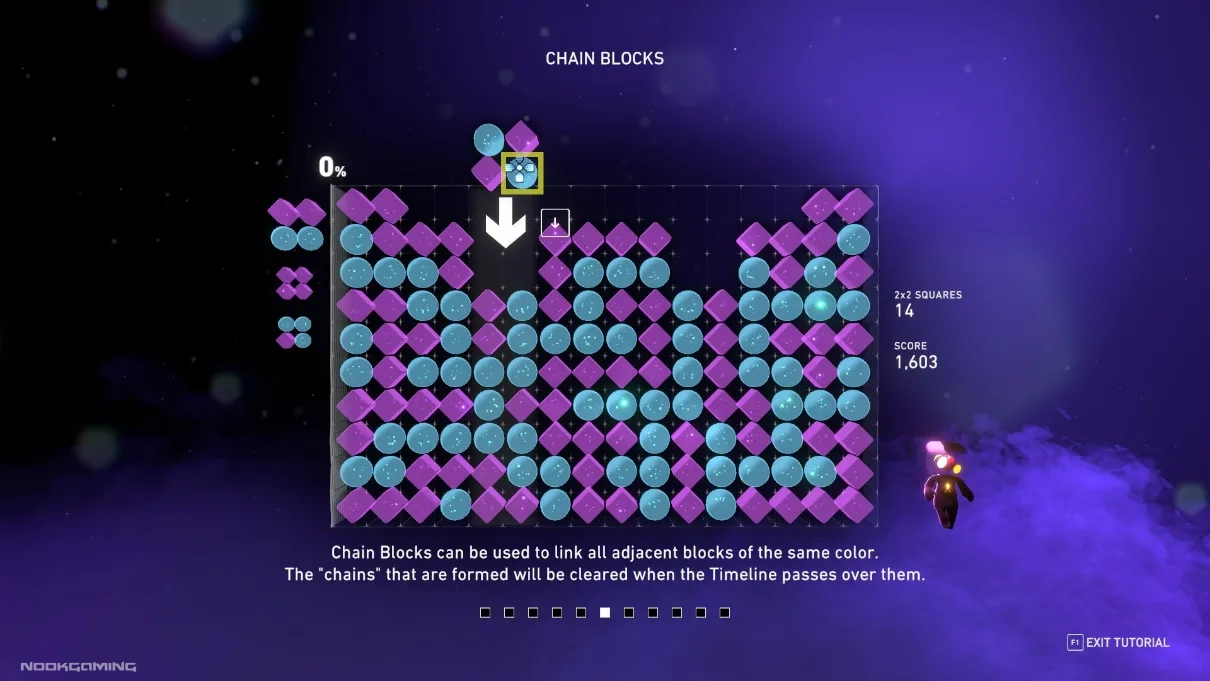
For those unfamiliar with how this series works, you get a (usually) 16×10 board to fill up with dropping pieces. These pieces come in the form of 2×2 squares, each of which will have a random layout of tiles of two colors. You can rotate these clockwise or counter-clockwise and drop them into your board, aiming to quickly create as many 2×2 or bigger squares as you can. At all times, a line called the Timeline is swiping right (set to the pace of the music) and it checks for as many valid 2×2 boxes as it can, clearing them out as it passes by. Part of the trick to the game is that it will read any instances of valid 2×2 boxes of the same color, which means you can build off existing squares to create rectangles (3×2, 3×4, etc.) for valid clears, with bigger bonuses for clearing more each time the timeline makes a full swipe of the board. There are also the special Chain blocks, which have a glowing + shape on them, and when placed they will cause the timeline to clear out every tile of the same color connected to it via chain link, making them quite valuable for tile management and score. Go for high scores, don’t top out, and set up for the big chain reactions; it’s all quite addictive!
The demo has a brief tutorial that walks you through all this pretty well, though like most tile-matching puzzle games, there is a bit of a learning curve in getting the hang of its intricacies and logic. There are also a few settings in the options such as the “No-Stress Lumines” setting if you want a more casual little sandbox to play in with less punishment to get the swing of things.
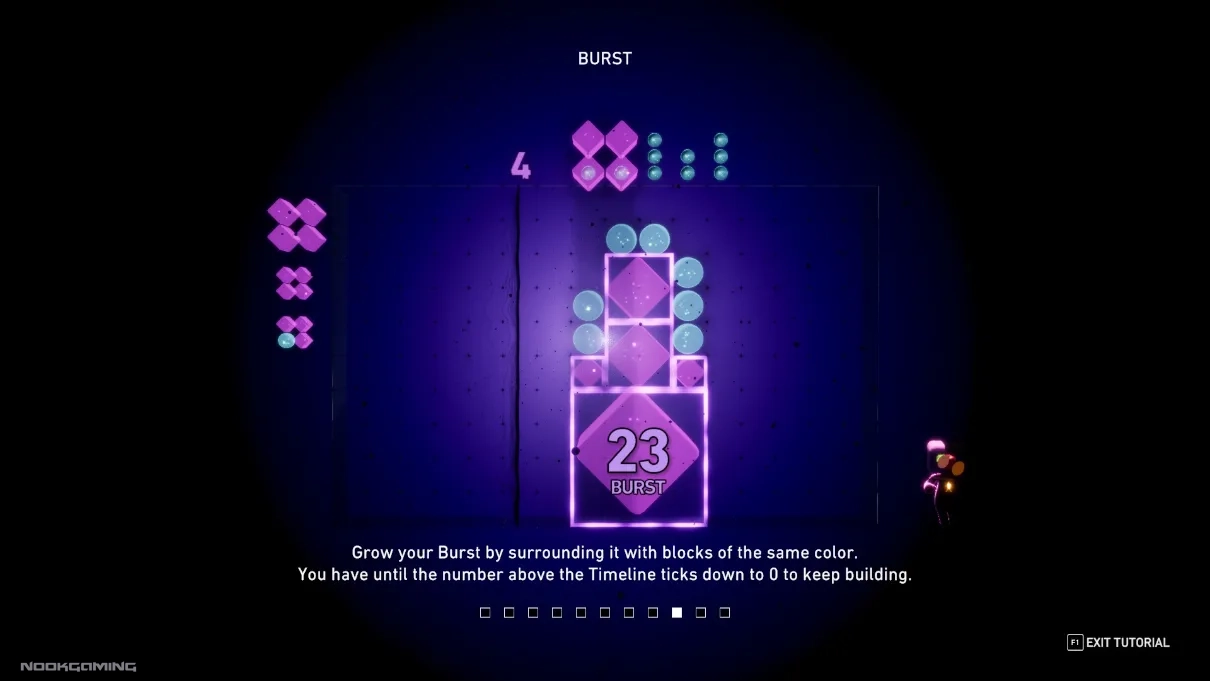
Lumines Arise introduces a mechanic called Burst. As you’re clearing out your squares, you build up a meter placed above the Timeline that you can activate with the press of a button. For a few seconds, the game will enter a sort of “still” state where you can build up a “burst” by combining as many squares of the same color as you can, which knocks tiles of the other color upward to fall back down later (and make squares of their own). This is a way to score big bonuses as well as get yourself out of a jam as you cannot top out while Burst is active. You can activate it once the meter hits 50%, though it lasts longer when maxed out. This is a nice and fresh little feature, one which is quite fun to work with and see how much I can do with. Given the demo is rather easy to clear, I’m eager to see how it fits into the pace of play of faster and more difficult Skins.
What’s On Offer
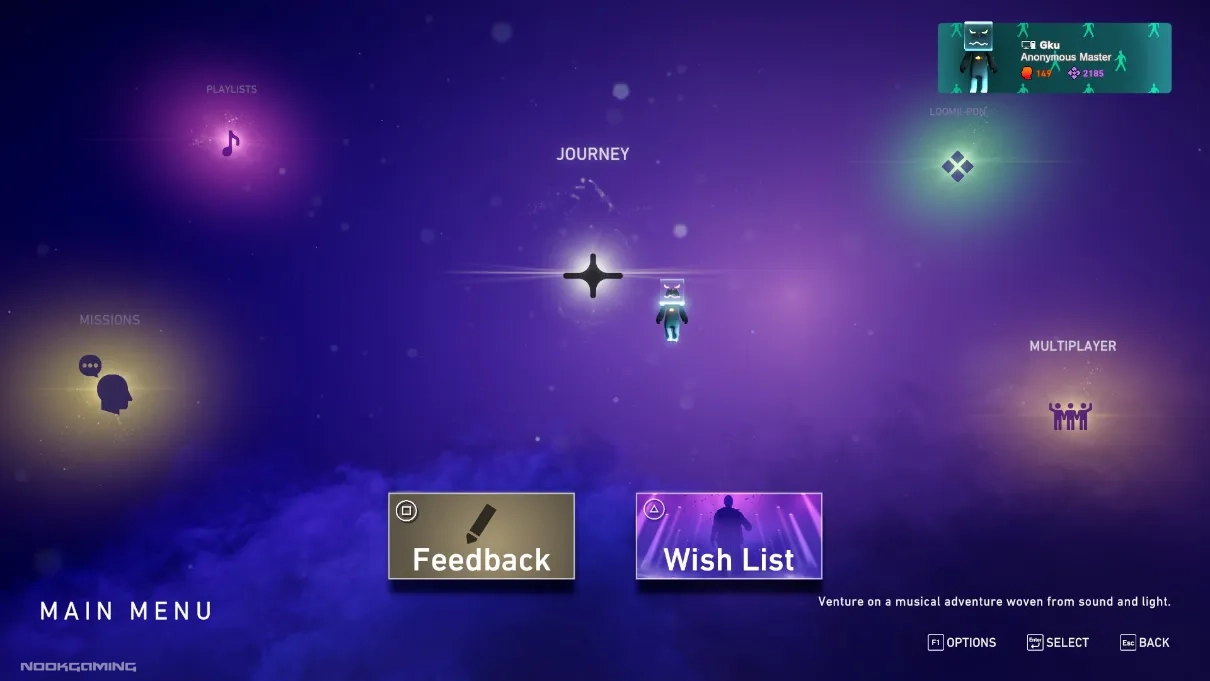
There are currently only two modes available on the demo. Journey is the standard 1-player mode, where you keep playing through a series of Skins. It took me about 7 to 10 minutes to clear the three Skins each time.
My only gripe with this so far is the fact that the game briefly pauses to change from Skin to Skin, as opposed to older games which pretty seamlessly transition from one to the next without interrupting gameplay. I’m hoping there’s a mode or setting come release for a more classic and seamless experience, though this is hardly a dealbreaker for me.
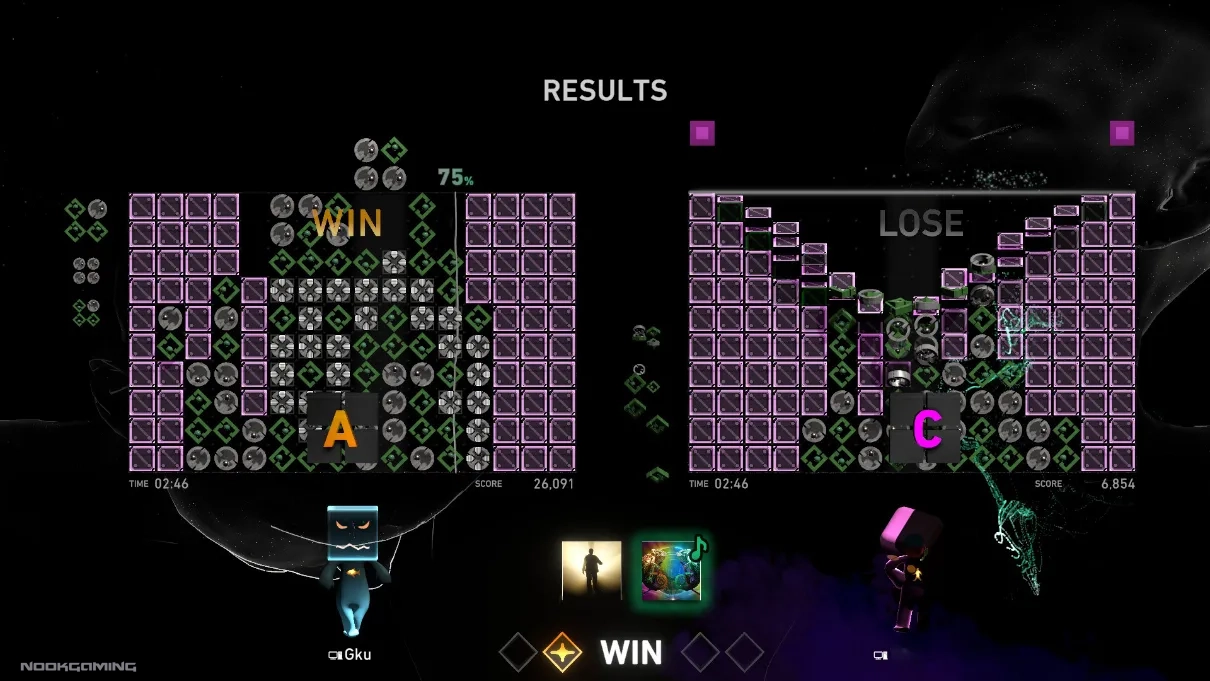
There’s also Burst Battle, which is the game’s online multiplayer mode. You can match up against other players and test your skills. While I had some connection issues at first, these seemed to become less frequent as the day went on. The game will support cross-play between platforms, though you can toggle it to be only against players of the same platform.
Obviously with this being the demo, the skill among the pool of players is inconsistent as many are learning the ropes, while others are seasoned veterans of the series, but I had a decently fun time with it. The way garbage spawns from the sides rather than the bottom or top (as is common for most competitive modes of tile-matching puzzle games) makes trying to keep a clear board quite difficult, and battles feel like they will have a pretty quick pace to them as players get better with Lumines’ mechanics. My skill level isn’t particularly high compared to more dedicated series vets, and I feel like I’m only beginning to scratch the surface of how to play optimally, so multiplayer looks to be a nice little battleground to get better whilst putting one’s skills to the test against others. I’m not sure how much the multiplayer will end up being the game’s selling point come time of release with more modes and Skins to play with, but I’m optimistic here.
Final Impressions
My impressions of the demo for Lumines Arise are pretty positive. While this is only a sampling of the game to come and I wouldn’t quite describe myself as blown away just yet, I’m excited to see this series that I enjoy get an installment for the first time in a while, done in a way that feels like it’s pushing forward with something a bit new. This is but an hors d’oeuvre to whet the appetite for what should be a more filling main course…and brother, I am definitely hungry for more.
LUMINES ARISE IS PROMISING
If you would like to see Puzzle games, you may be interested in our review of Puyo Puyo Tetris 2 or our look at The Enduring Appeal of Tile Matching Puzzle Games (and Why They’re Perhaps Underappreciated).
The writer played this demo on PC.
Been playing games since my papa gave me an NES controller in the early 90’s. I play games of almost all genres, but especially focus role-playing, action, and puzzle-platform games. Also an enjoyer of many niche things ranging from speedrunning to obscure music from all over the world.