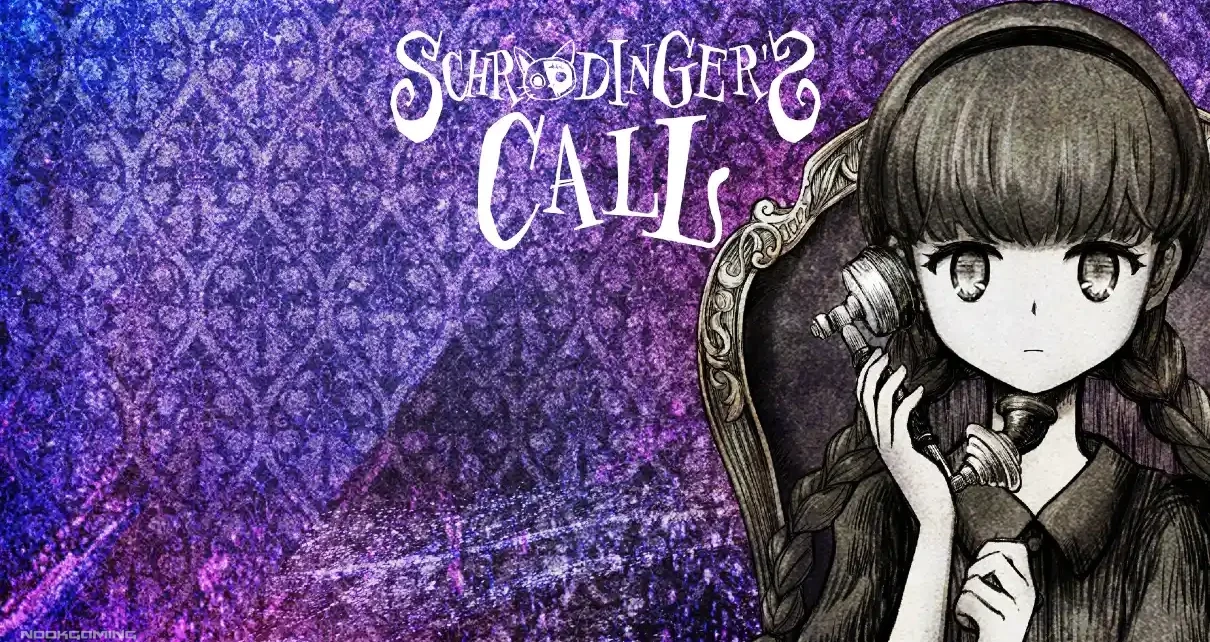
Schrödinger’s Call is the debut visual novel from Japanese indie developer Acrobatic Chirimenjako. Supported by a striking visual style and a 2025 demo, Schrödinger’s Call built a groundswell of excitement, racking up an impressive 100,000 wishlists on Steam. With the full game now available, I was excited to find out what it’s all about.
A Voice in the Void
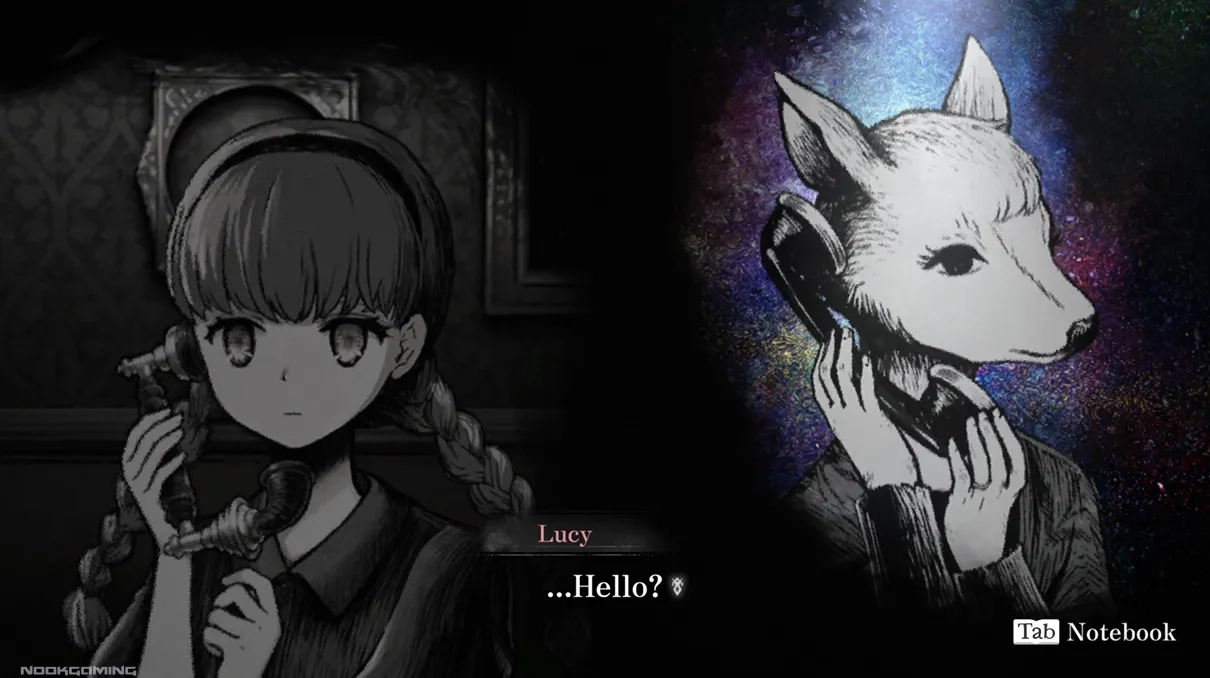
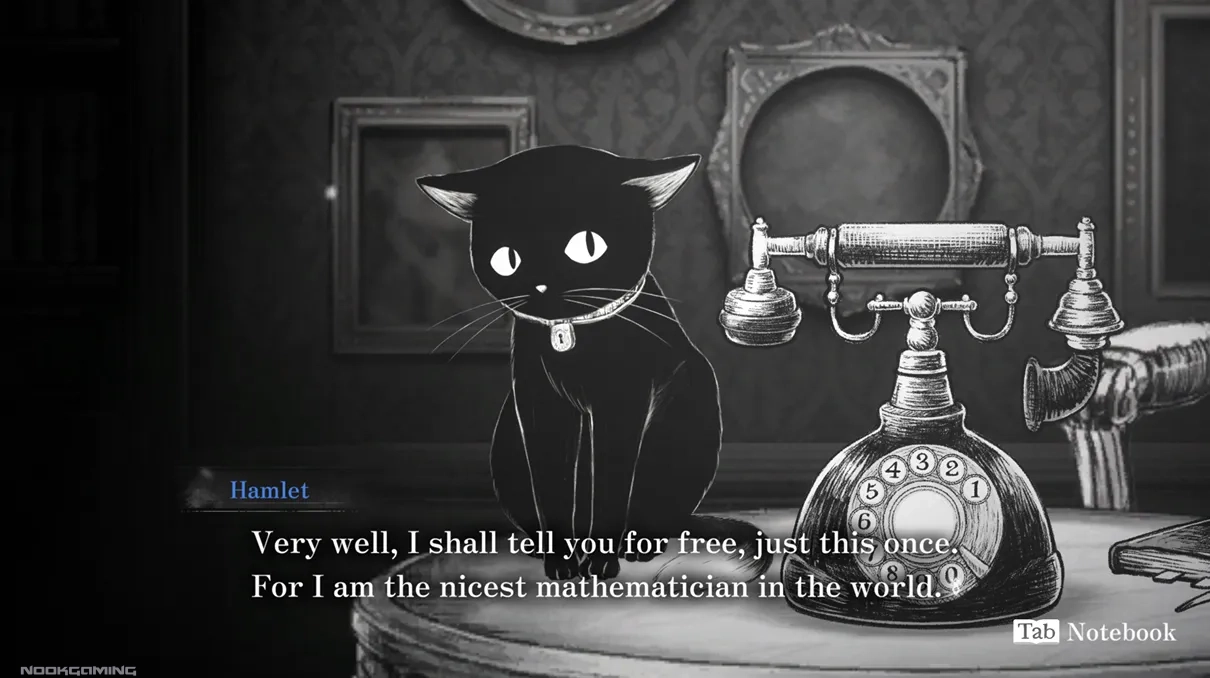
Schrödinger’s Call has an unusual premise. The apocalypse is upon us, as the moon fell from the sky and crashed into Earth. In the 21 nanoseconds before the world ends, a girl named Mary takes up the mantle of the world’s last confidant. Seated in a small room next to an unusual phone, her task is to speak with spirits tied down by regrets and unable to accept the end, and ultimately to save them. Mary remembers nothing from before waking up in the room, not even her name. A mercurial cat calling itself Hamlet fills Mary in on these strange details. He also tells Mary that her role as the world’s last confidant is the key to regaining her memories. It’s a lot to swallow, but seeing no alternative, Mary decides to press on.
The story is divided into five chapters, each centered on a particular spirit and their unfinished call. Fittingly, each spirit was on the phone the moment the moon fell, desperate to reach out and connect, but cut off by the sudden apocalypse, leaving things unsettled. However, the spirits’ memories are fuzzy and muddled. Only an idea or emotion ties them to Mary, one that solidifies into a mantra and allows the spirit to take shape. “We share the same grief” they cry out to her. Hamlet tells Mary that to save the spirits, she must listen, empathize, and ultimately help them move past their unfinished calls.
Playing Telephone
Each chapter follows a similar structure. After meeting the spirit and witnessing their unfinished call, Mary takes on the role of investigator. To help the spirit recover their memories, she speaks to spirits related to their story, called third parties by Hamlet, and records what she learns in her journal. As the only one able to communicate with spirits in the last moments before the apocalypse, Mary carries the conversation back and forth across parties until the original spirit is ready to face the trauma underlying their unfinished call. In helping the spirits confront their grief, Mary begins to recover her memories through the experience of the grief shared with the spirit.
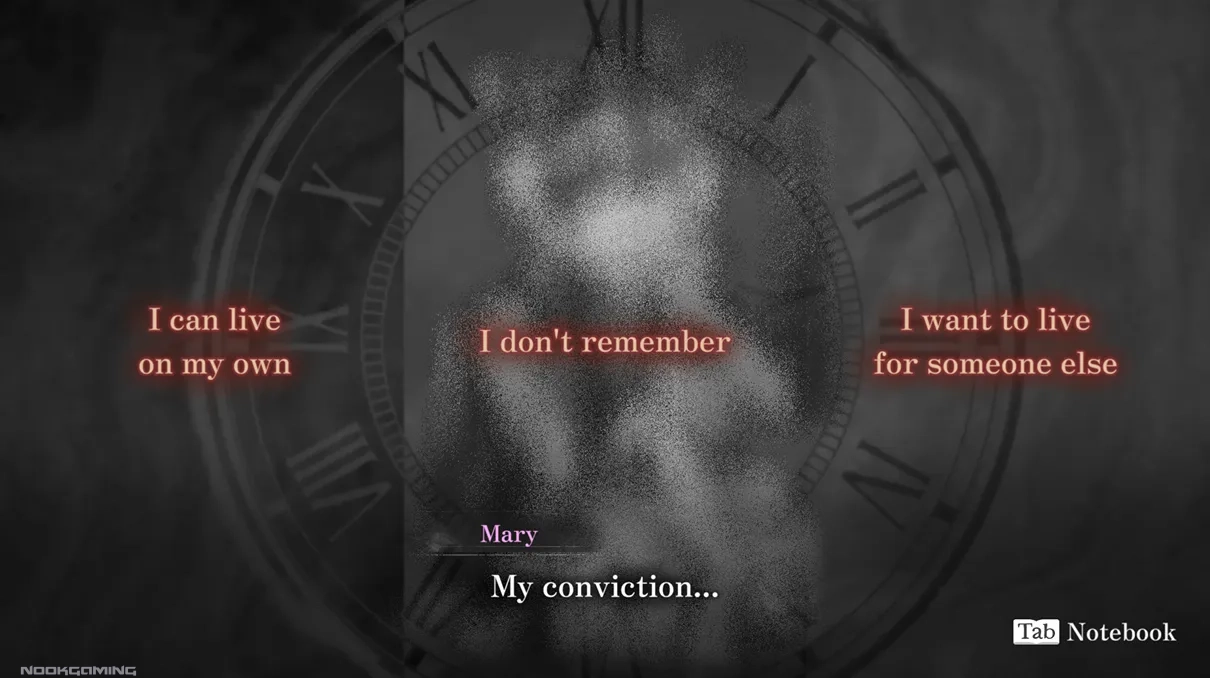
The gameplay underlying Schrödinger’s Call is simple. Some tasks like answering the phone or dialing spirits exist to aid in the immersion. You also occasionally choose Mary’s responses during conversations in typical visual novel fashion. The gamiest parts of the experience are some very light puzzles. Sometimes, in order to progress, you need to highlight the appropriate piece of information in Mary’s journal, and during the climactic confrontation with the trauma underlying the unfinished call, you must guide Mary to empathize with the spirit by choosing the correct responses. While it’s possible to make incorrect choices, Schrödinger’s Call is ultimately a linear game, and so the only consequence is that you have to try again. I thought the keeping interactive elements simple mostly worked as a way to highlight some of the story’s themes and build immersion, although some of the journal choices are so blatantly obvious (and even spelled out by Mary’s inner monologue in case you somehow needed a “hint”) that they seem to exist for the sake of giving the player something to do rather than creating any kind of challenge.
Dial S for Spirit
While each spirit’s chapter has a well-constructed narrative and emotional arc, the story and characters are rather simplistic. The main spirits have emotional stories that tug on the heartstrings, but they’re straightforward and without much nuance. Meanwhile, the third parties initially make a splash with exaggerated personalities and mannerisms, but are ultimately one-note characters. Though it’s not always noticeable, I found the middle chapters could drag at times once the novelty of the setting and structure wore off. Nor is this aided by certain characters’ verbosity and Schrödinger’s Call’s tendency to repeatedly show flashbacks of scenes or lines you just saw. Later chapters attempt to add more complexity by incorporating small mysteries and incongruities to the stories, but it didn’t fully make up for the lack of depth elsewhere.
The final chapter is different, focusing on the truth behind Mary’s lost memories. Without going into spoilers, it takes the story in an interesting direction, one hinted at by the preceding chapters but with a few surprises that would be difficult to guess in advance. The mystery is engaging, and more importantly, thematically consistent. I could see how the ideas of the preceding chapter built the scaffolding on which Mary’s story could stand. It was also rewarding to finally see Mary come into her own as a character and how her past shaped her actions. I found the final resolution to Mary’s story bold in its choice to focus on the emotional core and themes the narrative spent the previous chapters building, but also fitting: cathartic and moving while leaving the reader with plenty to ponder.
A Synesthetic Symphony
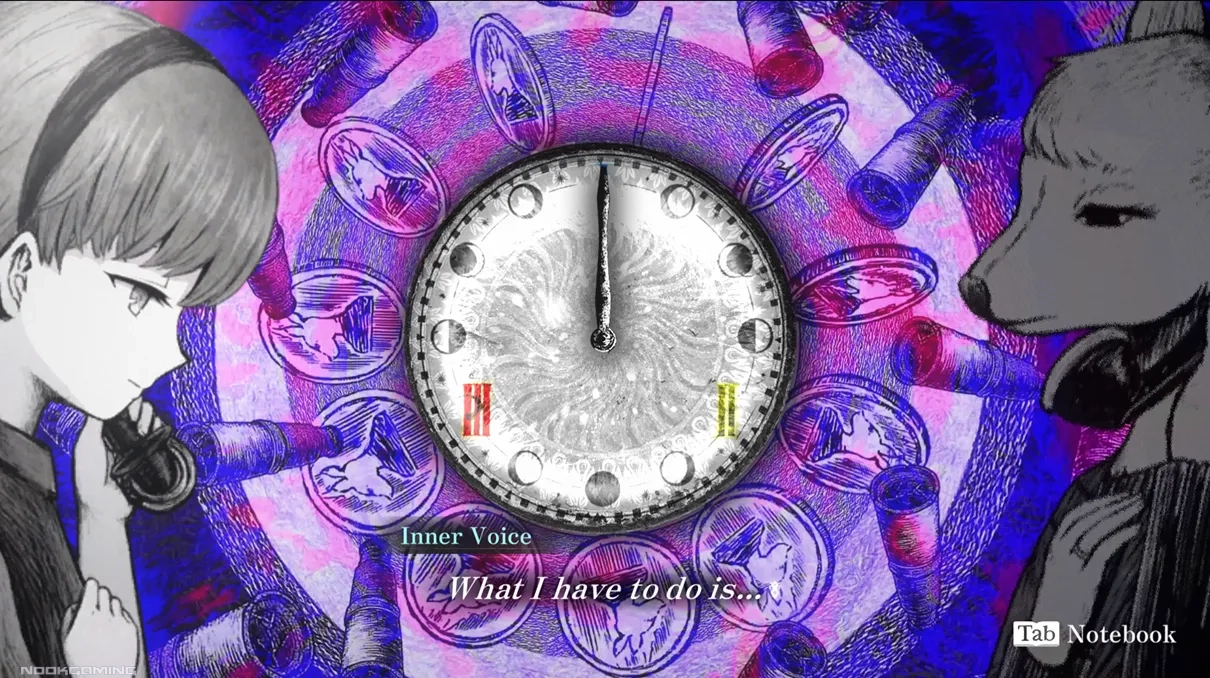
A simple story can be elevated by storytelling and presentation, and it’s here that Schrödinger’s Call shines the brightest. There’s simply so much life in every detail that it’s impossible not to get swept up in the experience. The art, which draws from anime, sketching, noir, and gothic, is striking and beautiful. It’s also dynamic, shifting and flowing with the mood of the narrative. Picking up the telephone, starkly illuminated against a black void, and watching wisps of light coalesce into a spirit when Mary greets them evokes a feeling of breathing life into a barren world. Watching Mary fill her journal with notes and drawings subtly shows the kind of person she is, even when her dialogue remains simple and her past is shrouded in mystery. Imagery in climactic scenes like spinning clocks or even abstract shapes creates a sense of urgency and the violence of something deeply buried welling up to the surface. It’s incredibly impressive that an indie visual novel like Schrödinger’s Call is one of the most visually spectacular I’ve played, taking full advantage of its medium in a way that few visual novels even aspire to.
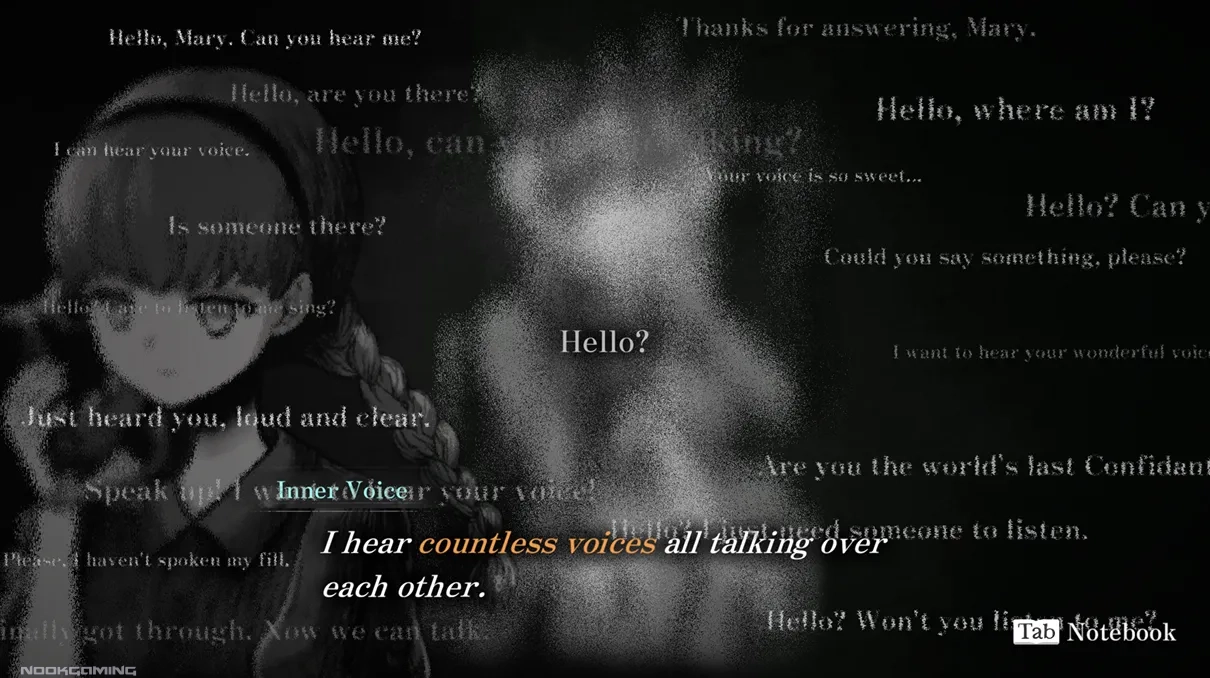
The sound and music are equally stunning. The sound adds a dimension that feels almost tactile. Effects like the whir of the rotary phone as Mary dials, the decisive snap when locking in a choice, the shattering of glass when one scene collapses into another make the simple gameplay feel weighty and engaging. While there’s no voice acting, characters speak in a distorted and muffled babble akin to Simlish or Animalese. It adds a surprising amount of personality to the scenes and characters. The cacophony of countless voices calling out to Mary from the void draws a stark contrast to the sincere and inquisitive cadence of a young playwright. Mary’s voice is meek yet also fittingly empathic or perhaps resigned and plaintive.
Unfinished calls are set to a haunting leitmotif that evokes longing and mystery. The theme returns and evolves, increasing in intensity and emotion as difficult truths and emotional trauma come into focus, and is part of the reason the emotional climaxes feel powerful. There’s good variety in the music too, from the lonely piano meditations that accompany Mary’s lonely room to character themes ranging from stately to upbeat to silly. Even when the music is sparse and simple or in some cases there is no music, it’s an apt accompaniment to the scene and mood.
Heart to Heart
Another reason that Schrödinger’s Call’s story is simple yet effective is that it highlights interesting themes. Schrödinger’s cat is something of a trope in visual novels, often brought up in support of science fiction infodump or philosophical diatribe. Fortunately, Schrödinger’s Call is more artful in its exploration of its themes, both because it focuses less on the hard details and treats the reader with respect. Schrödinger’s Call is not subtle about things. In fact, Hamlet explicitly references some of the ideas underlying the themes. But it’s effective because Schrödinger’s Call doesn’t simply lecture you about philosophy and call it a day. The themes are intricately woven throughout both the spirits’ and Mary’s story, and the narrative trusts you to think for yourself. The overt references are a genuine invitation to engage with Schrödinger’s Call’s ideas rather than hamfisted grandstanding or a misguided attempt to appear intellectual.
As the title suggests, one theme is superposition: the idea that multiple different states of reality can exist simultaneously, until an observer decides how to define the situation. That Schrödinger’s Call is a visual novel with many choices yet a linear story plays into this idea. For example, at the start of each chapter, Mary must choose one of two convictions. No matter which one you choose, you meet the same spirit with the same story, but perhaps that’s the point. It’s possible to view the spirit’s and ultimately Mary’s story from either perspective. It’s up to the observer, in this case the player, to decide which perspective to take, and even if this choice can’t materially affect the events of the story, how you think and feel about these events is still meaningful. The climaxes of each chapter reflect this theme as well. Acceptance and moving on are informed by perspective: what one decides is important and what meaning one assigns to one’s life.
The other major theme is the value of empathy. Hamlet repeatedly tells Mary that the past cannot be changed; the apocalypse is here and the world has reached its end. Saving others is not a matter of heroics but of kindness. With each spirit, Mary finds someone who is lost, disconnected, and unloved, and whose last attempt to connect went unresolved. What she can offer them is the comfort of knowing that there is at least one person in the universe who will listen, empathize, and hope for their final dream to be realized. It’s this act of love from a stranger, accepting and supporting them as they are, that allows the spirits to be saved. I find it an apt lesson for our world. When we encounter someone suffering, we often become so focused on engineering some tangible solution that we forget that sometimes what the person really wants is to be seen and heard, acknowledged as they are, especially because some problems have no attainable solution.
Verdict
Schrödinger’s Call tells a simple yet profound story with breathtaking beauty, thoughtful meditation on its themes, and a full heart; it’s well worth experiencing for yourself.
SCHRÖDINGER’S CALL IS HIGHLY RECOMMENDED

If you are looking for another visual novel, you may enjoy NICE TO MEET YOU, AGAIN. We have covered a wide variety of visual novels both original to English and localized from Japanese, which you can check out here.
Thank you to Shueisha Games for providing a PC review code for Schrödinger’s Call.
A veteran of Oregon Trail and Battletoads, Wes has been playing and talking about games for as long as he can remember. He’s down to try almost anything, and he especially enjoys games with gripping narrative experiences.