I’ll admit I knew very little about Sandfall Interactive’s Clair Obscur: Expedition 33 when it first released. These days, it’s hard to find the time to play a full length RPG, and so it needs to be something special to catch my attention. But then the whispers started: that Clair Obscur was just that, something special. I decided to give it a shot, and it turned out to be a great call. Not only was Clair Obscur something special, it’s the exceptionally rare game that felt exciting, powerful, and invigorating. Or to put it another way, it’s one of the best RPGs I’ve ever played.
A Candle in Shadow
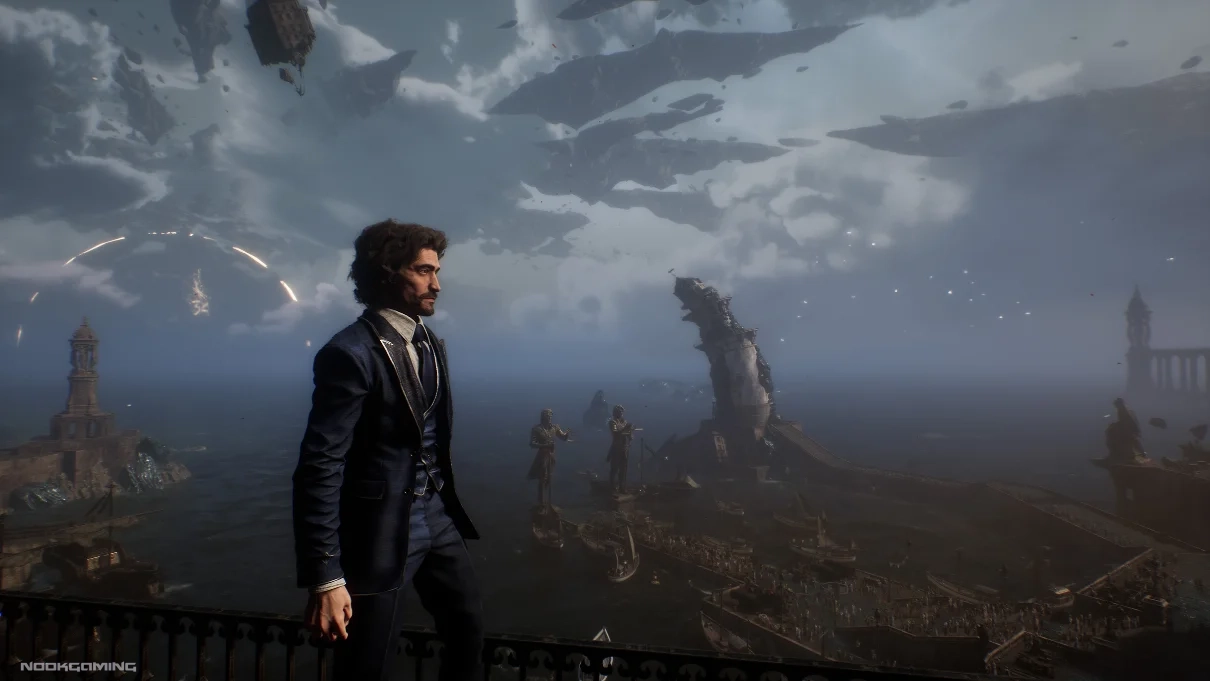
Our story begins in Lumiere, a charming Belle Epoch metropolis whose grand boulevards are dotted with cafes and florists. You’d think it the perfect idyll, if not for the obelisk looming ominously across the stormy sea, emblazoned with a massive 34. For this is the curse of Lumiere: the Gommage. Each year the Paintress across the sea rises to paint a new number one less, and simultaneously every Lumierian above that age vanishes into nothingness. Of course, the people of Lumiere do not idly accept their fate. Each year, an expedition sets out across the sea to vanquish the Paintress and put a stop to the Gommage permanently. Thus far none has succeeded, or even returned, but what other hope is there? Clair Obscur is the story of Expedition 33, of their quest, and of the truth of this strange world.
Clair Obscur builds its world without lore dumps and tedious expository monologues. Everything I stated above is conveyed organically through a short prologue set on the night of year 34’s Gommage. You see immediately how the all-consuming shadow of the Gommage falls over Lumiere, and the different ways the inhabitants respond. Parents make arrangements for their soon to be orphaned children while those destined for next year’s Gommage debate whether to join the expedition and fight to change their fate or treasure one last year with their friends and family. Protagonist Gustave has his personal entanglements with Gommage too. His enthusiasm for the expeditions and his hope “for those who come after” both motivate him and put him at odds with those who think differently, and he moves between tenacious confidence in Lumiere’s future and tentative regret over what his choices have already and might continue to cost him.
Into the Breach
Come morning, Expedition 33 sets sail to the mainland, into the unknown. The story is absolutely incredible, among the very best I’ve experienced in my years of gaming, and I don’t want to spoil a single one of its mysteries. It’s both ambitious and personal, fantastical and full of humanity. Clair Obscur: Expedition 33 isn’t afraid to demand of the player, whether through cruel choices, nuanced characters and storytelling, or meaning hidden in symbolism. But that doesn’t mean there aren’t moments of humor, joy, and fun too. It’s a wonderful expression of the multitudes contained within people and the ways people can be unexpected and even contradictory. The direction the story ultimately takes asks challenging questions about how to confront grief and hopelessness as well as what we owe to “those who come after.” And I love that Clair Obscur doesn’t offer easy answers. In fact, director Guillaume Broche is on record stating the studio didn’t even agree internally on what to think of the endings. They certainly left me and, if the internet message boards are anything to go by, many others with a lot to reflect on.
Clair Obscur: Expedition 33 also clearly comes from a place of love toward the long tradition of JRPGs, and has the perfect dash of JRPG magic. Something I associate with JRPGs is being a little weird and silly. Think Cloud crossdressing in Final Fantasy VII Remake or a certain phallic foe in Shin Megami Tensei and Persona. It’s that bit of unexpected goofiness in an otherwise serious game that gives things a sense of whimsy and adventure. Here, you’ll meet fantastic creatures with strange mannerisms and cultures that bring Lumiere and the world beyond to life and provide a breather from the undercurrent of horror and the emotional damage that Clair Obscur’s big climaxes inflict. And yet it never feels unnatural or like forced comedy for the sake of comedy. Clair Obscur ultimately offers a sensible in-universe explanation for the way things are, and more importantly, the vibes fit. There’s a reason that Esquie, a gentle giant with the outward personality of a kindergartener, became a fan favorite and manages to deliver some emotionally weighty lines in a way that only he can.
Despite the various influences and homages, Clair Obscur’s story feels like a revelation. When I think of what makes the storytelling of my favorite RPGs great, like the epic hero’s journey of Final Fantasy VII or the nuanced worldbuilding and politics of Dragon Age: Origins, certainly Clair Obscur has aspects of these things, yet it also feels somehow different. This is ultimately because I found in Clair Obscur a level of intimacy I don’t often find in stories. One level is the characters and the ways they’re allowed to be complex and messy, but it goes deeper. Stories can be written to entertain or to make some point, and certainly there’s nothing wrong with these goals, but Clair Obscur has something that affected me in a way that goes beyond these. It’s difficult to pin down, and subjective of course. I think it goes back to the way Clair Obscur engages with powerful emotional topics in an open ended way while simultaneously highlighting how, at least in our hearts, fiction can be just as powerful as “real” things, and that our relationship with art is an important part of our lives.
And this World, a Mirror
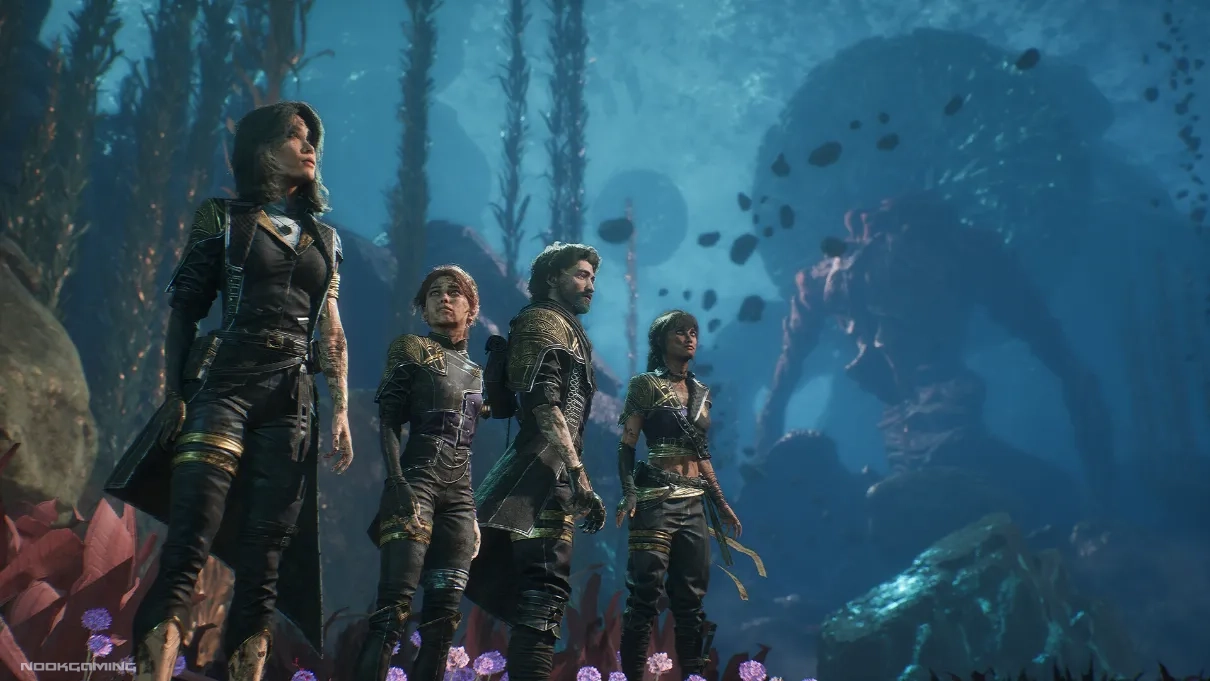
The story wouldn’t be possible without strong characters, and Clair Obscur: Expedition 33 shines here as well. Gustav’s first companion is his adopted sister/daughter Maelle, who joined Expedition 33 despite only being 16. Maelle, whose parents died when she was young, explains she never felt at home in Lumiere, and Maelle brings a teenager’s impulsiveness and struggle for identity to a world where there’s no time to grow up. Next up, Lune was strictly trained by her parents from birth to be the perfect tool for the expedition. Like Gustave, Lune is determined, but she’s not a machine, and you see the excitement that discovery brings her curious mind as well as her empathy and compassion. And then there’s the enigmatic Sciel. Despite joining Expedition 33, Sciel is very much one to live in the moment, something of an inherent contradiction given she could have chosen to enjoy one more peaceful year in Lumiere.
Like its story, Clair Obscur: Expedition 33’s characters are incredible. When playing narrative games and RPGs in particular, I often feel like I’m experiencing a story about stock anime characters or heroes of myth and legend. Certainly there’s an appeal to those types of stories, but I love how, in contrast, Clair Obscur’s characters feel very human. It’s a testament to the outstanding writing, dialogue, and voice acting that I can watch these characters make hypocritical and self-destructive choices but completely understand why, and even think that I might have done the same in their shoes. And yet, these same characters also have moments of courage, compassion, and love that are powerful precisely because they are not great heroes of destiny, just people doing the best they can. By the end of Clair Obscur, I was so invested in the characters and their journey that when the credits finally rolled, I had to put the controller down and process the emotional catharsis of the final act.
Going back to the voice acting, I honestly can’t praise the voice acting enough. The cast is full of heavy hitters, highlighted by names like Andy Serkis, Charlie Cox, Ben Starr, and Jennifer English, but everyone is excellent and the direction is top notch. Conversations between characters are just that: conversations with give and take that feel like two people talking with rather than at each other, complemented by both voice and motion capture performances that convey a full range of nuance and emotion. As game acting continues to move from its humble beginnings of characters shouting stilted exposition at each other to something with craft and artistry to rival screen and stage, it’s games like Clair Obscur that are leading the charge.
Parry Party
Clair Obscur: Expedition 33’s story is so good that it alone would make the game well worth playing. That said, the gameplay itself is also plenty substantial. The basics will feel familiar to anyone who’s played an RPG: travel the map, fight monsters, beat the boss. And again, it’s straightforward to see Clair Obscur’s influences and inspirations. But like with its story, Clair Obscur manages to take these influences and deftly meld them into something that feels coherent, intentional, and fresh.
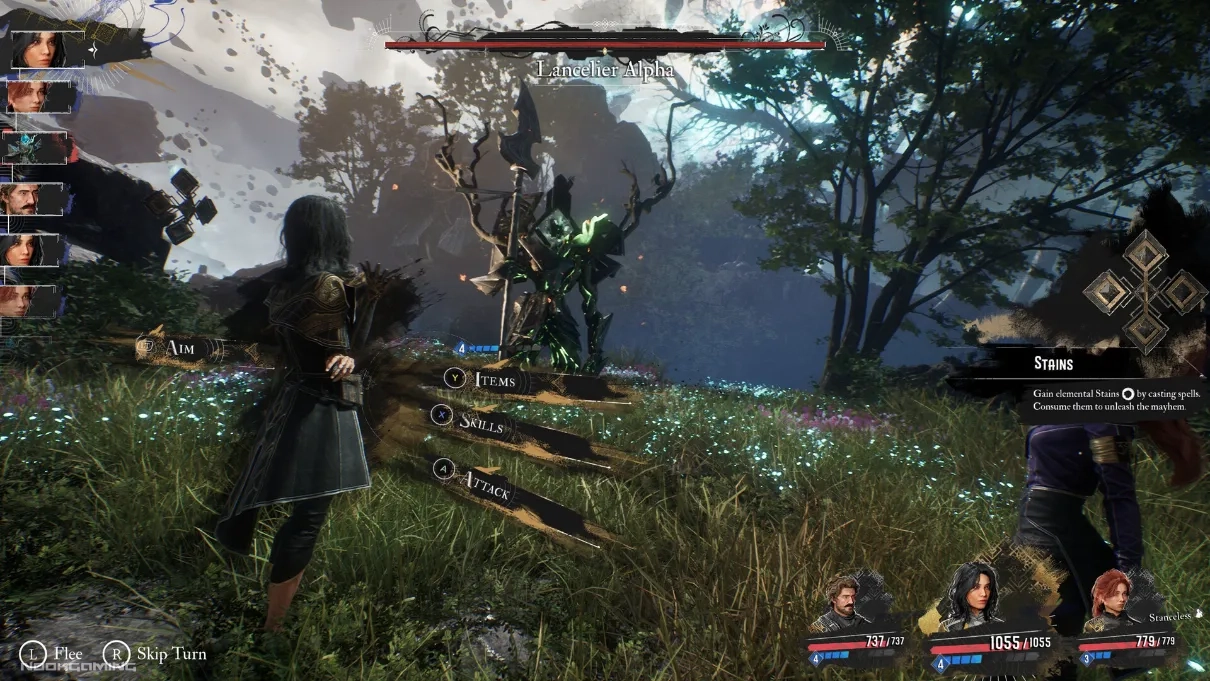
The bones of Clair Obscur’s turn-based combat are drawn from games like Final Fantasy X and Persona 5. Basic attacks build actions points to spend on skills, which form the meat of the combat options, and each character can bring six skills chosen from a larger skill tree into a given battle. I often find such systems strategically deep but tactically shallow. How you build your character matters and presents interesting choices, but once your build is set, you more or less do the thing you do in combat. Then when there’s a lot of combat or long boss fights, the repetition starts to grate. Even when RPGs try to address this by introducing mechanics like statuses and elemental weaknesses, these don’t always mesh well with a story-driven experience where the challenging enemies are unique bosses. I often find that either there’s no way to know enough ahead of time to prepare and implement tactics, or else planning around a weakness that doesn’t mesh with your build is less effective than simply playing your A game at a disadvantage.
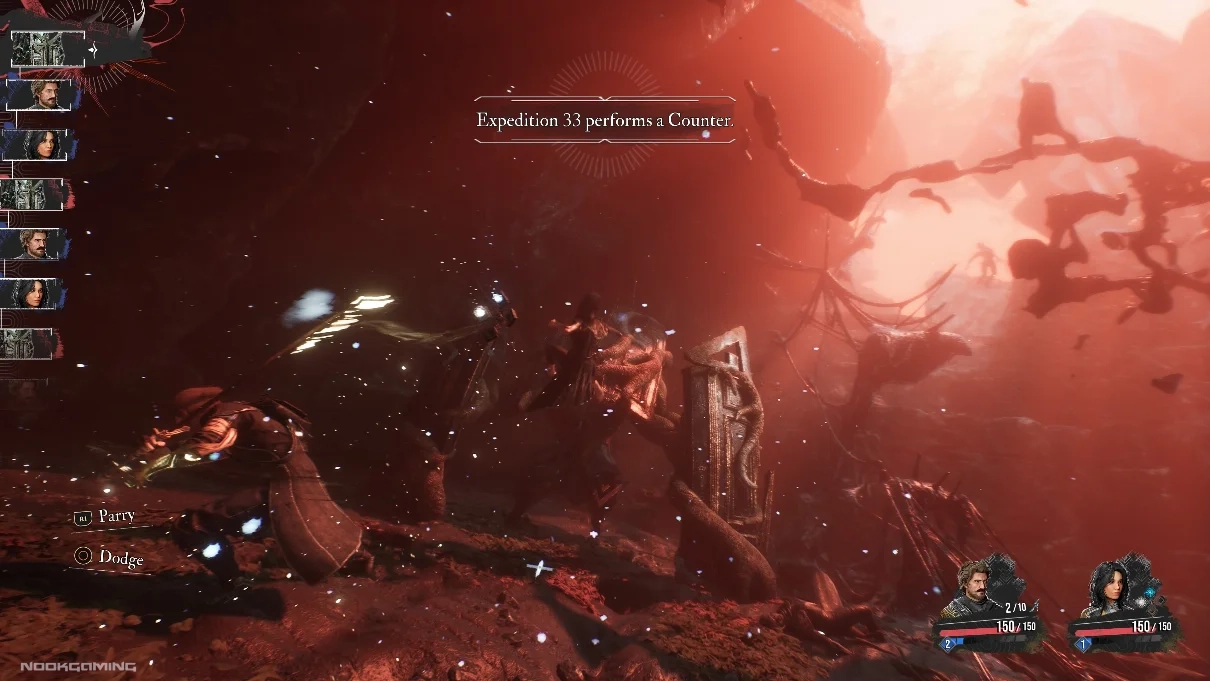
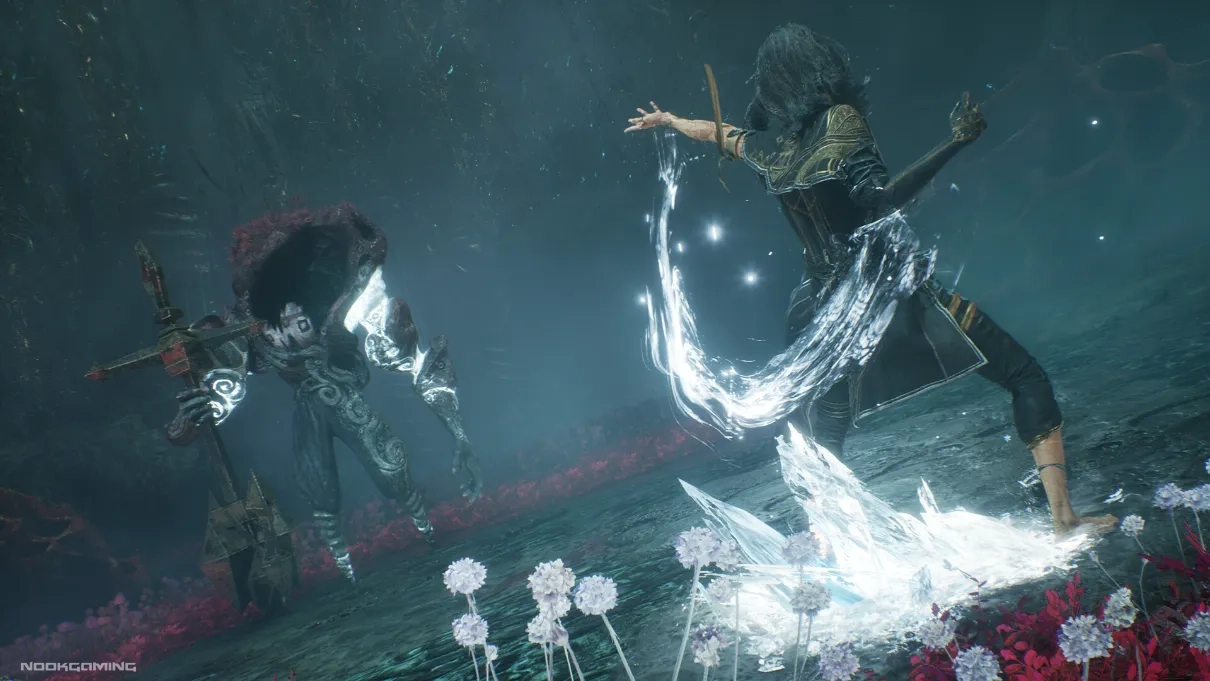
Clair Obscur takes a somewhat different approach, centering its combat around a system of timed dodges and parries. Almost every enemy attack can be dodged or parried, and Clair Obscur leans into this by making combat highly lethal. Powerful enemies might even be able to one-shot your characters, so some engagement with these systems is necessary for success. There’s a degree of risk-reward, with dodging being the safer option and offering more forgiving timing, while successful parries grant action points and, if you completely parry the enemy offensive, devastating counters on par with some of the stronger things you can do on your own turn. The importance of parrying does naturally mean that strategy is less emphasized, but I found Clair Obscur’s focus on action and immediacy consistently exciting.
In fact, despite being a turn based game, Clair Obscur reminded me of Sekiro. It’s hardly the first RPG to have QTEs and parrying, but I’ve never seen execution this tight and satisfying before. Enemies bring the dance to life, hitting you with feints, combos, and special attacks that require different responses. Like Sekiro, it perfectly captures the tension and excitement of cinematic action. Battles ebb and flow as you initially fight for survival long enough to learn the enemy attack patterns and set up your powerful skills before turning the table and pushing the offensive, and sometimes putting you on the back foot again as bosses reveal new tricks and mechanics. Clair Obscur’s combat constantly had me on the edge of my seat, and I found it immensely satisfying to finally take down a difficult boss.
Keep It Focused
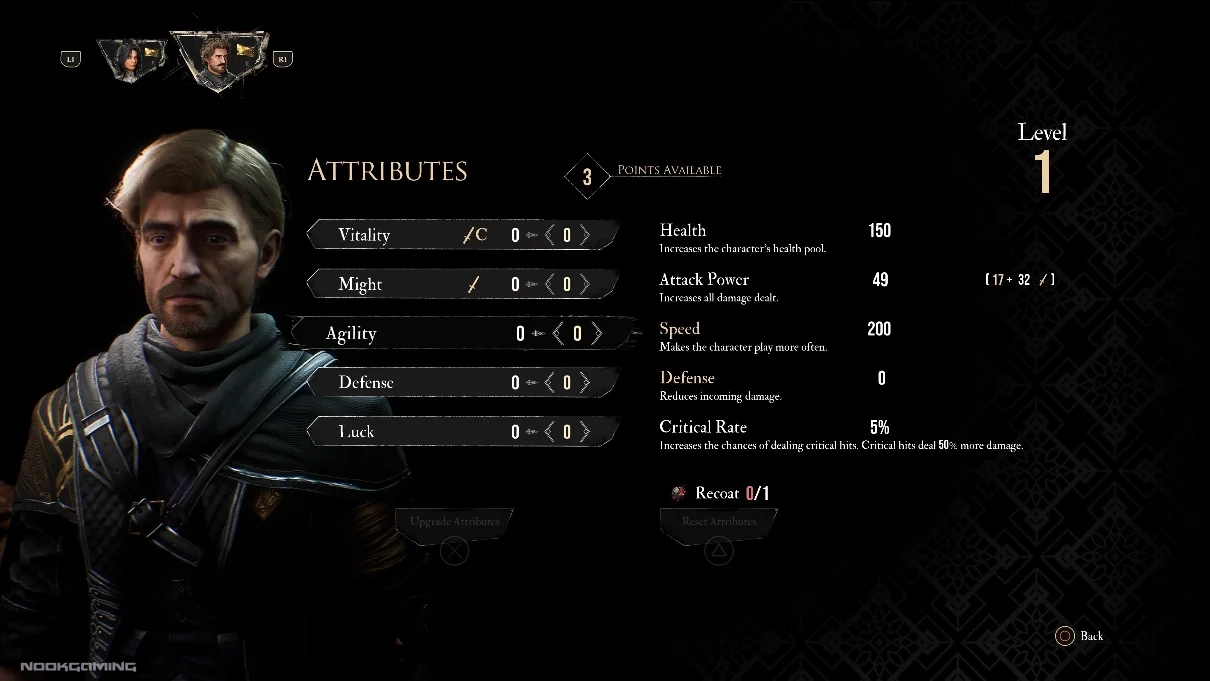
The parry mechanics also help calibrate the difficulty. Being a bit overleveled won’t save you if you whiff all your parries, while conversely it’s theoretically possible to win any fight if you can hit them all. I dislike when battles feel like filler, so it was refreshing to go through the story of Clair Obscur and find the vast majority of battles present an appropriate degree of challenge. Balance can start to break down at the end though, especially if you do too much side content before facing the final story boss. I went straight for him and he put up a good fight, but I’ve seen others beat him on turn 1 after collecting some of the overpowered lategame abilities that are meant for the optional superbosses.
Outside combat, Clair Obscur makes elegant choices that minimize the tedium often associated with inventory management. Equipment is limited to weapons and accessories called pictos. Any weapon can be leveled up, and so ultimately you’ll choose based on how the passives and damage type complement your build. Pictos offer a wide variety of stat boosts and abilities. However, after winning four battles with a picto equipped, its ability is mastered and can be assigned to any character, limited by a pool called lumina points. The system strikes a nice balance, enabling a variety of build options without requiring constant upgrades and swapping or clogging your inventory with useless junk. Meanwhile, consumables are handled as they are in games like Dark Souls. Resting at expedition flags provides a free restock up to your max, which can be expanded only through finding rare items. It’s neither necessary nor possible to save 99 max elixirs for the final boss.
Art and Music
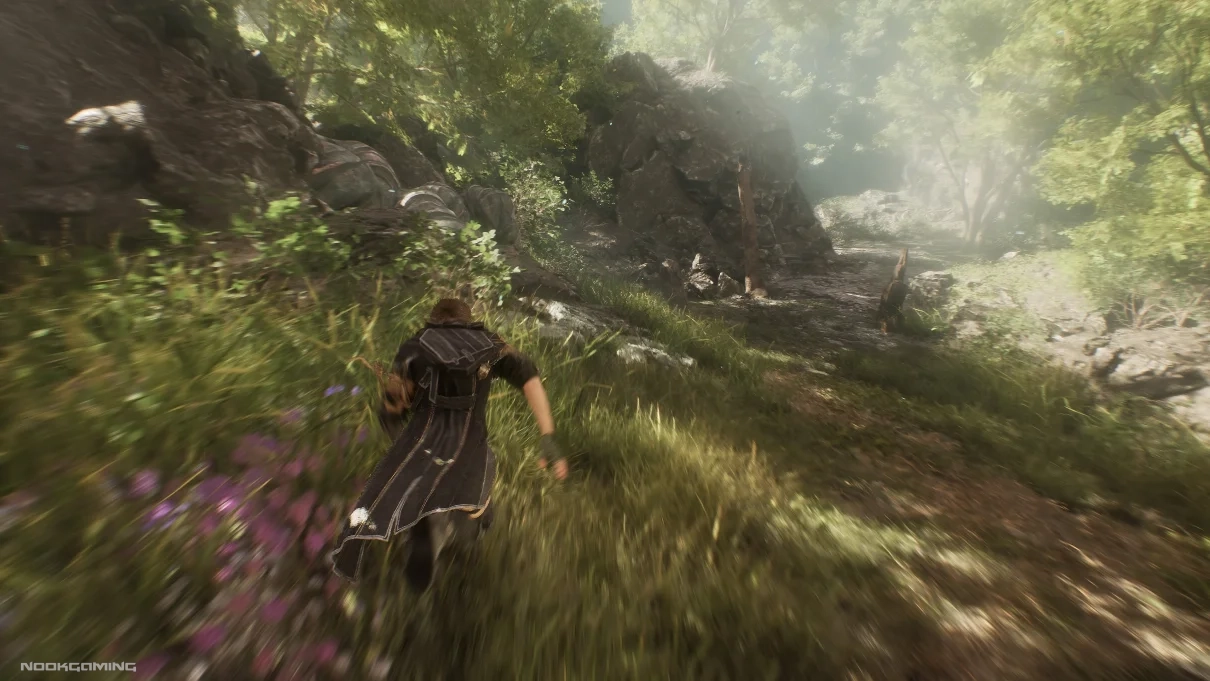
Clair Obscur: Expedition 33 complements its outstanding story and gameplay with an aesthetic that is both captivating and beautiful. Evidence of the fracture, the event that shaped Lumiere and its world, abounds in floating islands and impossible cityscapes that look like someone rearranged the pieces of a jigsaw puzzle. The natural world is as alien as it is alluring. From traversing an ocean bed while marine life floats gracefully above to scaling the towering scaffolding of the tallest mountain in the world, every location has a distinct identity that inspires awe yet reminds you that you are an unwelcome trespasser in a world you don’t understand. The enemies too run the gamut from charming to terrifying to just plain weird. When exploring a new area, it was always a pleasure to see what Clair Obscur’s artists would come up with next. And in everything, Clair Obscur revels in its delightfully French character. This is most blatant in the hidden “classic French mime” enemies that can be found throughout the world, but also can be seen in the small details of the locations and characters.
Primary music composer Lorien Testard, together with vocal composer Alice Duport-Percier, came out of seemingly nowhere and dropped an all-time great OST. It’s striking and memorable for how it uses a huge variety of musical tools and styles to embrace the identity and story of Clair Obscur. It also breaks away from the convention that in many games, perhaps except in a few pivotal moments, music is something to set the atmosphere. Not that there aren’t nice atmospheric tracks, but the OST isn’t afraid to grab your attention. While I usually think of vocal music in an RPG as something that comes in for a Carmina Burana-style power chorus to hype the epic final boss fight, in Clair Obscur it’s used regularly and spans multiple languages: Latin, English, French, and a constructed language that incorporates elements of Occitan. I also enjoy the way the OST plays with moods. Battle music might feature driving beats or screaming metal guitars, but it also might be beautiful, with soaring vocal counterpoint or a quiet lament. No matter the scene or locale, the OST always finds exactly what it needs to tell its piece of the story, and Clair Obscur wouldn’t have the same identity without it. From the first few phrases of Lumiere’s theme (a recurring motif throughout) I was hooked, and this is the rare OST that not just accompanies but elevates its game.
Verdict
In Clair Obscur: Expedition 33, Sandfall Interactive made something amazing. You can feel how much love and care went into every aspect of the game, and the result is an RPG that’s exciting to play and tells one of the most powerful stories in gaming, backed by incredible music and visuals. Clair Obscur: Expedition 33 is a generational masterpiece and my new all-time favorite RPG.
CLAIR OBSCUR: EXPEDITION 33 IS A MUST BUY

If you are looking for another RPG with a story we had high praise for, check out Octopath Traveler 0.
The writer played Clair Obscur: Expedition 33 on PlayStation 5.
A veteran of Oregon Trail and Battletoads, Wes has been playing and talking about games for as long as he can remember. He’s down to try almost anything, and he especially enjoys games with gripping narrative experiences.