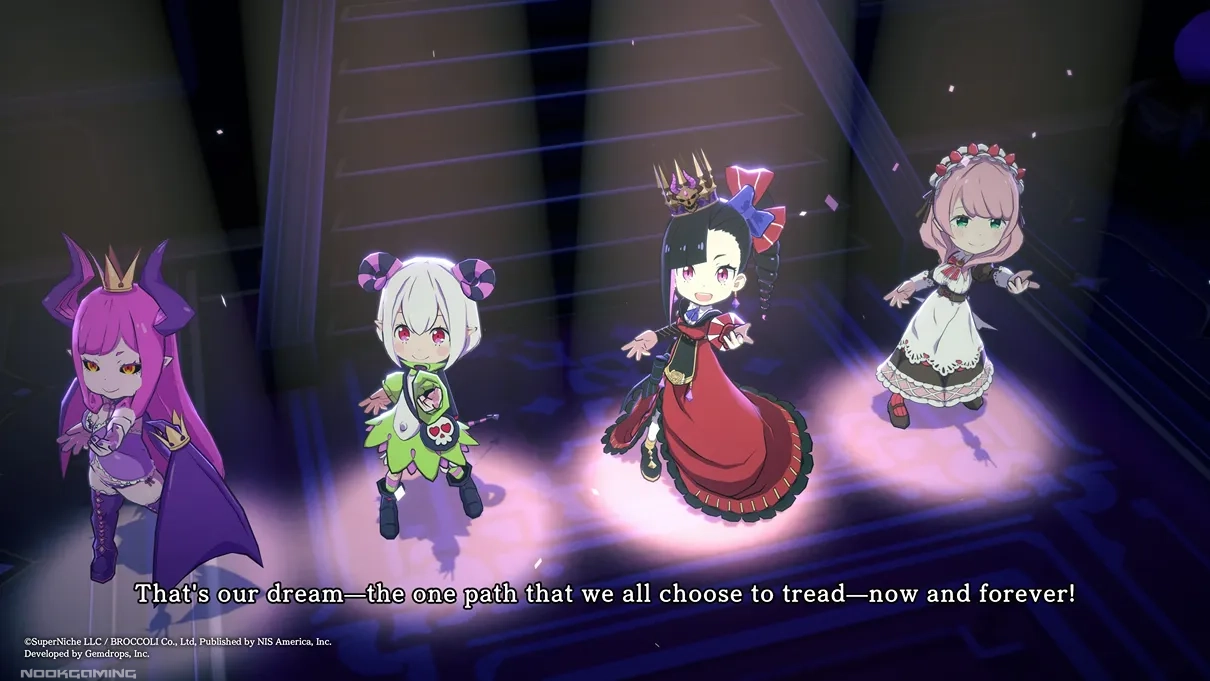
Etrange Overlord is an action RPG with musical interludes produced and written by Sohei Niikawa, the creator of the Disgaea series, whom we interviewed previously. The project is a collaboration between his company SuperNiche LLC, BROCCOLI Co., and Gemdrops, Inc. Notably, the president of Gemdrops previously worked with Niikawa on Rhapsody: A Musical Adventure, another similarly musical game.
Second Life of a Villainess
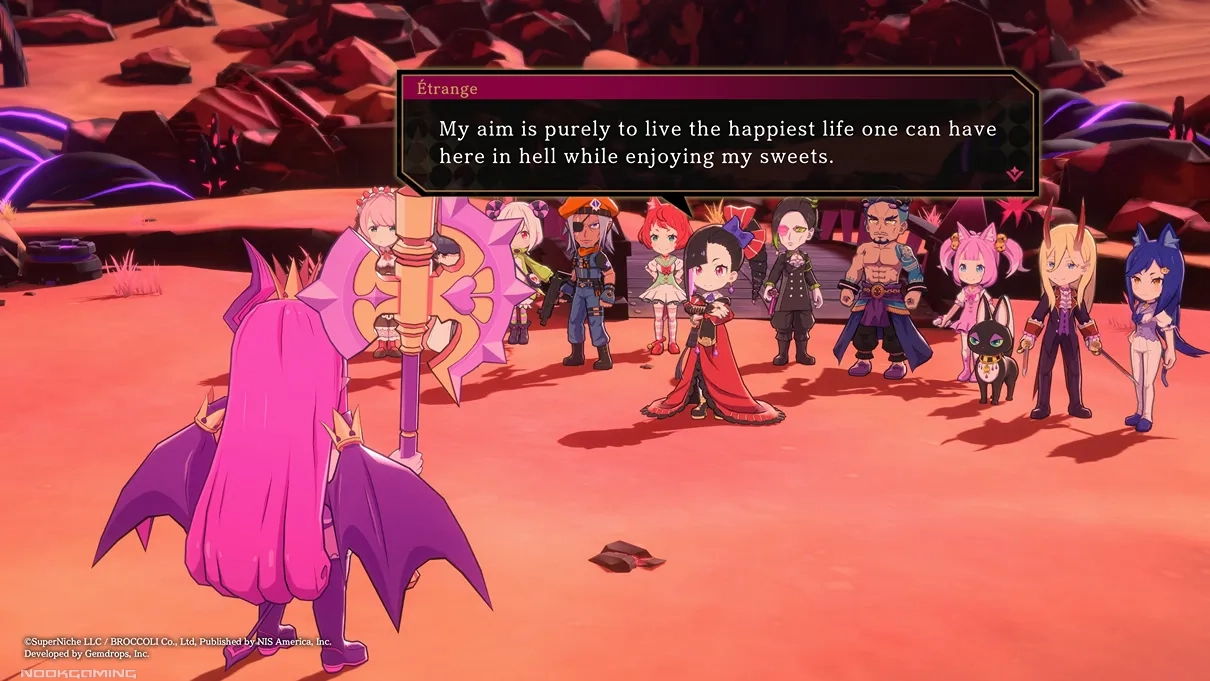
Étrange von Rosenburg’s story begins under the guillotine’s blade. She’s been falsely accused of a plot against the royal family and is executed for her supposed crime. Luckily, this is just the start of a new chance, as she wakes up in hell immediately following her untimely death. In hell she proves a rather confident protagonist, immediately demanding that the demons surrounding her prepare a fluffy bed, luxury tea, and sweets (only of the highest quality, of course). That confidence isn’t unfounded, as she uses her dark magic to quickly bring the demons to heel and recruit them as vassals.
Étrange declares her new goal to be to live a happy life here in hell, surrounded by her beloved sweets. This is a theme throughout the story: she’s not interested in things like revenge; she just wants to live her life how she wants. And if that means destroying anything and anyone in her way, so be it. Something that keeps many of the story’s moments humorous is that she has absolutely no doubt that she’s in the moral right about anything she does, whether it’s hijacking vehicles, killing demons for the offense of getting sand on her sweets, or punching God himself.
The humor in general is the strong point of Etrange Overlord. It can perhaps get a bit repetitive when we see Étrange use over-the-top magic to save the day yet again, but her refusal to compromise on her ideals and her strong personality, along with the silliness brought by some of the wide variety of companions she recruits along the way (and the absurd visual gags), really carry the game in a way that the plot unfortunately doesn’t.
For the Light Novel Fans
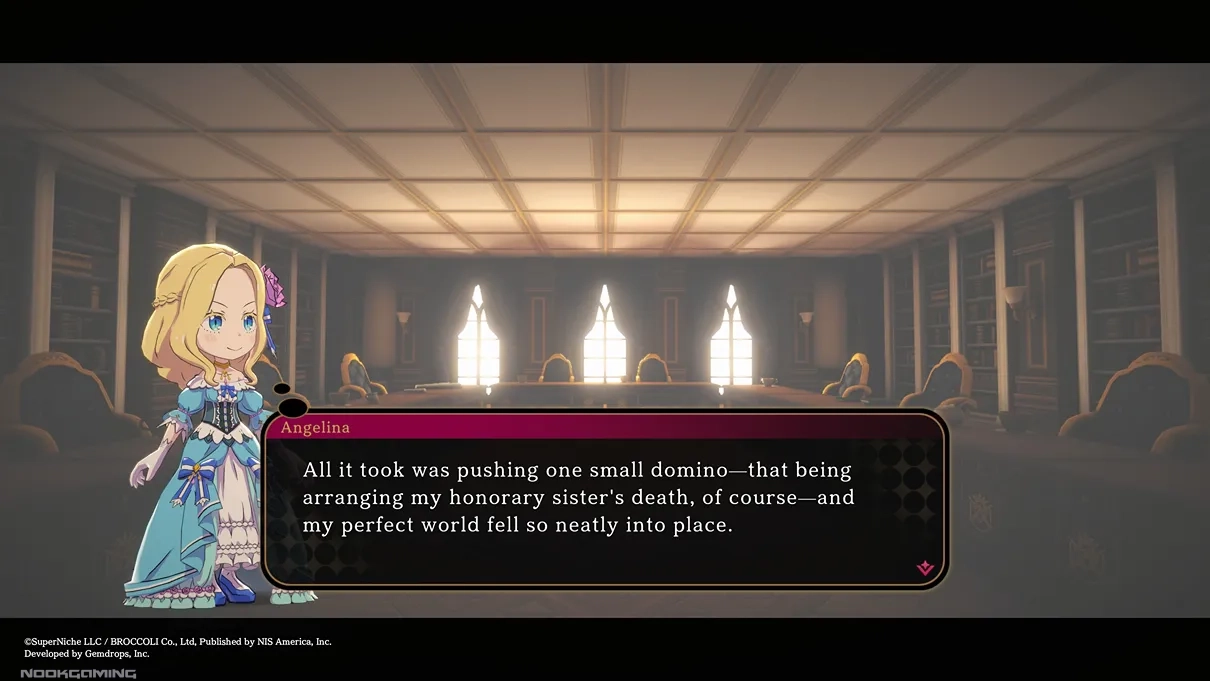
As a medium, light novels are known for being very referential, using the same or very similar genre tropes and events. For better or worse, Etrange Overlord is based on one. It uses the ‘not actually a villainess trope’ by having the dark magic user and ‘villainess’ Étrange more interested in sweets, while we can see the ‘heroine’ Angelina plotting in the background and clearly acting as the true villainess. It has reincarnation into other worlds, characters bringing up status screens and levels, naming monsters to bring out their power, discrimination against characters with black hair, and more. If you enjoy isekai or villainess light novels or the anime based on them, you’ll probably recognize quite a few aspects along the lines of the above that feel like they’re pulled straight from popular titles. This in itself isn’t negative and, as mentioned, is fairly common for the medium. But I didn’t feel like Etrange Overlord’s spin on this distinguished it, nor was the story it had to tell outside of that particularly memorable.
Much of the story involves Étrange reacting to circumstances and threats to her sweets while recruiting most of those who initially opposed her. There is an ongoing plot with Angelina told in the background, but this only really comes to a head near the end of the game, and if you know light novel tropes and pay attention, aside from one or two reveals, it’s almost entirely predictable.
Musical interludes are used on occasion, with Étrange and sometimes other characters breaking into song as if it were a musical. These are part of telling the story, but they didn’t really do anything to advance the plot in most circumstances; instead, they more often focus on Étrange summing up how much she enjoys sweets and her new life. They don’t really capture the same magic as Rhapsody: A Musical Adventure, despite the shared heritage.

One aspect that really didn’t work for me was that it seemed to be trying to create a heartwarming story about friendship at times. All those she recruited (typically by beating them up) seemed to immediately be enamored by her, wanting to be her best friend, adopted sibling, or incredibly loyal subject. But this never felt particularly earned, with them going from enemies to absolute loyalty with barely a word. On top of that, with a cast of 15 characters, most of them didn’t even have many interactions with Étrange to build a relationship or time to show any depth to their own character. Yet it’s framed as if an important part of Étrange’s journey is the friendships in her second life, and many of her more serious thoughts and her few desires outside of sweets tend to be about this.
Another part that didn’t really work for me were the 7 Chef story segments. Several of the unlocked recipes have an associated scene where one of the characters cooks it and serves it to Étrange. These became tiresome to say the least, and followed the typical anime stereotype where Étrange suddenly becomes a food critic, explaining her impressions of it in an overly descriptive way.
Overall, when I think of Etrange Overlord’s story, words like minimal and rushed come to mind. It never really takes time to add much in the way of plot or the depth of relationships to support the intended heartwarming moments. It is quite a brief game though, so this isn’t a surprise, even if it’s unfortunate.
Sushi Lane Musical Action Adventure
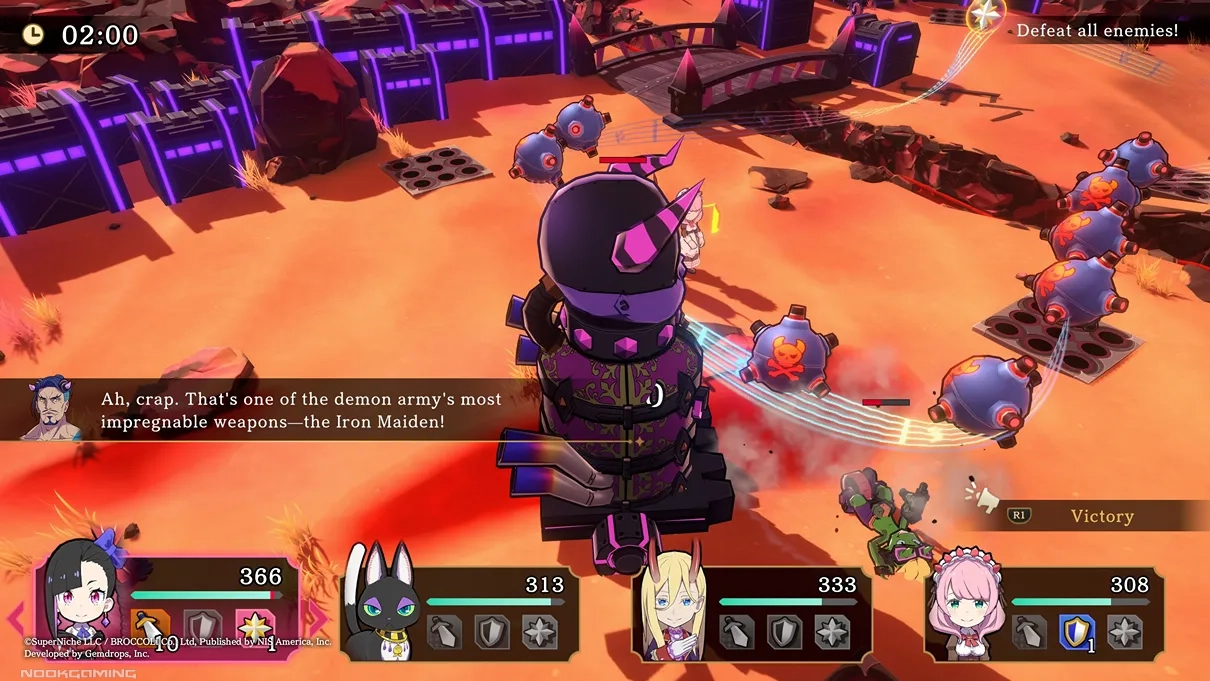
What I feel somewhat more positive about is the gameplay. It’s divided into 43 short levels, most of which only take a few minutes each at most. They’re split into a few different mission types, including defeating all enemies, defending a target, occupying points, and delivering items to boxes. In most levels, you can take up to 4 characters and switch between them mid-battle. The 15 available characters play somewhat uniquely, being divided into the wider categories of power, speed, healer, technical, or balanced, but having their own slight differences. Levels require the use of specific characters relatively often, which I thought worked well, as it gave me reason to try them all out and ensure I spread weapon upgrades reasonably evenly.
What makes Etrange Overlord somewhat unique is the revolving lane mechanic, sometimes referred to as the “sushi lane” mechanic. Most levels have lanes on them, which have items moving around on them, similar to conveyor belt sushi. The use of items to temporarily strengthen characters or use as weapons against enemies was well-implemented. Brute forcing levels by just using standard combos without items isn’t impossible most of the time, but interacting with them was typically well-rewarded by either making it much easier or by just being more fun to grab a bomb or a special attack power-up and blow up a ton of enemies rather than chipping away at their health. On some levels this is a requirement too, as certain large enemies or bosses only become vulnerable after using items in certain ways, such as throwing a bomb at them during an opening or knocking them into a trap.
Some levels feature movement mechanics such as rotating platforms that the characters need to use to move between areas, gadgets from healing towers to mountable turrets, and traps such as spikes that pop up from the floor and pitfalls. This often means 4 characters dodging around, activating gadgets, avoiding traps, and trying to grab the best items, all while taking down enemies under a time limit. It can make for a rather exciting time, except for one thing:
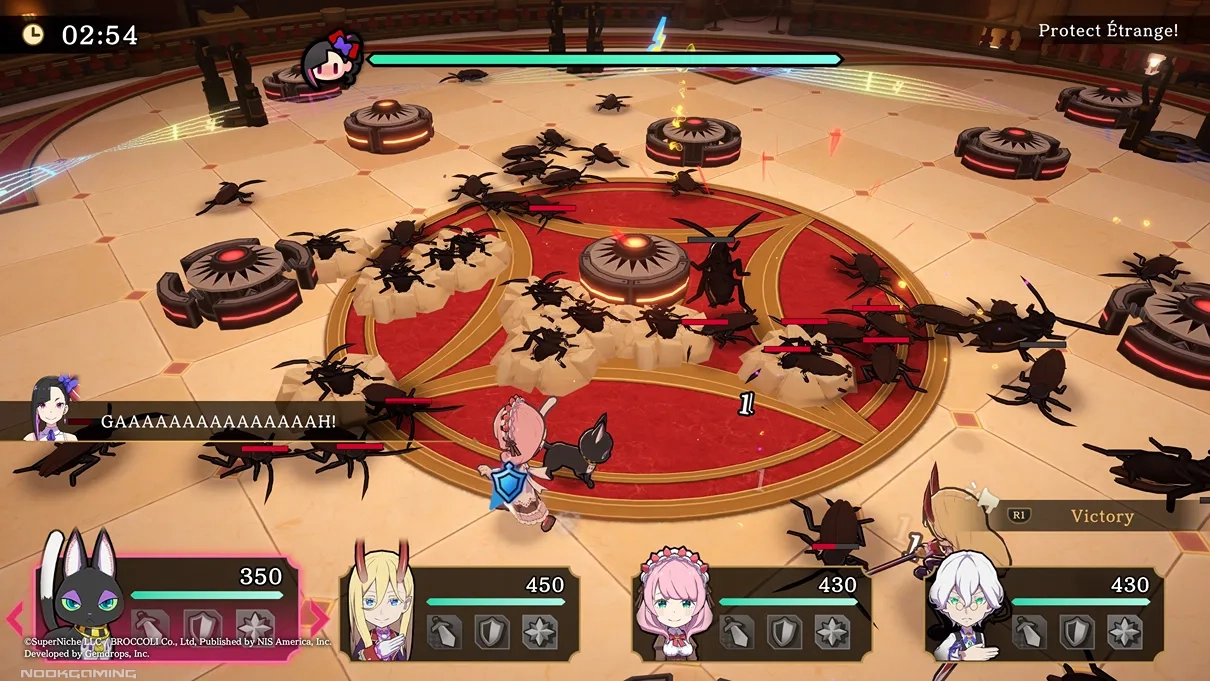
The gameplay of Etrange Overlord has issues with difficulty, or lack thereof, in most cases. Etrange Overlord comes with a ‘Sweets Mode’, which lowers the difficulty, but I found that the majority of the levels were far too easy even on the normal mode, and there is no higher difficulty level. With that said, there were odd difficulty spikes at times, which stood out.
The difficulty isn’t helped by the enemy AI. I’ve seen examples of them both unintentionally being ‘too smart’ and ‘too dumb’. One of the first bosses was over incredibly quickly for me, as he walked into a trap twice in a row, assisting in his own near-immediate demise. Another enemy later on managed to stick itself in a position where its back was constantly against the wall, which was its only vulnerable point, making it temporarily impossible to defeat. The feature to set tactics for your party when you’re not controlling them isn’t always followed in what should feel like a logical way either, with them sometimes not acting toward achieving set objectives. Luckily, this sort of thing isn’t an issue too often.
Most of the missions do have hidden optional objectives, but the majority of them aren’t particularly challenging. The only one that I felt was genuinely challenging was the final mission, with most others having some trick to them if they seemed difficult at first. Many of them I completed by accident, such as defeating a certain number of enemies while using a certain level mechanic or completing the level within a certain time frame.
While the lack of overall difficulty is a pity, it’s still rather fun to jump into these bite-sized levels and complete them. Sadly there is no post-game content, so when you’re done, that’s it, unless you want to jump into the separate multiplayer mode with friends, grind levels to unlock materials for any remaining upgrades, or return to any missed optional objectives on missions. And even that won’t take long. While 25 hours was given as an estimate when we interviewed Sohei Niikawa, it only took me 12 hours to 100% complete everything and get the platinum trophy. I expect it’d take no more than 8 hours for someone who is just playing through without repeating levels to pick up missed objectives or grinding for upgrade materials.
Supporting the Overlord
The underlying systems work together quite well. Many features, including weapon and item upgrades, are gated by your ‘Happy Life Level’, which is unlocked through completing mission objectives. Recompleting mission objectives that have already been cleared doesn’t get you experience like in most RPGs; instead, it just earns you crafting materials and money, so this somewhat limits any attempt to grind to make the game even easier. Levels don’t directly increase your strength either; only weapons and items do.
One way that you can briefly increase your strength is through a cooking mechanic, which lets you turn ingredients into buffs that typically last for one level. There’s quite a variety to choose from, and using them well can make even some of the few more difficult moments much easier.
Item upgrades are an interesting one. Similarly to weapons, you can improve how well the items on the revolving lane work by upgrading them. However, you can only set certain item upgrades in your loadout, so it can be a matter of picking and choosing. This adds an additional layer of thought to your preparations at first. It does lose this later on however, as you can just choose to assign all the item upgrades after a certain Happy Life Level is reached.
An additional feature is the Dispatch system. This lets you assign characters to areas you’ve completed to gain materials. Controlled areas sometimes rebel against you, which can lead to needing to return to a level to recomplete it to clear away negative effects. It works well to let you choose which materials you want to collect and gives you a reason to quickly return to a level. It also helps to mop up those final materials to get upgrades, as all materials can be found somewhere within the dispatch system.
Returning from Death
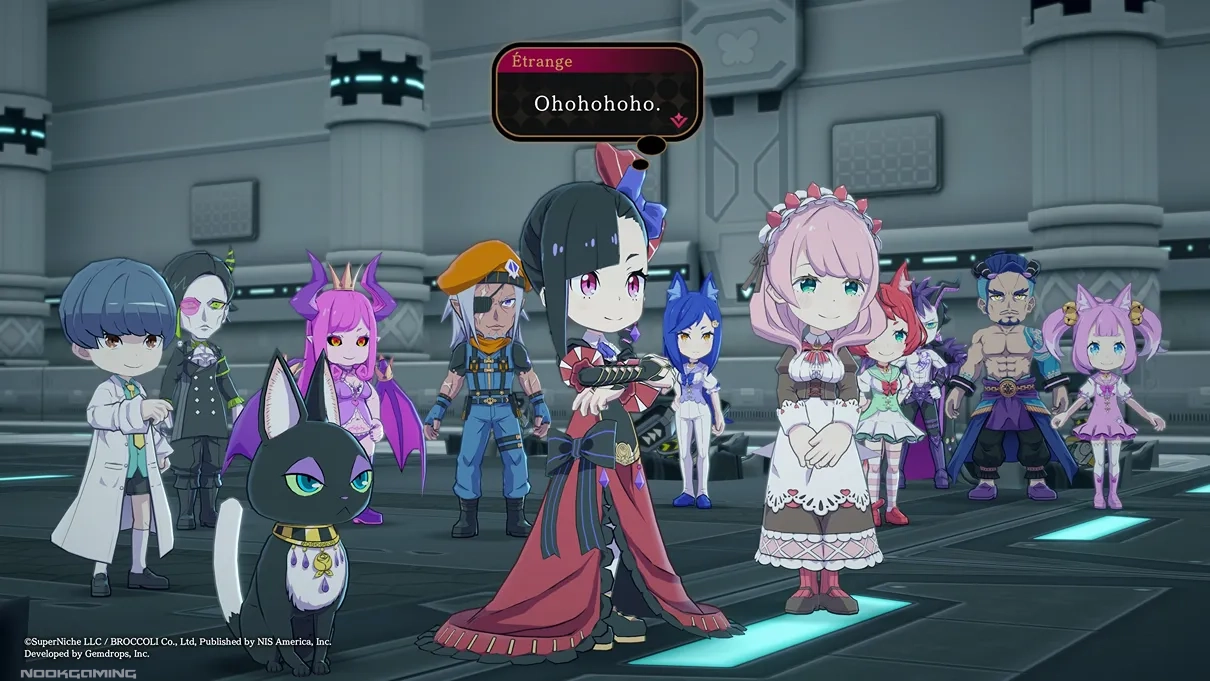
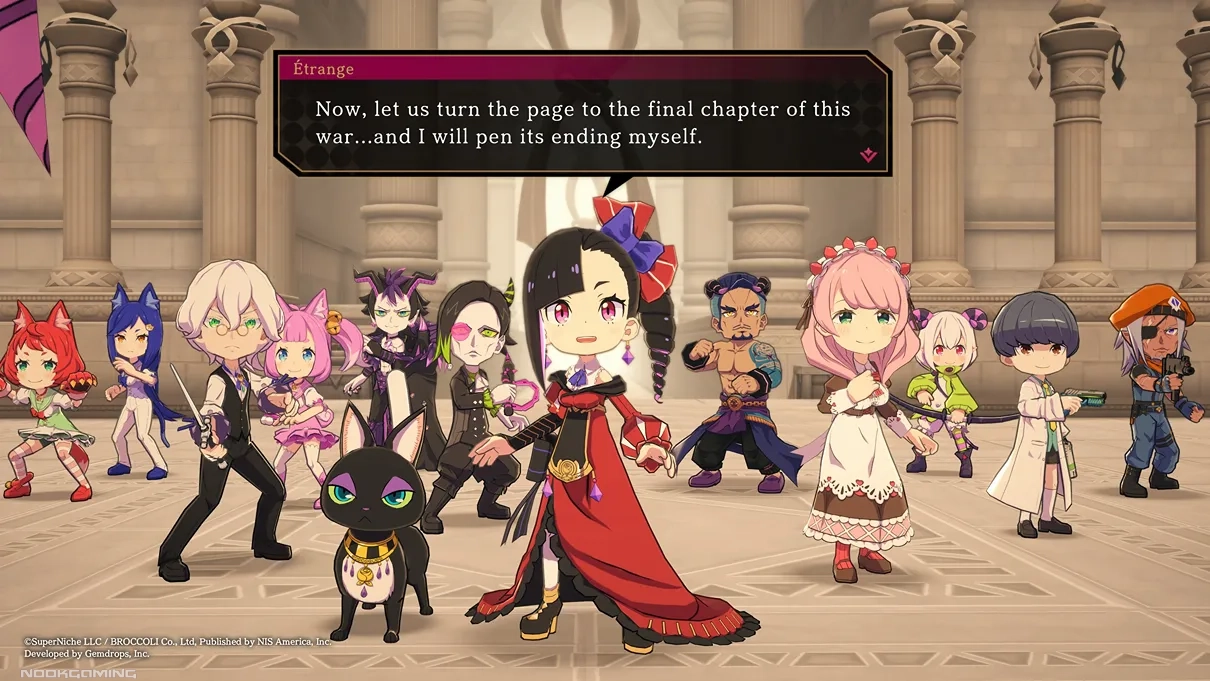
Etrange Overlord features character designs by Shinichiro Otsuka, the illustrator best known for the Re:Zero light novels. He’s also worked on a number of games, including the Conception series, Mado Monogatari: Fia and the Wondrous Academy, and, unsurprisingly, Re:ZERO -Starting Life in Another World- The Prophecy of the Throne. The character designs and art in general are certainly very distinct despite the ‘chibi’ style of the models, which is helpful for a game with such a large cast. There are quite a few little touches I enjoyed, such as the maid Sweetia’s strawberry hairband and dress bringing to mind a cake, and the asymmetrical bows on Étrange feeling like they balance out. Étrange and Angelina do end up looking perfectly like the villainess and heroine they’re supposed to be too.
The background music is pleasant to listen to and fits the various situations well. The insert songs are perhaps more notable, but I don’t think they’ll exactly be put on people’s playlists by themselves. They work as part of the story, but aren’t exactly catchy. Hololive fans hoping for a lot of songs from Watame (who plays Sweetia, along with singing the opening and ending songs) and Fubuki (who plays Aria) may be left a little disappointed too, as the musical interludes primarily only feature Étrange. Fubuki’s character doesn’t get much screentime either.
The voice acting works well. Étrange herself is the only character I felt that really stood out here, perhaps in large part just due to having far more lines than most other characters. She certainly plays the ‘villainess’ voice well, managing to sound proud and slightly haughty, while throwing in plenty of Ohohoho’s and speech patterns like ending sentences with “desu ne”. No English dub is available.
Verdict
Etrange Overlord is an interesting idea, essentially telling a light novel villainess story through the medium of a game. However, it doesn’t really deliver its message, in part due to the short playtime, minimal story scenes, and the use of some of its time on skits and silly moments, which could’ve been better used to develop its themes. However, the humor and Étrange as a character do somewhat save it.
The gameplay is also simple and lacks overall difficulty, but it is action-packed and genuinely fun for what it is. Dashing about the various level mechanics and grabbing items from the conveyor belt makes for a great time, and the levels are short enough to never overstay their welcome.
WAIT FOR SALE ON ETRANGE OVERLORD

If you are looking for another eccentric game with action elements, you might want to check out our review of Romeo is a Dead Man.
Many thanks go to Reef Entertainment for a PlayStation 5 review code for Etrange Overlord.

A gamer since the days of Amstrad and DOS and someone who has dabbled in a variety of professions. He enjoys a wide variety of genres, but has been focusing on visual novels and virtual reality in recent years. Head Editor of NookGaming. Follow him and the website on @NookSite.