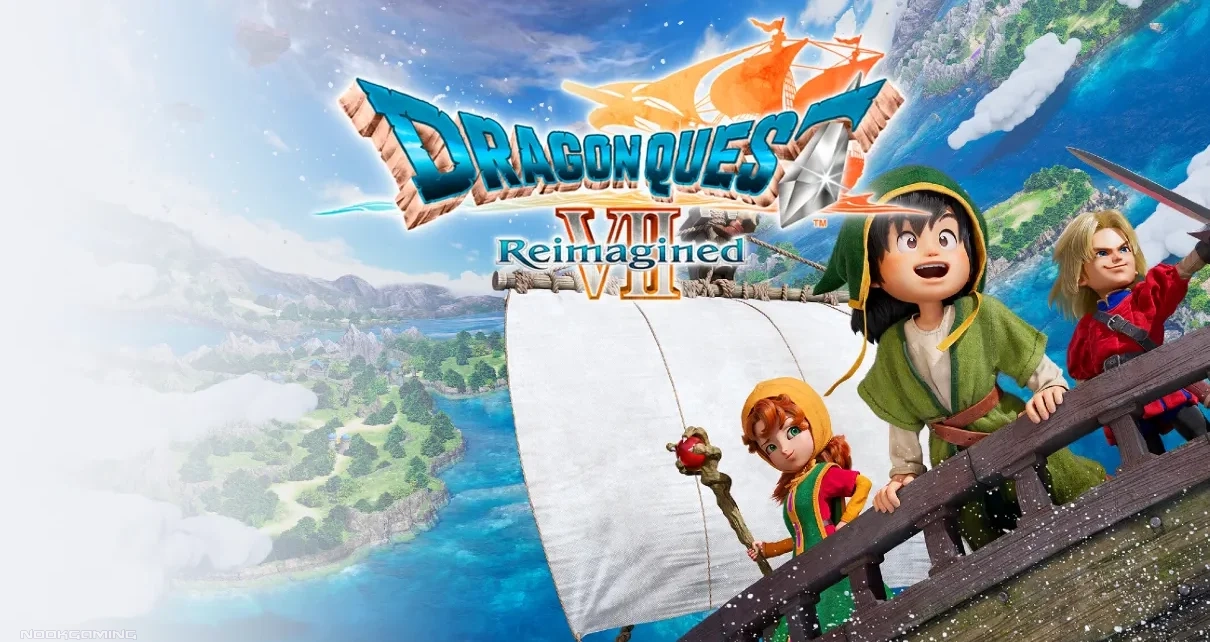
The remake train of Dragon Quest just doesn’t seem to be slowing down. While we still wait for the next new numbered installment of the series, remakes of the Erdrick trilogy have been keeping us occupied for the past few years. Now, we’re skipping ahead a whopping four games for our next remake, the rather unexpected return of Dragon Quest VII. Originally released as a very late PS1 title, Dragon Quest VII’s legacy has endured thanks to its infamous length and volume, and the 3DS remake it received more than a decade ago only furthered this perception. Now it’s on the docket for its second overhaul in the form of Dragon Quest VII Reimagined, which aims to make this a more accessible and player-friendly title than before.
The Kids from Pilchard Bay
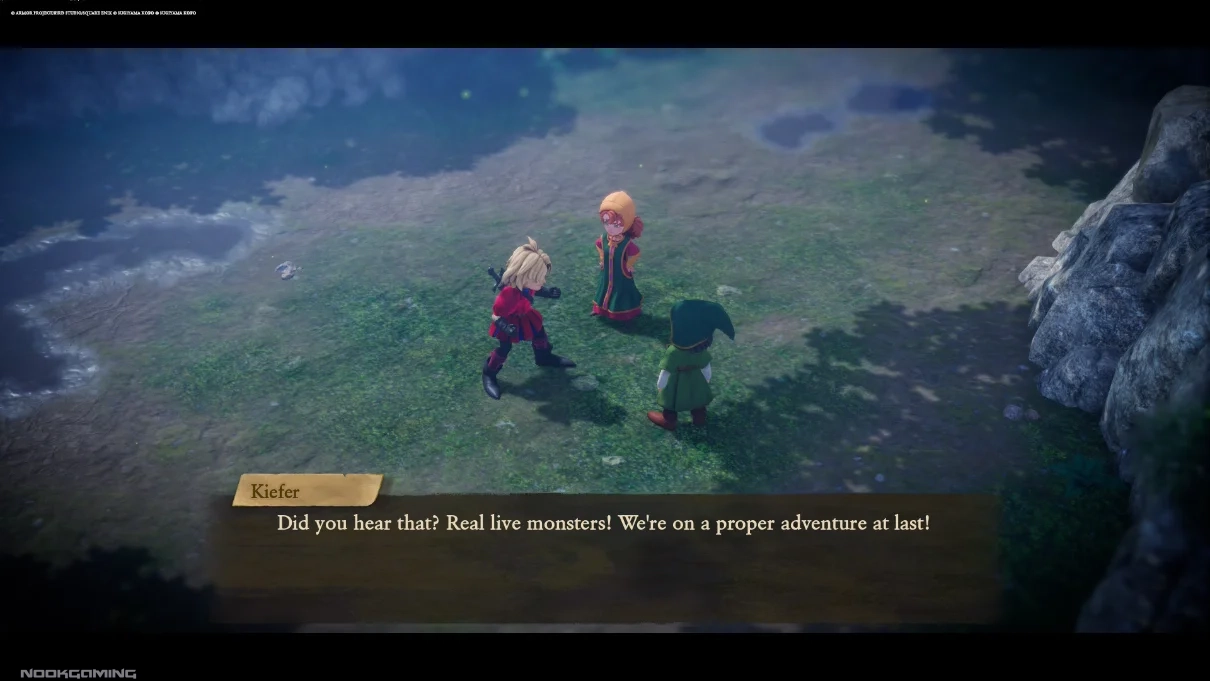
In a world made up of nothing but sea, one lonely but peaceful island houses a group of three curious children. There’s the plain son of a fisherman (that’s you), Prince Kiefer, and local rich girl Maribel. The days spent with these three children are ordinary and even somewhat boring, and Kiefer, in his curiosity and desire to find his own destiny, opts to uncover what secrets may still lie in Pilchard Bay to launch himself and you into the adventure that you’ve always dreamed about. After playing with some stone tablets in old ruins, you do just that, having been launched into an unknown island in peril.
After helping the locals of that island, you’re able to head home, and that same island has now mysteriously appeared near Pilchard Bay, as if it was always there. That’s not because that island was part of another world; it was because it existed in the past, and the party was sent there through the aforementioned ruins. As it turns out, the world was filled with all sorts of landmasses of all shapes and sizes, but every one except for Pilchard Bay was wiped out for one reason or another in a past calamity. With this, the monumental but ultimately simple goal is established: slowly restore the world to how it was by collecting tablet pieces in order to travel to past landmasses and fix their problems before they can be wiped out.
The overarching story and mystery behind why the islands were all wiped out isn’t really introduced for a while, but the actual reason this setup is there is to facilitate a story where lots of vignettes with different ideas and tones can take place. It’s essentially a Dragon Quest staple for each town or major location to have an isolated story that contributes a little to the grander narrative, but how much that’s the case can vary on a game-by-game basis. Something like Dragon Quest V is generally more focused on the overarching story, but Dragon Quest VII on the far opposite end of the spectrum. In the end, this is a story about a group of children going on an adventure far larger than themselves, and reacting in the way that children might.
While the protagonist is mute as always, the other party members have an excellent rapport thanks to their distinct personalities and the way they can butt heads with each other over even the smallest things. Kiefer is hot-headed and curious, always looking for adventure and getting himself into trouble to sate his own boredom, but he’s a bighearted guy and like a big brother to the group. Maribel is more like a cat, always complaining but never actually wanting to be left alone, though behind her tsundere-like personality is someone who’s actually quite sweet and considerate, she’s just obtuse about that. There’s also Ruff, who joins the party a small ways into their adventure, and because of the unique circumstances of his existence (which you can guess based on his name), he has a peculiar outlook on life and their adventures.
Thanks to Party Chat, a feature that debuted in the PS1 version of Dragon Quest VII, you get to hear their opinions on… basically everything. At the push of a button, a character will make a small comment on random characters that you’ve interacted with or most of the story beats, big or small. Kiefer will chime in on how he can’t believe the player character is related to their slovenly drunk uncle, while Maribel might comment on how she’s unsurprised that the player’s mother knows they’re upset about something. Walk into a casino and talk to an NPC, and Maribel may make a funny jab about how she wants the player to steer clear of developing a gambling addiction. Even outside of that, there’s lots of little environmental characteristics that effortlessly express the story of every character who occupies this world. It’s really quite impressive, and sharp writing across the board only elevates this.
Fragments of the Forgotten Past
Dragon Quest VII’s tone, despite being a game about kids going on adventures and not really changing visibly due to them, is actually morose and sad for a lot of its runtime. The very first island you visit is one that involves a town on the verge of collapse due to a monster invasion and the townsfolk essentially backstabbing the only people doing something about it because of their cowardice. An island dealing with a robot invasion of all things involves bickering brothers who can only barely set aside their differences to counteract the invasion and save the day. What makes these stories especially impactful is how the passage of time changes these settings, in ways both good and bad, as if the protagonists don’t really have any say with what lessons the people they’ve just saved have learned. In the aforementioned story about the robot invasion, while the land is still at peace in the present day, it’s ultimately revealed that a major character from that story had stubbornly kept to their ways and died in lonely misery. In another early one, a town where people turned to stone and ultimately withered away from the elements, it’s revealed that the island is deserted and nobody even remembers the incident in the present.
What this creates is a story of unpredictability. While the entire game follows a relatively rigid formula of going to the past to sort an issue on an island before returning to its restored state in the present, it never feels like the endings of those stories are similar. Some don’t even have battles or boss fights to speak of, and others might end in an anti-climax because the main villain of that storyline is having second thoughts about the whole thing. While time travel is the main conceit of the storyline, what Dragon Quest VII is ultimately about is the passage of time and how that might shake up the status quo. A story about a group of islanders following a religion that’s being exploited by dark forces might end with that religion being forgotten about in favor of those islanders instead prioritizing tourism and making capital. Sure, they’re not going to wind up dead anymore, but there’s a certain melancholy in seeing the way the past can only be peered through a keyhole in the present.
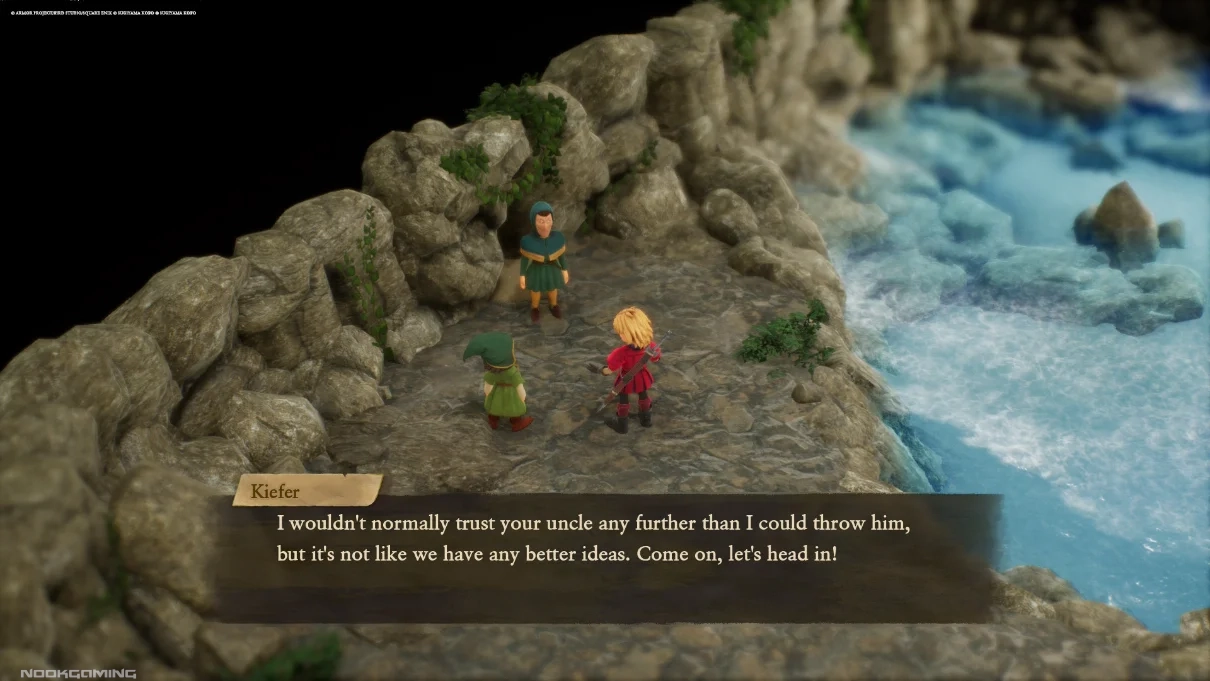
Thanks to Dragon Quest’s trademark sense of humor, it never becomes overly heavy or gratuitous. Horrible things happen regularly and you can’t even do much to prevent a lot of it, but it has a streak of gallows humor that keeps things at an approachable level. This is again partly thanks to Party Chat illuminating the main party’s thoughts at all times, while you’re never told how to feel about incidents throughout the plot, you’re given additional perspective that adds food for thought to what happened and why. A lot of the most heartwarming dialogue from the game shines through this, where simple gestures can say a lot about a character’s actions or ideals.
I’ve alluded to this a few times in my reviews of previous Square Enix games, but Dragon Quest VII’s storyline is my single favorite across the entire medium of games. It’s heavy, it’s ponderous, it’s sad, it’s hilarious, it’s everything. Thanks to its immense length that fully utilizes its famously voluminous script, it covers all of its bases while still feeling as though it leaves a lot of room for interpretation. You can kind of intuit how things end up the way they do when you return to see past islands in the present, but the game never spells it out and encourages players to come to their own conclusions on things. Reimagined makes some choice changes and additions to the narrative that make me like it even more than before, elevated by modern presentation that we’ll dive into a little later.
Too Much of a Good Thing
Dragon Quest VII Reimagined is a humongous game that’s actually quite linear when things are laid out for you. Rather than set off into a large world where you have to piece your path forward by talking to NPCs and gaining the right items needed to progress, you’re instead set down on a linear path where you have to pay attention to unlock the next area. Since you have just the one island at the start, it means combing over everything to search for the keys forward, usually in the form of wayward stone tablets needed to progress to the next island. It’s kind of daunting, but doable and ultimately a positive in expressing the adventure game element that Dragon Quest is famous for… Or it would be, if not for some of the overbearing changes made in the Reimagined edition.
For context, Dragon Quest VII has a reputation of being a hard game to sink one’s teeth into for several reasons, not the least of which being its incredibly lengthy opening and occasionally obtuse nature. I had several false starts with both the 3DS and PS1 version thanks to its quirks and slow pacing, and it took me until just a few years ago to finish the whole thing. When bringing the game to new audiences, much of the question of how to bring it up was how to make it more accessible, while still maintaining what makes it so charming. A noble pursuit by itself, but also one that can risk shaving off unique characteristics for the sake of achieving accessibility. The 3DS version already made many changes in an attempt to make the game more approachable, so going further with that could risk overkill.
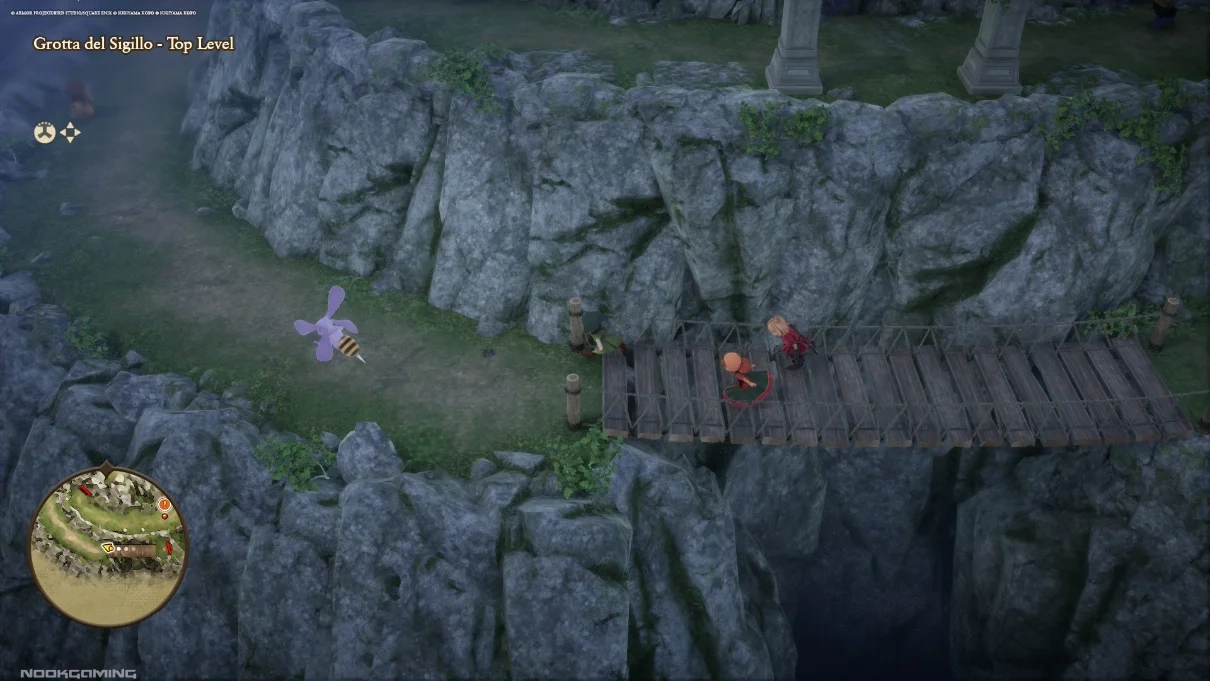
Unfortunately, “overkill” is exactly what Reimagined falls into, boasting many changes that are there in an attempt to make the game more accessible that are also just not necessary and even somewhat damaging. The tablet pieces that you search for throughout the game suffer a notable blow, since they’re all marked on the map for you and require generally little searching to find. While I thought the PS1 version’s tablet-finding system was a little too unhelpful, I thought the 3DS version’s radar was helpful. You got help, but you still had to put in the legwork of actually finding them. In Reimagined, the map conveniently tells you outright where they are, right down to what floor of a building or dungeon they’re in. They might as well be handing them to me outright if they’re this hellbent on being helpful towards me. It’s just too much assistance, and this extends to obnoxious quest markers for even small things.
This also extends to new elements of battle. Dragon Quest is rather notable for its inventory system, wherein each character has a limited inventory that they can carry with them into battle. Everything else is stored in a bag that can only be accessed outside of battle. That added a nice splash of planning and decision-making because it meant that you had to ask which characters were best carrying what items. Here in Reimagined, that’s no longer the case, and every character has access to an infinite inventory at all times. On top of that, character deaths aren’t devastating because they’re automatically revived upon the completion of battle. This wouldn’t be so bad if it were optional, but unlike the HD-2D remakes of the Erdrick trilogy, players can’t opt out of these new changes. It makes for a frustrating experience where I’m trying to go on a big adventure and get absorbed by it, but I can never forget about my overbearing and worried mom stalking me the whole time.
Combat and Vocations
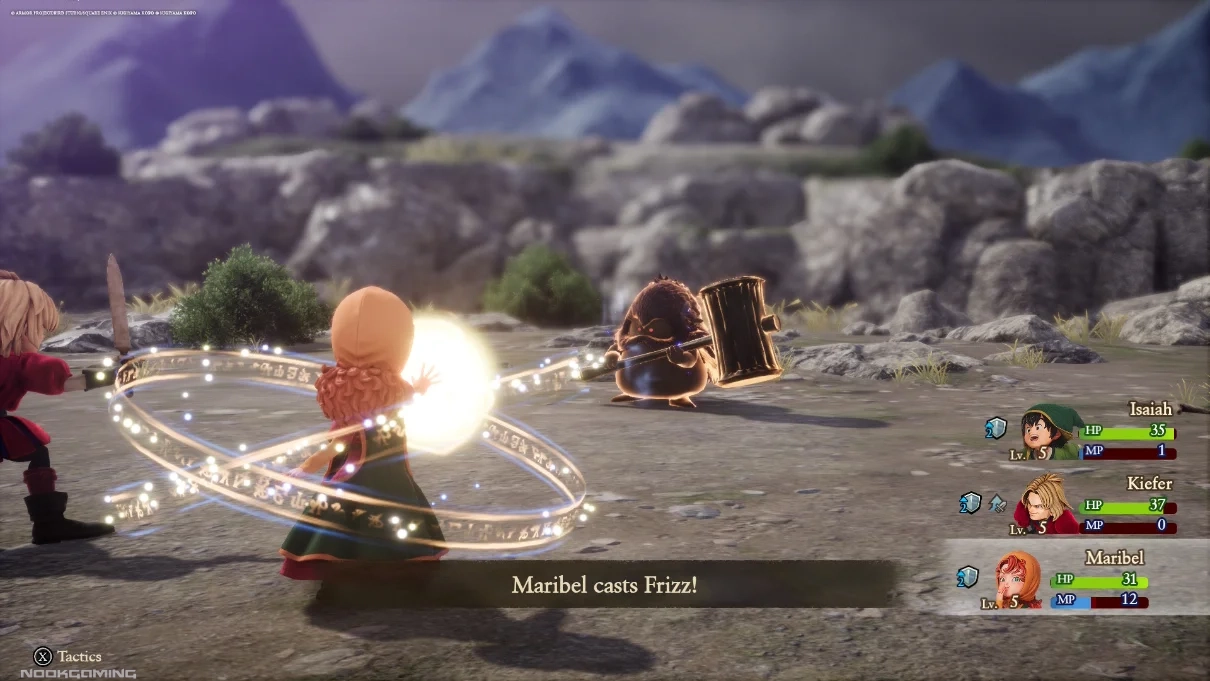
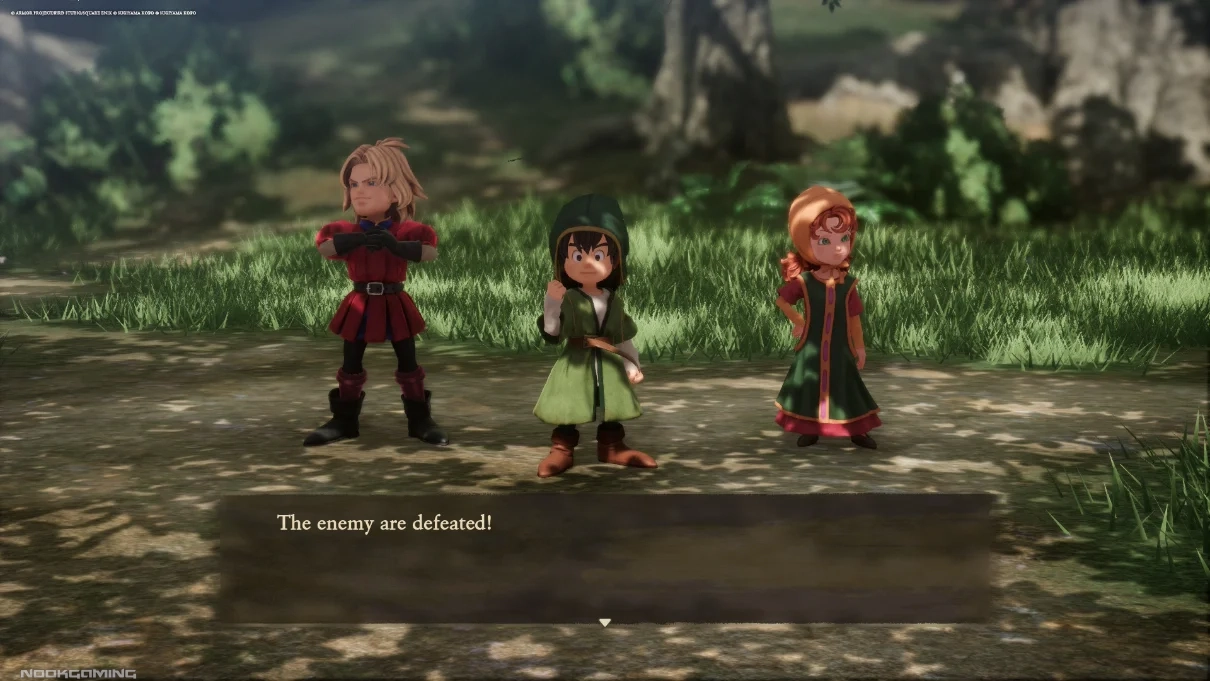
Dragon Quest’s combat is more of the same, aside from the aforementioned changes made to character deaths and inventory. Indeed, you can expect well-balanced turn-based combat wherein you’ll be firing off all manner of weapons and abilities to best the opposition. Each party member specializes in a certain role, with the protagonist focused on support and healing, Maribel focused on magic-based offense, Kiefer focused on physical offense, and Ruff being speedy-but-frail offense. Each character and boss comes equipped with Magic or Abilities that are as characterful as they are useful, with many having some rather niche applications until you know how best to utilize them. It’s as old-school as it gets, but some choice changes made to Reimagined brings it closer to the more modern Dragon Quest outings.
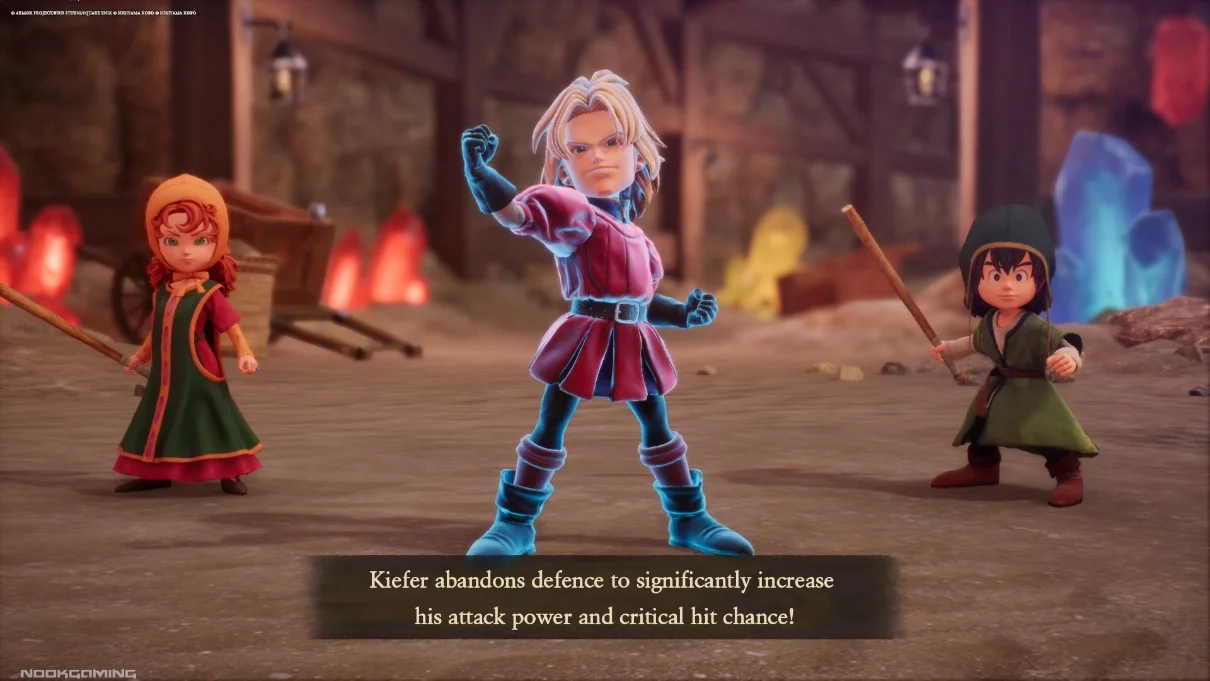
The most obvious addition is the new Let Loose ability, where each character can perform a unique buff that lasts for just a few turns. It doesn’t happen randomly per se, since you can influence when it occurs again with certain skills, but you’re never told outright when you’ll next get it. This can range from Kiefer exchanging defense for extra offense, the player granting a one-time only shield to any attack for the whole party, or Maribel having stronger attack power when exploiting enemy weaknesses. It’s perhaps closest to Pep Powers from Dragon Quest XI and the Coup de Grace system from Dragon Quest IX, where it’s a semi-random benefit that the player should always keep in mind during mid-battle strategy. It’s not really necessary for normal encounters until lategame, but can prove essential to bringing down the game’s many bosses. While Dragon Quest VII isn’t a hard game no matter the version, it has a lot of depth thanks to this new Let Loose ability and the returning Vocations from the older versions.
Vocations, like in Dragon Quest III before it, allow you to change up your party by assigning each character a different archetype. These come with changes in abilities and stats, as well as what kinds of equipment you can bring into battle. It’s with this system that you’re able to customize and find good strategies for boss battles, though unlike before you don’t get it at the start. In a rare instance that keeps to Dragon Quest VII’s infamy, you don’t unlock the ability to change them until roughly a third of the way through the adventure. They’re a nice splash of choice, though again due to the game’s overall easiness, it’s debatable how much you need to really experiment to get by.
To express my praises, there’s generally less grinding needed to mix and match Vocations and experiment compared to both the PS1 and 3DS versions. While I have an aversion to sliders and convenient difficulty modifiers, you can fiddle around with how much experience you get in both normal level ups and Vocational masteries, the latter of which are what grant you new Spells and Abilities, while level ups naturally increase your stats. Rather worrying is that even with both set to “Low”, I was still able to level up a little too easily. Not really bad in most scenarios, but Dragon Quest VII features an auto-battle function where attacking enemies on the overworld will automatically defeat them. Whether you defeat them or initiate a battle depends on your level relative to the monster’s. Even if it was by a little bit, I felt like I was getting auto-battles too often, resulting in me steamrolling enemies as I strolled through areas to pick up missed fragments.
Revived and Reimagined
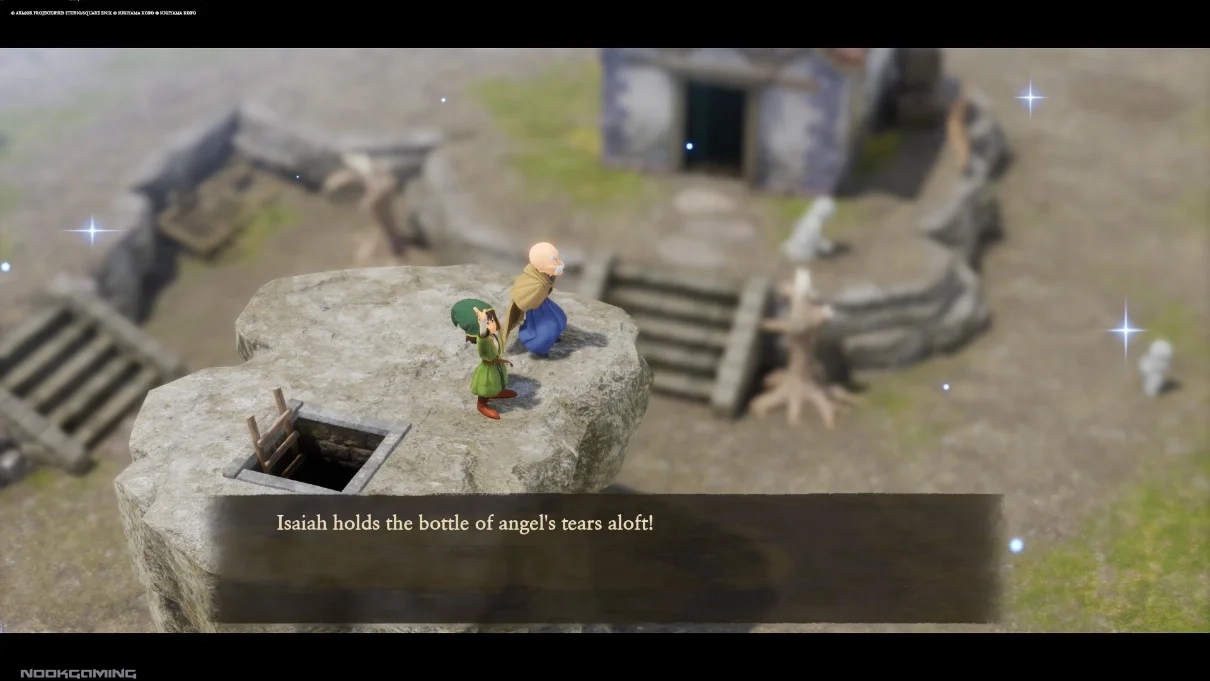
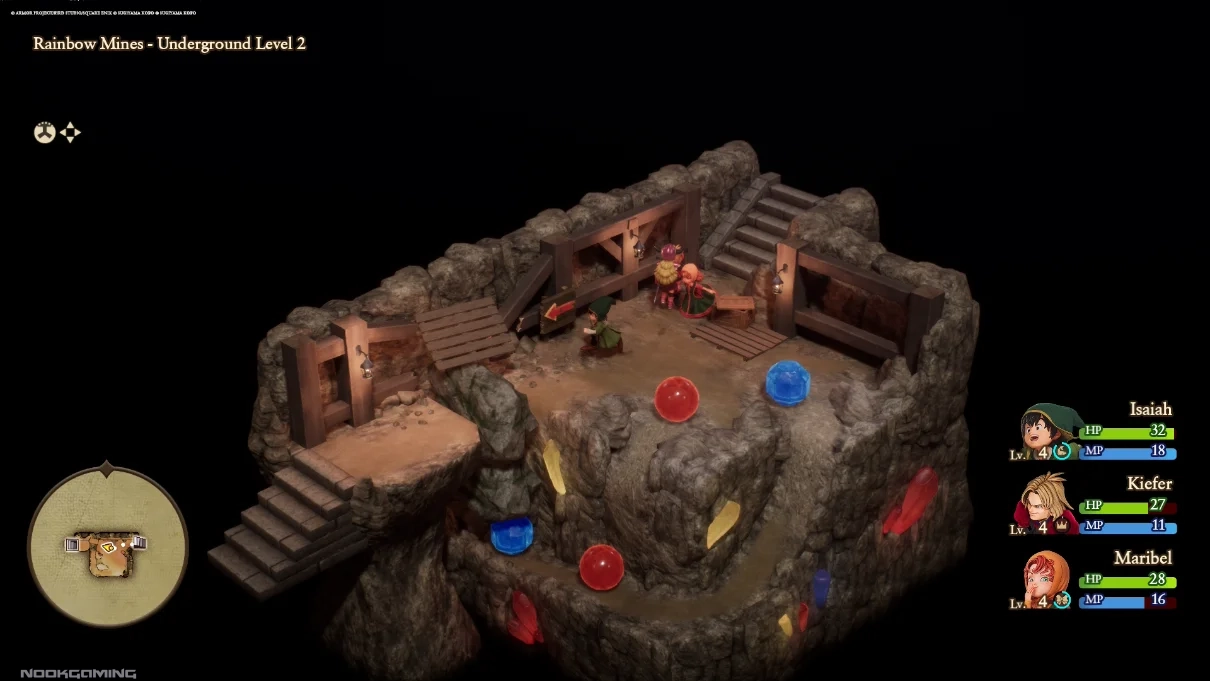
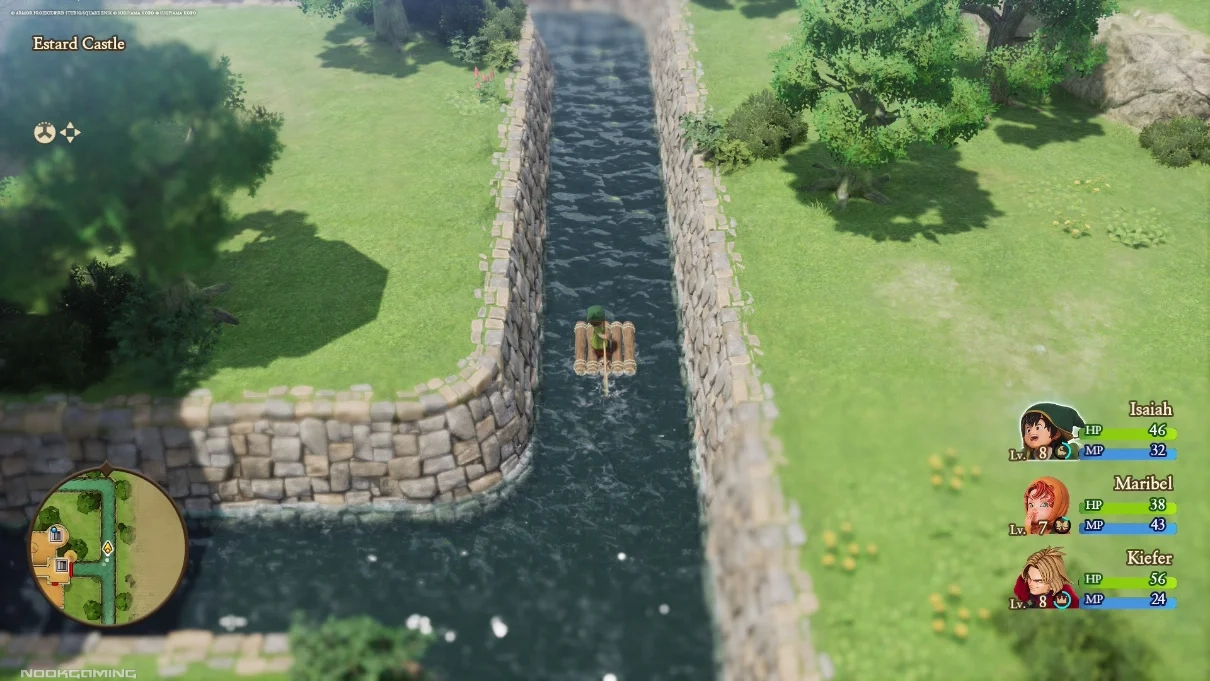
Perhaps the biggest claim to the “Reimagined” subtitle this version of Dragon Quest VII boasts is in its visuals. Barring any supplemental materials or spinoffs, this is easily the biggest visual departure that mainline Dragon Quest has seen. While still keeping true to the designs of the late Akira Toriyama, rather than go for a cartoony aesthetic like before, this outing goes for a diorama style that’s frankly breathtaking. Each character is like a highly detailed doll that moves and emotes with a lot of polish, whether they be a playable character or a monster. There’s also a slightly ugly, dope-y quality to them that fits each of the main characters as being snot-nosed brats. The actual illustrations from the original version of Dragon Quest VII made them all look a bit ugly purposefully, and I think this new style maintains that well.
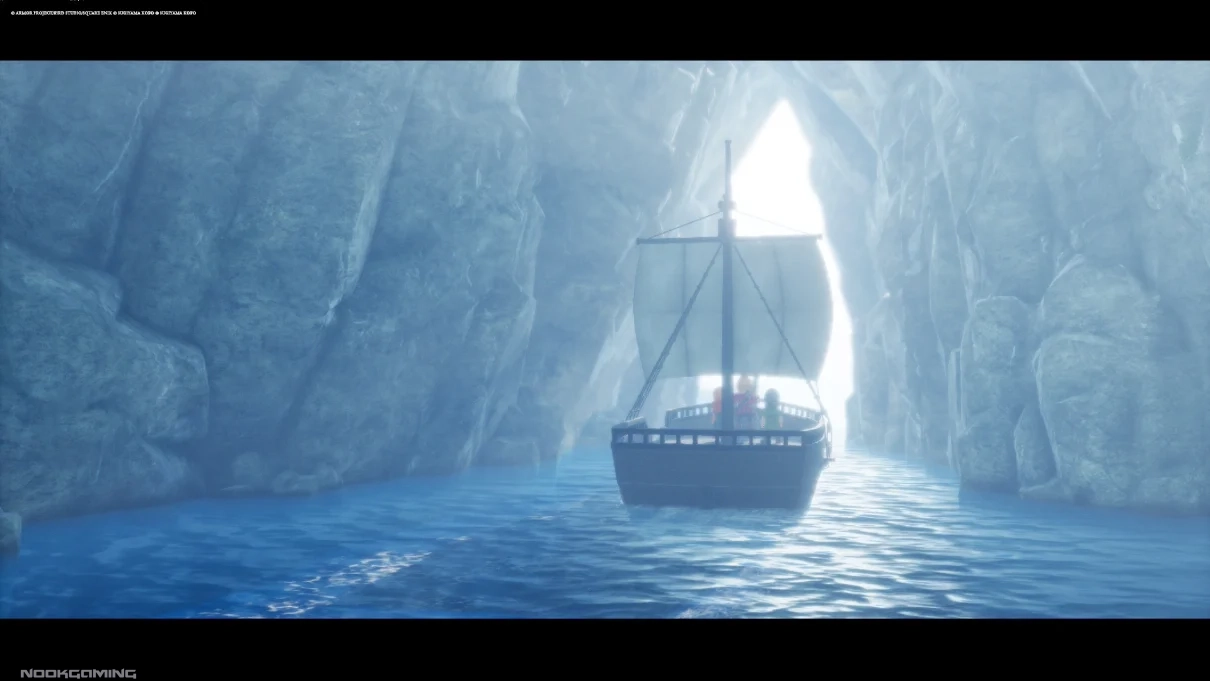
Environments also look great, lovingly decorated with a lot of detail while also being readable and easy on the eyes. Be it from the shining waves of Pilchard Bay to the downright depressing fog of Regenstein, this game prizes a sense of mood above all else. This is elevated further by excellent lighting and crisp visuals, which actually boasts a noticeably higher resolution than the HD-2D Dragon Quest games while still maintaining a locked 60fps on Switch 2. It’s a feast for the eyes, and visiting new towns and dungeons was always a treat just to see what new details they added over the older versions.
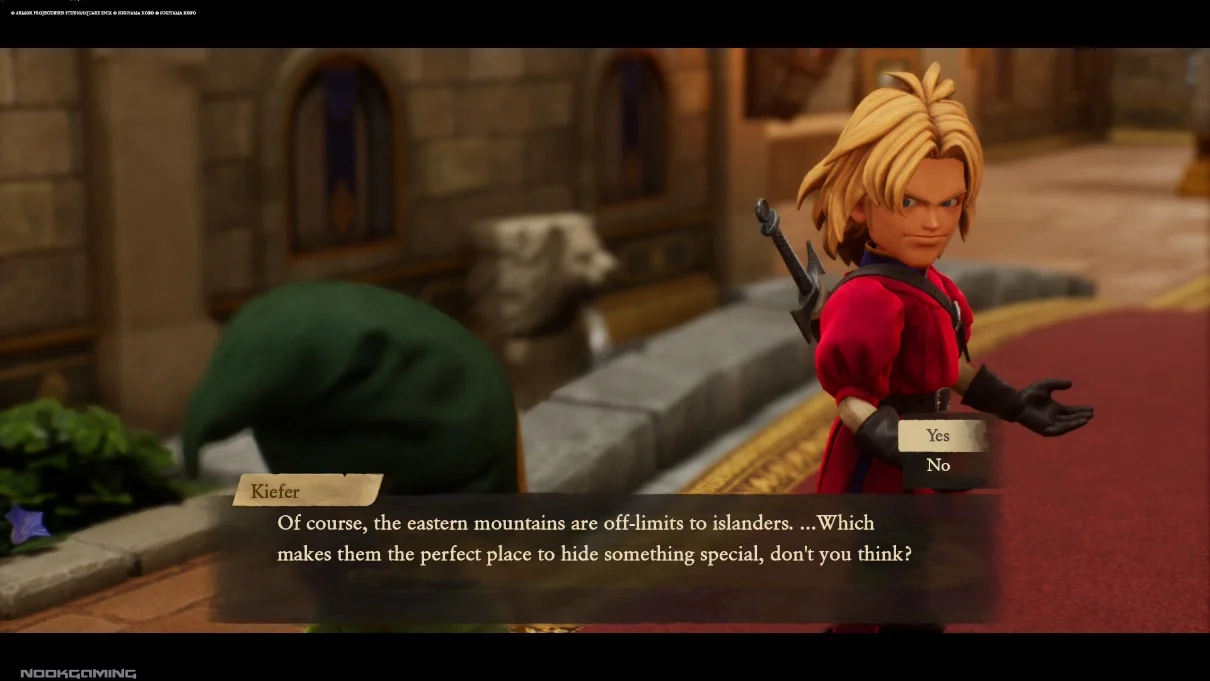
Better still is that this is complimented by excellent voice acting, cutscenes, and localization quality. Most of the “big” cutscenes use elaborate animations and storyboarding, while elsewhere it falls back on expressive voice work where nearly everyone feels perfectly cast. Kiefer in particular is spot-on to how I always imagined he would sound in English, while Maribel sounds like a cuter version of Veronica from Dragon Quest XI, a great match since Maribel is essentially her predecessor. The text in this version utilizes the superb Nintendo Treehouse localization previously seen in the Nintendo 3DS version, barring any of the new content that’s still done in the same style. Despite the enormity of Dragon Quest VII’s script, it’s very polished and I encountered only a small handful of typos over the course of my journey.
Like the Japanese 3DS version, this version also uses the Symphonic Suite variations of Dragon Quest VII’s music. While I appreciate the far higher quality sounding music, it must be said that the actual melodies found in the Symphonic Suite version are noticeably shorter than the old MIDI arrangements from the PS1 version. It puts a spotlight on an already notable problem that DQVII simply doesn’t have enough music to compensate for its enormous scope. Throughout the entire runtime, you get only a handful of town, dungeon, and boss themes, which can occasionally cause noticeable whiplash in tone when shifted between.
Verdict
Dragon Quest VII Reimagined is a game I feel is only a few small changes away from being the best of its ilk. Its dedication to being accessible means that newcomers will likely have a great time with it, but that’s at the cost of overbearing quality of life and mechanical changes. Its adventure and explorative elements are left wanting due to the across-the-board simplification of puzzles and Reimagined’s overeagerness to tell the player exactly what to do. In some places, it feels as though it’s a remake that’s embarrassed of its own legacy when it really shouldn’t be. It’s a stark contrast to the Erdrick trilogy remakes, which wholeheartedly embraced and expanded upon the things that defined them.
On the other hand, this is an ambitious remake in other places. Most notably, the artistic facelift leaves it as perhaps the best-looking Dragon Quest game to date thanks to its diorama style and excellent use of color and lighting to convey mood. This is especially important in that the story is still Dragon Quest VII, one of the very best in the entire genre. Here in Reimagined, it’s been elevated thanks to new additions to the story that are emotionally considerate of its legacy while also being surprising for returning players. Thanks to voice acting and more expressive cutscenes, it’s also the most fun version of Dragon Quest VII’s story to simply watch unfold. Tying all of this together is the familiar yet strong core gameplay of Dragon Quest, and you have a great, if undoubtedly imperfect iteration of one of the series’ more hard-to-breach titles.
DRAGON QUEST VII REIMAGINED IS RECOMMENDED

If you are looking for another Dragon Quest title, check out our review of Dragon Quest Monsters: The Dark Prince or Dragon Quest I & II HD-2D Remake. Or perhaps check out our looks at some other JRPGs.
Many thanks go to Square Enix for a Nintendo Switch 2 review code for Dragon Quest VII Reimagined.
The copyright of the images used on this page is jointly owned by SQUARE ENIX CO., LTD. and other co-owners. The unauthorized reproduction and distribution of the images is prohibited. Ⓒ ARMOR PROJECT/BIRD STUDIO/SQUARE ENIX Ⓒ SUGIYAMA KOBO Ⓟ SUGIYAMA KOBO.

A hobbyist who took up the pen to write about their favorite pastime: games. While a lover of many genres, Isaiah Parker specializes in Platformers, RPGs, and competitive multiplayer titles. The easiest way into his heart is to have great core gameplay mechanics. Self-proclaimed world’s biggest Sonic fan. Follow him @ZinogreVolt