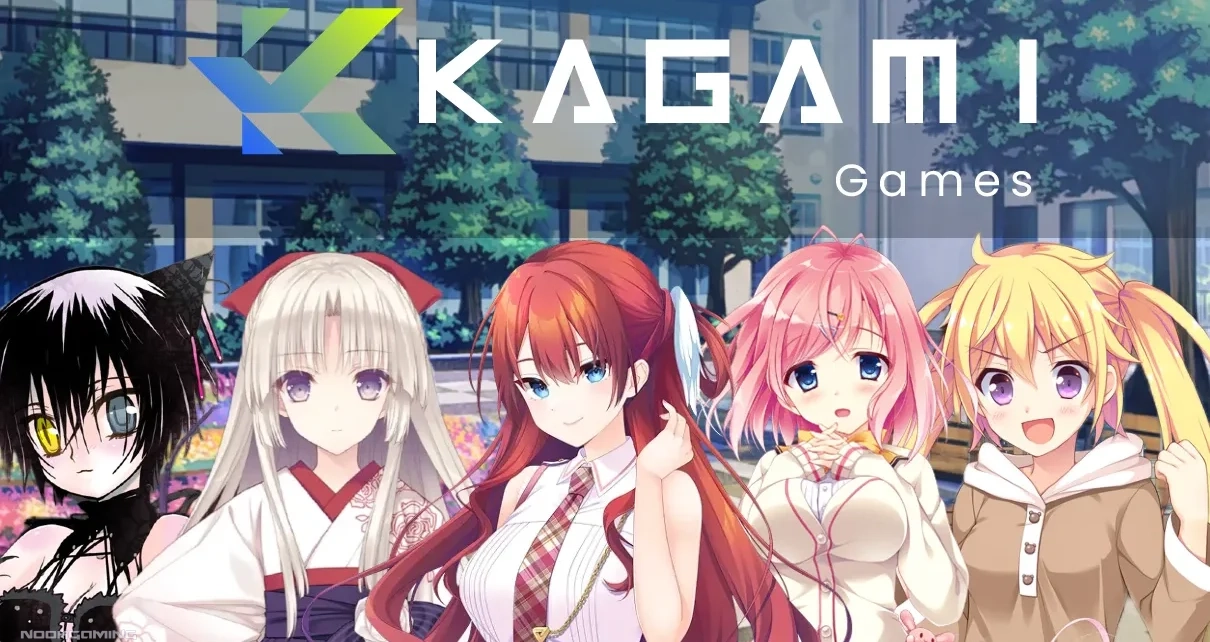
Kagami Games has recently made a significant splash in the global visual novel industry. Following the mid-2025 release of their first localized title, Putrika 1st.cut: The Reason She Must Perish, the publisher added two more titles to its catalog by the end of the year. Their most recent launch, Lovepical-Poppy by the popular developer SMEE, combined with several exciting announcements of upcoming titles, have grabbed the attention of the community. As a result, quite a number of questions have been raised about the publisher and their plans.
To find answers, we spoke with Berth, the CEO of Kagami Games, and Bishounen-P (Public Relations and Project Management), who kindly offered to share their time to give us a closer look at how they operate in this interview.
The Company
To start, could you introduce Kagami Games? We would love to know how the company was founded and what your core mission is. Specifically, what motivated you to enter the visual novel publishing market, especially given how niche and sometimes risky the industry can be?
Berth: Well, to start off, thank you very much for offering us this interview. Kagami Games is a company that was born from the collaboration of several professionals in the translation industry, not only from the West but also from China. We didn’t want to stay only on the consumer side, and instead wanted to use our diverse skills to help expand the catalogue of visual novels available in both languages.
What we want to achieve is simple: to offer as many visual novels as possible, always keeping our feet on the ground, and above all, never limiting ourselves to just one genre, but diversifying as we go.
Could you walk us through your internal structure? We would appreciate hearing more about your core staff and their roles, along with how you integrate freelancers into your workflow.
Berth: Our organization is divided into two main teams. First, we have a team focused on the English side, made up of internal members, or “in-housers”, ranging from translators to Project Manager (PM) and Public Relations (PR), like Bish
The second team is organized in a similar way in terms of roles, but the people are completely different, since they come from the Chinese visual novel community. On this side, we also have in-housers such as our PR, PM, and programmers.
When it comes to projects, what we most commonly do is hire experienced freelancers from both communities.
Bishounen-P: I’ve been managing workflow since I joined the company last year. In my years of experience as a freelance editor, I’ve had the opportunity to work and chat with many other freelancers, and I’ve been able to see what works and what doesn’t. One pitfall I’ve seen come up a few times is check-ins. Sure, you can set a contract and a deadline, but that doesn’t guarantee it’ll be followed. I’ve worked on projects where I was checked in on constantly, and ones where I wasn’t checked in on at all. I try to strike a friendly balance with people so they aren’t afraid to tell me if something comes up that will prevent them from reaching their target so I can look for alternative methods to reach it, but also do my best to stay firm on final deadlines. Basically, as long as everyone’s communicating, I can figure something out.
On the topic of English and Chinese, while Kagami Games only has three releases so far, have you noticed significant differences in purchasing habits or feedback styles between the English and Chinese markets?
Berth: I definitely think there’s a difference between both markets when it comes to this.
Positioning yourself in the English market as a new, fully independent company isn’t as easy as you might think at first, and in the end, that shows in sales. In China, while this issue isn’t as big, it still happens too.
That said, it’s a problem that gradually gets solved as we release new titles, so overall we’re happy and satisfied with the feedback we’re currently receiving from both audiences.
Bishounen-P: At the very least, I can certainly say that both sides love little sisters!
Some fans have described Kagami Games as feeling like it appeared almost out of nowhere, especially given the number of high-profile licenses you’ve already announced for a 2026 release. You’ve mentioned that you’re a new and fully independent company, so what were the biggest hurdles you faced in securing the support needed to go from a new startup to handling major titles from names like Navel and ASa Project?
Berth: All I’ll say is, I wish I were an oil baron and could release at least one visual novel per month, haha.
No, but seriously, I completely understand why people react that way. Still, I want to be clear that as of today, Kagami Games is a fully independent company. Like I said, it was founded by several people to make this possible.
Personally, I think there’s a lot of misinformation, rumors, and assumptions that aren’t true about what it’s like to work with developers and secure licenses. It’s true that the bigger a company is, the more corporate and difficult it can become to get a game from them. But let me tell you a secret… devs are fans too! Many of them genuinely love their games, and if you approach them the right way, at the right time, they’ll be more than happy to let their games reach people in other countries, in other languages, on their screens.
Bishounen-P: To put it plainly… Magic.
Berth: It’s my way to say, “I just sent an email guys, that’s it”.
NookGaming: Fortunately, we have plenty of questions about working with the devs, so you may be able to clear some of those misconceptions up!
Now that you have a few titles released and more being worked on in the background, is there anything regarding your launch strategy or anything else that you would have done differently? Any lessons learned along the way?
Bishounen-P: YES. Well, I’m not 100% sure how much I’m allowed to share, but when I was working on Lovepical Poppy as the editor, I did a little investigating on Kagami’s socials, because I honestly had no idea who this company was before they randomly reached out to me on Discord. And what I saw was, um, lacking. So I started offering free help to them and ideas because, as a visual novel fan, I want my projects to succeed. That was when they offered me to join them in-house as their PR person… to which I countered, “Okay, but I want to have control of recruitment.” Because like I said before, I’ve got years of experience in the industry, so I know how to hire and such.
The translation test from before I took over was far too long and wasted both my time and the translators’ time, so I refined it. There wasn’t enough promotion on socials. Announcements were happening too late and too suddenly. The most important things I bring to the table, in my opinion, are my skills in planning and my experience. To be clear, I can’t exactly blame them for how it was before I joined, because they just lacked the professional experience that I have, which is something you can only get over time (and with luck.) But now, we’ve got many plans in the works, a release schedule, social media plans, etc…
That being said, I’m not trying to toot my own horn too much, and I’m sure there will be things that I learn as this continues on. Only time will tell…

Working with Japanese Partners
Could you tell us a little about how you successfully pitched to Japanese rightsholders when you were a new entity without an existing portfolio of releases?
Berth: When you don’t have experience as a company, it’s hard to email developers and expect them to respond positively. A lot of the time, they don’t reply at all, even when you’re already an established company with years of experience, so you can imagine…
So the key point here is knowing who you can reach out to and how to approach them. In our case, or in my case, since my job is almost entirely about securing licenses and dealing with devs, I started by asking myself questions like: “Has this developer released anything in English before?” “What have their international releases been like?” “Would they be open to working with another partner?” “How many games do they have, and how many can they produce per year?”
Once I had those answers, the first thing I tried to do was set up an in-person meeting and explain the strengths of our team. Not so much the company itself, because there isn’t much you can say about a company that’s just getting started, but you can make up for that by focusing on the strengths of the people running it, or the team you have in mind for that project. Once you land the first project, you’ve taken off, and after that it’s mostly about waiting for the right moment and sending a strong email.
Bishounen-P: I don’t work on that side, but from my understanding, the ability to do an in-person meeting helps a lot, doesn’t it?
Berth: Meetings are absolutely decisive when it comes to whether you get a license or not
You mentioned, “Would they be open to working with another partner?”. Are certain developers locked into working with certain international publishers, or is it more about having an existing relationship and a strong preference to work with a known partner?
Berth: I think one thing leads to the other. But in my personal experience, it depends entirely on the dev’s catalogue and production model. For example, if a dev releases several visual novels in a single year, they tend to be more open to negotiating licenses with multiple publishers at the same time, because they, or their current partners, can’t fully cover all the demand.
On the other hand, devs who release only a few visual novels per year, or one every few years, are usually locked in with a single partner. That’s a mix of trust and comfort, and the fact that they don’t really feel a need or a reason to work with another publisher at the same time. Since their catalogue is limited, their current partner already covers the demand.
So, relationships with your Japanese partners are important. How do you maintain these after a game is out? Do you provide developers with feedback on how their stories are landing with overseas audiences to influence their future titles or support your requests for further licences?
Berth: The best way to maintain a good relationship with any Japanese partner is, first of all, to do things right with their game, both in the localization and in the release. You also need to be fully transparent throughout the whole process and explain even the smallest detail or any issue that comes up during production of the international version. That helps them see how important their games are to us and how seriously we take them, and that’s where the trust comes from to keep collaborating on future titles.
Of course, if on top of that you can deliver releases with strong sales numbers, that speeds things up a lot, haha.
NookGaming: So would you say that if people want to see more titles from a certain developer, then buying the existing ones increases the chances that the developer will let it happen?
Bishounen-P: (said with whimsy) Yes. ✨
Berth: Basically.
We sometimes hear about friction between publishers and Japanese partners regarding content. This can include developers insisting on minimal cuts despite Steam’s strict policies, disagreements over mosaics, or even last-minute changes regarding whether to allow an 18+ release at all. How do you manage these expectations and prevent conflict, particularly when the power dynamic often favors the Japanese rights holder?
Berth: Fortunately, we haven’t had to deal with any case that extreme so far. Devs are people too, and if you explain clearly why you think a certain decision will benefit the title, they’ll usually end up letting you apply it.
I know the concern around mosaics usually comes up when you’re releasing the game alongside the Japanese version. They worry a lot about legal issues in Japan, so they’d rather avoid any possible trouble by not doing a no-mosaic release. Although, to be completely honest, that’s something I heard many years ago, and the reality today is that a lot of devs already have, and even produce, their visual novels with a no-mosaic version ready for an international release.
Bishounen-P: In terms of the players, it’s best to be completely up front so they have the proper expectations. You don’t want people thinking that we’re evil and forcing this upon anyone, and the same goes for Japanese developers. In most cases, it’s not like they want to put out a censored release, but various, countless things out of anyone’s control happen, so unexpected things can just… crop up. It’s why, for example with our upcoming titles, I am clear up front which titles we can promise will be uncensored, and which ones we cannot promise, but are trying to. As we all know, the climate for R18 games is a whole can of worms right now. I think a lot of people are scared and nervous about what the future will hold. So… all we can do is be honest and put our best foot forward.

Licensing
Beyond enjoying the visual novel itself, what factors go into deciding on which visual novels to license?
Berth: The decision on which visual novel to license comes down to three questions: Do we like it? Do people like it? Is it available in Chinese?
Bishounen-P: And if the developer is willing to license it out.
When you say “Do we like it?”, does that mean your staff members have a significant input into choosing titles they would like to see licensed?
Bishounen-P: Like our “wishing well” in the public Discord server, we also have a “premium wishing well” in the staff server, which is often pulled from the public wishing well.
A question that we’ve seen asked a few times is whether Kagami Games will be localizing fandiscs, considering that both Lovepical Poppy and Koikata: How Our Love Grows both have one. Are fandiscs in general something being considered, and if so, are they more likely to be planned from the start or decided on after seeing sales numbers of the main game?
Bishounen-P: In general, we can’t decide on it from the start, because ultimately, it depends on how the games do. We aren’t at all opposed to them, and in fact, we’d like to do them. So… if you want to see fandiscs… you know what to do. Buy, buy, buy!
You recently conducted a survey asking fans which titles they want to see next. How heavily does data like that influence your business decisions? Even if specific titles that respondents ask for aren’t possible, do you look at trends and try to find similar ones?
Bishounen-P: The survey was something I did to gather data and see what titles people are interested in one place. In particular, their “#1 most-wished-for visual-novel.” When you can’t just dump a ton of titles that you’d maybe like to see, you gotta look within and pick out something special. From there, I take the list and ask Berth to look into them. Additionally, I had a question about interest in companies that haven’t seen an English release thus far, and have Berth reach out to those companies as well. If they’re not available, we try to at least find out why they aren’t available, and then go cry in a corner.
Anyway, TL;DR, we just want to please The People.
On the topic of the survey, were there any titles or trends in titles requested that you found surprising?
Bishounen-P: Loads of moege. But then, of course, there are people asking for the big classic untranslated kamiges, which… well… I mean, there are various reasons they’re not already out yet, right? We try to look into them regardless, but it kinda is what it is.
There were also some titles requested a decent amount of times that we are working on, but haven’t announced yet. So stay tuned. 🙂
NookGaming: So nothing too surprising?
Bishounen-P: Not for me, at least. I’m a visual novel otaku, so I’m pretty in-tune with trends and what the community is into. It was fun to read through regardless, though.
With many classic visual novels having never left Japan, what is Kagami Games’ stance on localizing older titles? Is there a particular era of visual novels that you feel is underserved in the current market? Do you think there is any truth to the sometimes-stated idea that older titles don’t sell well enough to localize?
Berth: Personally, I’d love to license a lot of titles from 2000 to 2008. There are a few issues here. One is licensing: many titles run into disputes between the devs and the companies that adapted those games to other platforms. Another issue is that the older the title is, the less likely it is that the dev still has the original files.
But the biggest problem in my opinion is, unfortunately, how hard they would be to sell. There is an audience interested in older games, but from my point of view, it’s still a small group compared to the people who buy new titles at higher resolutions. There are exceptions, like titles that have left a real mark on visual novel fans and deserve an international release.
In the end, if you want to release an older game and give it a better chance to sell, you’re basically talking about remasters, or even remakes. That raises the cost a lot, and it can lead to the conclusion that it’s just not really worth it economically.
Many fans were surprised by the Twilight’s Folclore announcement, especially since Navel hasn’t been active in the English market for about ten years. How did this collaboration come about, and why did this specific game feel like the right one to lead their return? Were there any particular challenges in getting them back on board for an English release?
Berth: As I mentioned in an earlier answer, the important thing is sending a strong email at the right moment. Now, even though Twilight’s Folclore is a game that we find extremely appealing both visually and in terms of its plot, I understand why some people say, “But why didn’t you start with more well-known titles? Like Tsuriotsu, Sorechiru,” and so on.
I’m not sure how people will take this, but my personal strategy for starting a business relationship with a developer is to begin by licensing a title that, at first glance, they won’t have any issues handing over to a completely new partner. In other words, going for the most famous titles usually isn’t a good idea. They might already be in talks with other publishers, and when that happens, the dev often won’t even reply to your emails, which basically closes the door to any kind of collaboration.
As for the process, everything went very smoothly. The person in charge at Navel was always very pleasant in their replies to us, and they fully understood our offer and our suggestions on the best way to sell this title.
Ensemble is primarily known for their ‘Otokonoko’ titles, yet between the previous release of Secret Agent by NekoNyan and now Koikata: How Our Love Grows by Kagami Games, the English market has only seen their more traditional titles when it comes to official releases. Was the decision to go with a title featuring a non-crossdressing protagonist a conscious choice to lead with a broader appeal, or was there something specific about Koikata’s charm that made it the right fit for Kagami’s lineup despite the developer’s reputation for more niche themes?
Bishounen-P: When they showed me they got this title, I instantly decided that Saori is my wife.
Berth: We’re aware of that question, and honestly the answer comes down to a completely personal reason. From the beginning, I always said that if we released something from Ensemble, the first one would be Koikata. Koikata was the first game I ever read from Ensemble.
Of course, people wouldn’t naturally know this, but a lot of the time, we’re not against licensing more than one game at a time from our partners. Still, when a business relationship is just starting, sometimes you have to prove you can handle one title first, and then build from there.
Bishounen-P: Believe me—Berth is not afraid of licensing an otokonoko title.
Berth: Totally not.
NookGaming: Some of your comments in your Discord server previously have made it clear that you’re interested in these types of titles.

Production
When you have secured the rights for a title, what does the immediate roadmap look like?
Bishounen-P: First, I check with Berth if there’s any requirement for the title to be released at a specific time by the Japanese side. Then, I look at our current release schedule. Based on how long a title is, I will set a target month/quarter and immediately start recruiting for a title. If not ready to recruit quite yet, I’ll put out feelers to trusted translators I know. If no one I know is available, I’ll start looking elsewhere and sending out tests.
Some Japanese visual novels are built on legacy engines that were not originally designed for English or Chinese characters or word wrapping. How much of Kagami Games’ work is technical versus linguistic? Do you have an in-house engineering team, or is this work handled by the Japanese developer or otherwise outsourced?
Berth: At the moment, all the technical work is handled entirely by Kagami Games. Sometimes we hire freelancers, although it’s not that common. We have a full team of in-housers with extensive experience in almost all Japanese visual novel engines, as well as engines commonly used for ports, like Ren’Py, Artemis, and Unity.
If I had to list Kagami’s strengths, the technical side would definitely rank very high.
Many publishers rely on a mix of in-house staff and freelancers. How do you vet your external recruits to ensure they can meet the high technical and linguistic standards Kagami Games sets?
Bishounen-P: I spent a lot of time over the years networking, be it online on Discord or meeting other professionals at cons. For those whose standards I’m familiar with, I bring them in knowing what they can handle. For those I haven’t worked with, I have a test for them to take that I evaluate myself and provide feedback on. For anyone who fails the test, I allow them to reapply at a later date, as I know how much people can improve when provided with feedback.
Certain publishers have faced criticism for releases with bugs, a significant amount of incorrect text, or other problems. Could you tell us how your QA and other processes help to avoid these issues?
Bishounen-P: I’ve worked with plenty of QA over the years and have experienced both good QA and bad QA. As of now, I’ve got my most trusted QA that I have handle a variety of tasks, and the output has been stellar, as expected.
You recently announced a simultaneous release of Triple Pairing by Hooksoft. How do you navigate tight deadlines like this, both with the work internally and with issues like Steam’s approval process reportedly sometimes taking weeks longer than expected? And does a simultaneous release require you to work with incomplete scripts and builds while the game is still being developed in Japan?
Bishounen-P: For Triple Pairing, we’ve had to set up our team in advance and go with people we’ve worked with before. The team for Triple Pairing is very similar to Lovepical Poppy. In the past, I, separate from Kagami, had to work with an incomplete script on a simulpub title, but for this project, we have the scripts, but lack a build. It’s definitely harder when you don’t have a build to reference things from, but luckily, working closely with Hooksoft means we can check certain things with them.
Quite a few of your 2026 announcements have been revealed to be coming with significant increases in resolution and a shared set of new features. Will these be upscaled versions or remasters with new, higher-definition assets? Can you tell us about the engine you’re porting to?
Berth: Most of them, or at least the games that aren’t that old, are remasters made using the original assets provided by the developers. In fact, many of those assets already supported higher resolutions, but for some reason, the Japanese versions stayed at basic HD.
Other games like Inganock, for example, are handled with a mix of both approaches: remastering and upscaling, all done with the devs’ support. As for the engine, for our ports we’re currently using Ren’Py.
What is Kagami Games’ philosophy on AI? Do you see it as a tool to speed up parts of the technical or linguistic pipeline? Or do you remain committed to a strictly human-only localization process from start to finish?
Bishounen-P: There wasn’t AI-usage in place before I joined the company, but after I joined, I took it upon myself to include in our freelance contracts that the usage of AI and MTL are strictly forbidden, just to be on the safe side. We’re not interested in it going forward either. If we aren’t putting in the effort to bring forth a quality release, why would someone give us their hard-earned money?
Handheld gaming on the Steam Deck and similar devices is seeing a surge among visual novel fans. Do you specifically optimize your releases for small-screen readability and touch/controller inputs?
Berth: I can say we do it whenever the engine in question allows it. It’s important to clarify that some Japanese engines are very difficult to modify, and sometimes we might not be able to add optimizations for specific things like the Steam Deck and so on. For the ports we’re currently working on, we are doing it, that’s something I can confirm as for now.
On top of that, we’re setting up an infrastructure that will be ready for any potential Android release and also for consoles, which is actually something we’re considering more and more as time goes on.
Storefront Difficulties
While many publishers, including Kagami Games, use restoration patches to provide a complete experience. What are your thoughts on having to cut the majority of content instead of just the adult content to fit onto a storefront?
Bishounen-P: If I had it my way, we’d do a proper all ages release with a patch on the side. But it’s just not feasible in this day and age. The current R18 climate is so messy on storefronts that it’s gotten absurd.
You know, I bought a certain all ages game on Steam a year ago or so, which was going to get an R18 version at a later date, and so I thought, “Okay, I don’t need to patch it then, since it’s the ‘Safe for Work’ version anyway.” But I got to the end of the prologue and it went back to the title screen. The current climate of Steam is that you need a patch for an all ages version of a game that has no sexual content.
I don’t think any publisher really wants to put out a version with cut content. We’re just forced to. And, from an editing side, I will say it’s really annoying to have to go through and flag every single line that you think might upset Steam. But they have such a significant portion of the market that you just have to do it or you go bankrupt. I really hope that one day, getting banned on Steam isn’t such a killer for these games. Thankfully, platforms like JAST help out a lot with that.
Berth: Honestly, I don’t think any publisher, or the devs either, likes cutting content at all. Unfortunately for everyone, Steam is the platform that represents the vast majority of reach and sales a game can have today, and to get a visual novel onto Steam these days you have to go through a review process that, most of the time, is completely absurd. I’d even go as far as to say it can feel malicious, depending on who’s reviewing it.
I won’t lie, there are times when, depending on who reviews your game, it can get approved without much trouble just by removing the 18+ scenes, but those cases are extremely rare. In most cases, if you don’t do a very meticulous cut, as ridiculous as it sounds, Steam can claim they believe there is mature content in your game without being able to confirm it, and they won’t approve it until you tell them what mature content is in there, even if that content doesn’t exist at all.
So in short: for a visual novel to sell well right now, it needs to be on Steam, and for a visual novel to be on Steam, you either adapt or you take the risk.
Does the reliance on external patches make it harder to market your games? If so, how do you combat the inability to advertise and host the full content on major platforms and avoid the issue of people inadvertently buying the cut-down build with no awareness of the patch?
Bishounen-P: By now, most people buying these games are in the know. And if they’re not, there are always people in the reviews and forums talking about the patches. We, as publishers, cannot talk about the patches ourselves on Steam, so we rely on fans. It’s another one of those things where I can only really say, “It is what it is.” We share the patch where we can, and try to make it as easy as possible to apply, and word of mouth will carry it far.
Does Kagami Games have a contingency plan if Steam becomes even more restrictive? Do you feel the company could be profitable without it if needed at this point?
Berth: I think the contingency plan in those cases isn’t very different from what other publishers do. You sell on other storefronts, and whether it ends up being profitable or not honestly depends on each title. I don’t have enough personal experience yet to tell you right now if it would be or not, but it would definitely reduce sales numbers significantly.

The Future and Closing Thoughts
Beyond localization of visual novels, does Kagami Games have any aspirations to move into other areas? Is localizing other types of games, anime media such as light novels, or anything else something you’re looking at? Any thoughts on physical releases?
Berth: Right now, we’re fully focused on localizing and publishing visual novels. We’d like, and we have plans, to move into visual novels with RPG elements, as well as physical merch.
It might be a bit early to share more details, but we’re even considering the option of developing our own visual novels in the not-too-distant future.
I think we’ve seen plenty of cases where trying to run different types of businesses at the same time is not a good idea at all, so when I planned how Kagami Games would operate, I was very careful not to overextend ourselves.
As a more personal question for each of you, even if unrealistic, what would be your dream visual novel to localize and release?
Bishounen-P: Listen. I am a visual novel otaku, but I am also a fujoshi. I am a big fan of Boy’s Love titles like Hadaka Shitsuji, Slow Damage, and NO, THANK YOU!. So, if you take all that information and put it together, the obvious answer would be Shin— Gakuen Handsome. I LOVE shitposts and parodies. I want to publish every single game in the Gakuen Handsome series. More impossibly, in my ideal world, we would also dub it with really poor-quality microphones. And I would literally never stop talking about it for the rest of time.
Berth: I don’t think my answer to this will surprise many people. For me, that dream project would definitely be Da Capo 4, 5, and anything else that comes next. Da Capo has a special place in my heart because it was the first visual novel series for me, with Da Capo 1 being the first visual novel I ever read in my life. Since then, I’ve followed the series faithfully from the first game, including every single fandisk, some of which were pretty hard to get. I even had to ask some friends in Japan to track them down in second-hand stores and send them to me, haha.
So yeah, my answer is definitely Da Capo.
To wrap things up, you have already released three visual novels and 2026 looks to be a busy year for the company. Is there a message you would like to share with the fans who have supported you so far, those who are looking forward to your upcoming titles, or those who are still skeptical?
Bishounen-P: Gosh. I’m trying really hard to come up with a message that’ll come across the right way. Most importantly, I want everyone to know that the company is truly full of people who are passionate about Japanese visual novels. And I’m really proud of what we’ve managed to accomplish so far, and the community we’re building. I and the rest of Kagami Games are working incredibly hard to prove to everyone that we can do it and we will keep our promises. Thank you for your support up until now! ❤️
Berth: First off, I want to sincerely thank everyone for the support you’ve been giving us over the past few months. To be honest, I didn’t expect we would build such a friendly and loyal community in such a short time, and that only gives us more motivation to keep pushing ourselves, deliver the titles we’ve promised within the promised timeframe, and not make too many mistakes so no one feels let down by us.
We have many more projects that we still can’t announce because they’re either waiting to be started or have only just begun, along with other surprises that I think we’ll be revealing sooner than you expect. So stay turned on our socials, and don’t forget to stop by our Discord server, there are really fun and interesting chats every day!
Thank you to Berth and Bishounen-P from Kagami Games for talking with us about the visual novel industry and starting as a new publisher. Please check out their titles such as Putrika 1st.cut: The Reason She Must Perish and Lovepical-Poppy, along with their announced upcoming titles.
Want to see more interviews? We’ve spoken with Ono Wasabi the CEO of Laplacian on visual novel industry challenges and TAKUMI, Kazushige Nojima, and Yoko Shimomura on their work for Reynatis. If you’re interested in localisation of games and novels, we’ve also got an interesting interview with Tristan K. Hill, a Japanese to English translator.

A gamer since the days of Amstrad and DOS and someone who has dabbled in a variety of professions. He enjoys a wide variety of genres, but has been focusing on visual novels and virtual reality in recent years. Head Editor of NookGaming. Follow him and the website on @NookSite.