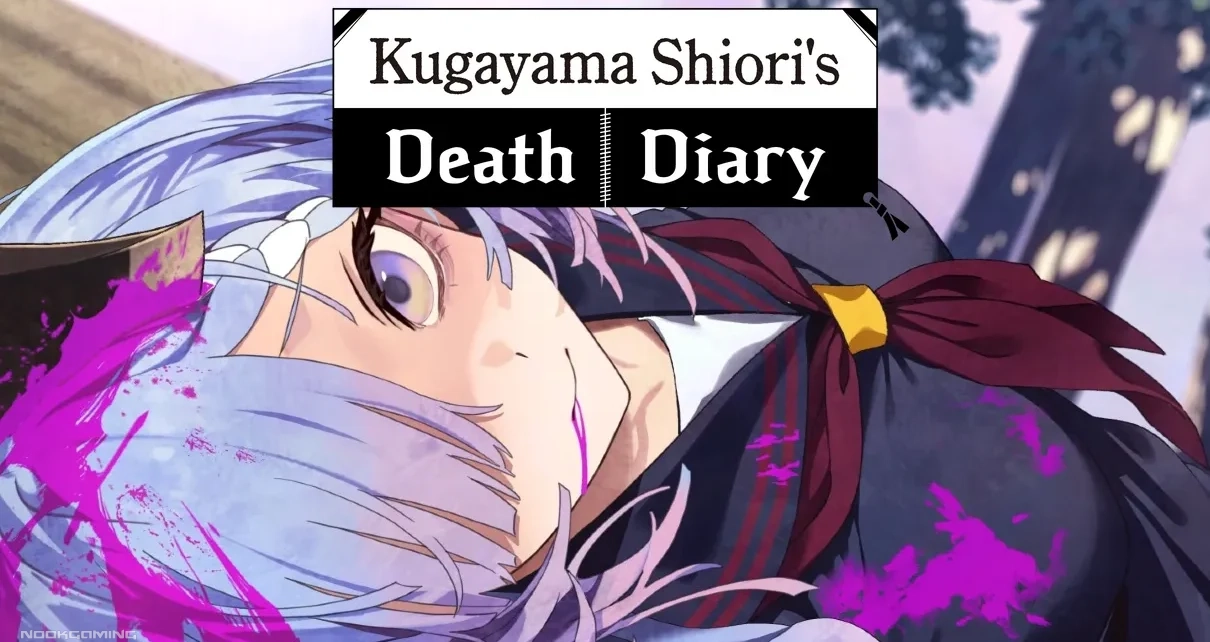
Kugayama Shiori’s Death Diary (Kugayama Shiori no Shinizama Techou) is the latest visual novel from developer Laplacian, and it’s one that sees the studio trying new things. The lead writer is Kazuki Fumi, known for the Criminal Border and 9-nine series, rather than Ono Wasabi, who was the main writer on Laplacian’s previous visual novels. It’s also a striking departure in visual aesthetic and has a greater focus on interactivity. Kugayama Shiori’s Death Diary is certainly different from my previous experiences with Laplacian, but I found a lot to enjoy in the new ideas.
Die, Die, Repeat
Kugayama Shiori’s Death Diary begins with the protagonist encountering a strange woman hanging ominously from a tree in the park. The woman introduces herself as Kugayama Shiori, a ghost with no memories besides her name and a strange obsession with suicide. She’s excited to meet someone who can see and hear her, and asks the protagonist to meet her at a nearby convenience store and help her regain her lost memories.
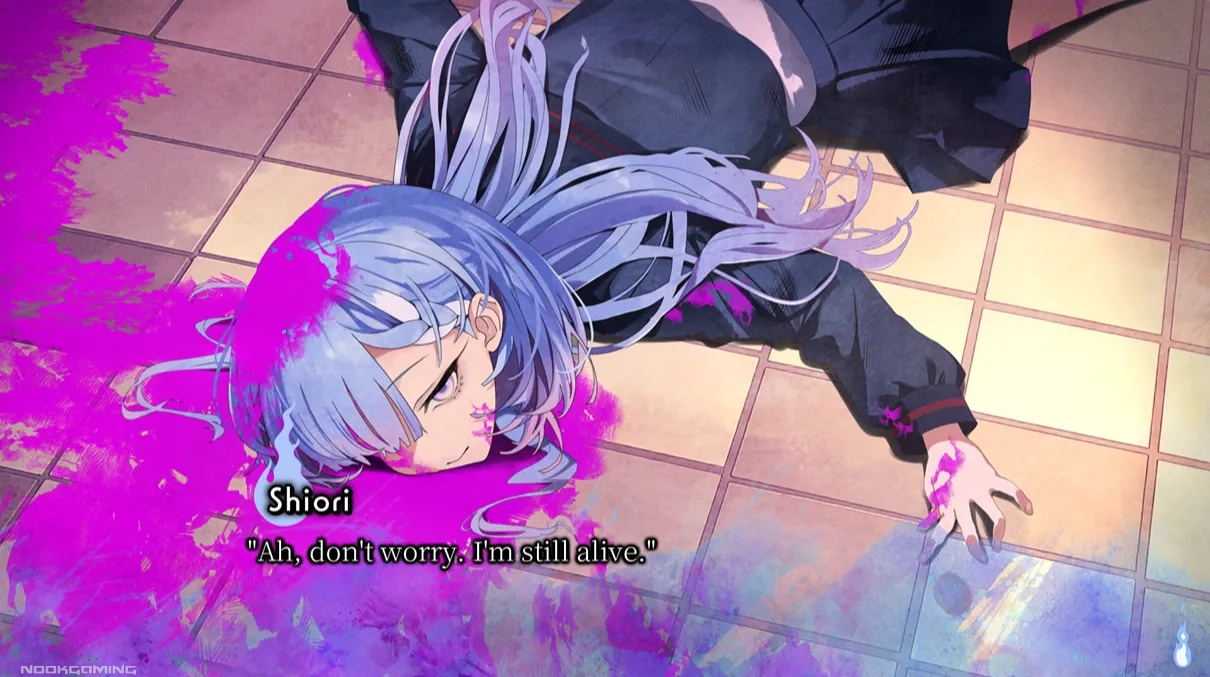
Interestingly, the nameless protagonist of Kugayama Shiori’s Death Diary is mostly mute. They occasionally have a line of dialogue when you make a choice or a line of inner monologue during scene transitions, but otherwise the story is filtered through the dialogue of the other characters. This is a bit awkward early on when the characters haven’t been established and there are a lot of scenes of Kugayama Shiori having both halves of a conversation with herself to stand in for the protagonist. Things get better as the story progresses and more characters are introduced, providing Shiori with responsive conversation partners. Beyond that, you get to know the characters better, and it becomes more believable that Shiori and the protagonist can communicate effectively with a minimum of dialogue. There is ultimately a narrative reason that Kugayama Shiori’s Death Diary leaves the protagonist so blank, though I still think a bit more verbosity would have been preferable.
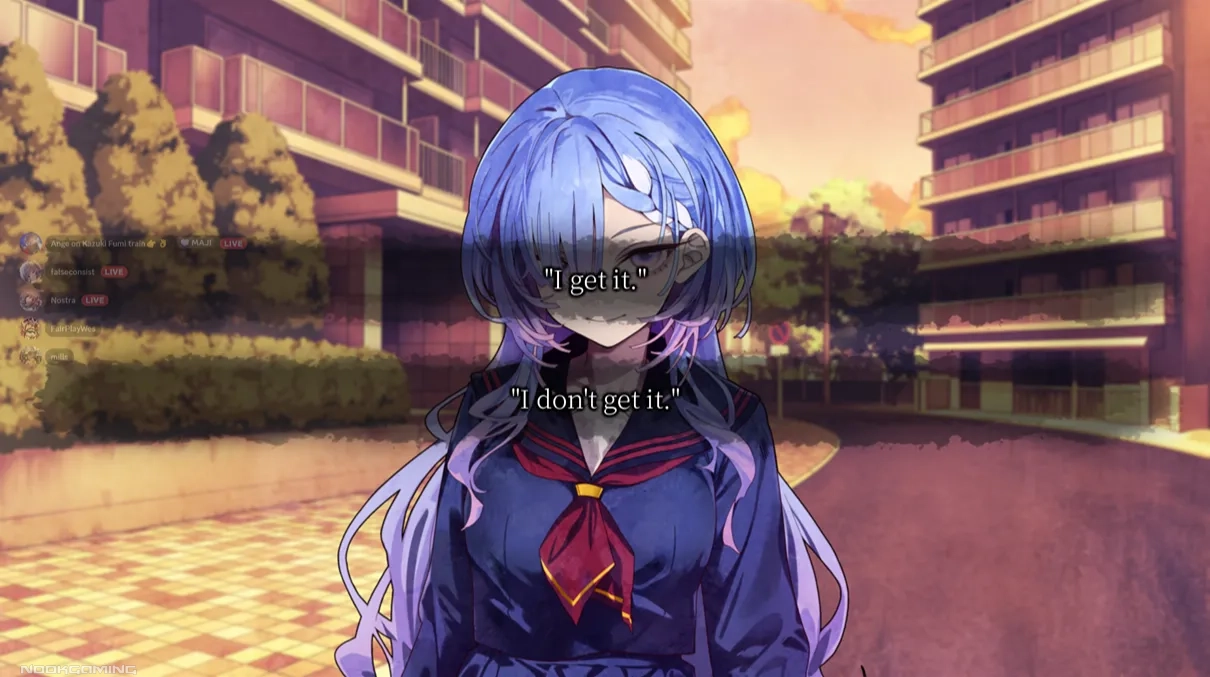
Despite my issues with the mute protagonist, I found the early parts of Kugayama Shiori’s Death Diary engaging because it establishes a strong atmosphere from the outset with its art and music. The color palette emphasizes the otherworldly, using colors such as the ethereal blue of Shiori’s hair, while washing out the greens and browns of the natural world. The CGs are also ever so slightly grainy in a way that evokes found footage horror. Simultaneously, the music is creepy and unsettling, with little in the way of melodies for the listener to grab onto and heavy use of repetitive patterns and drones. The aesthetic effectively creates an unnerving and otherworldly mood that serves as a flavorful backdrop to a story full of ghosts.
A Shiver of Spectres
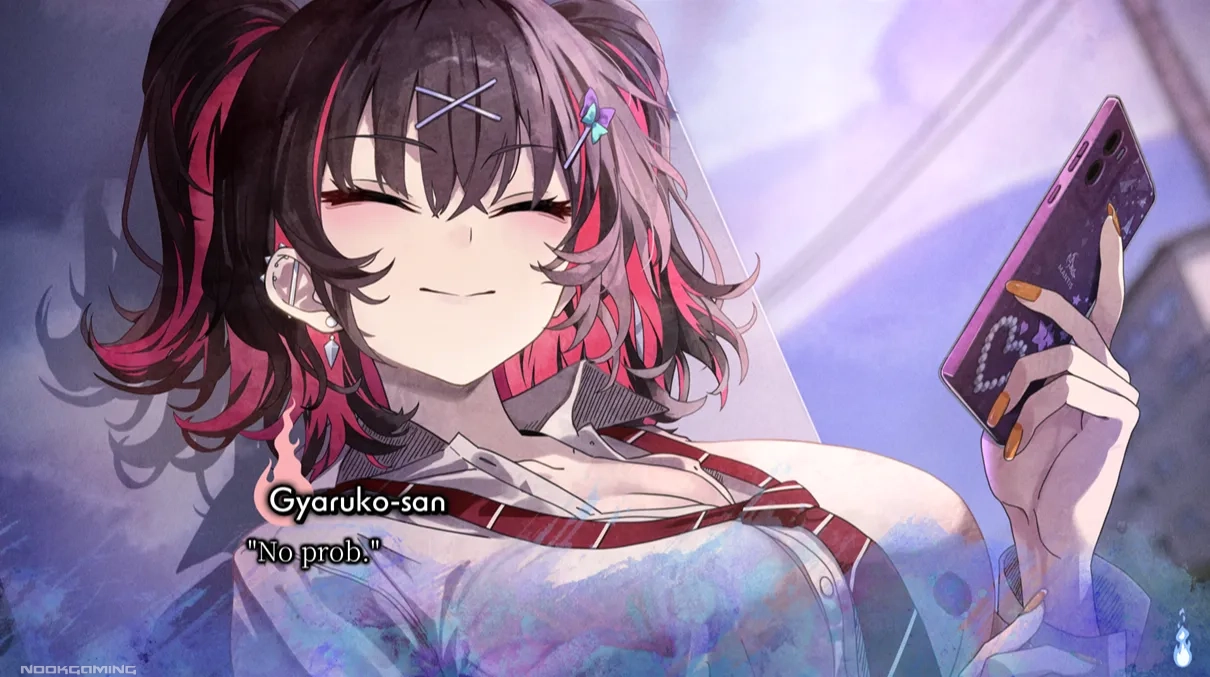
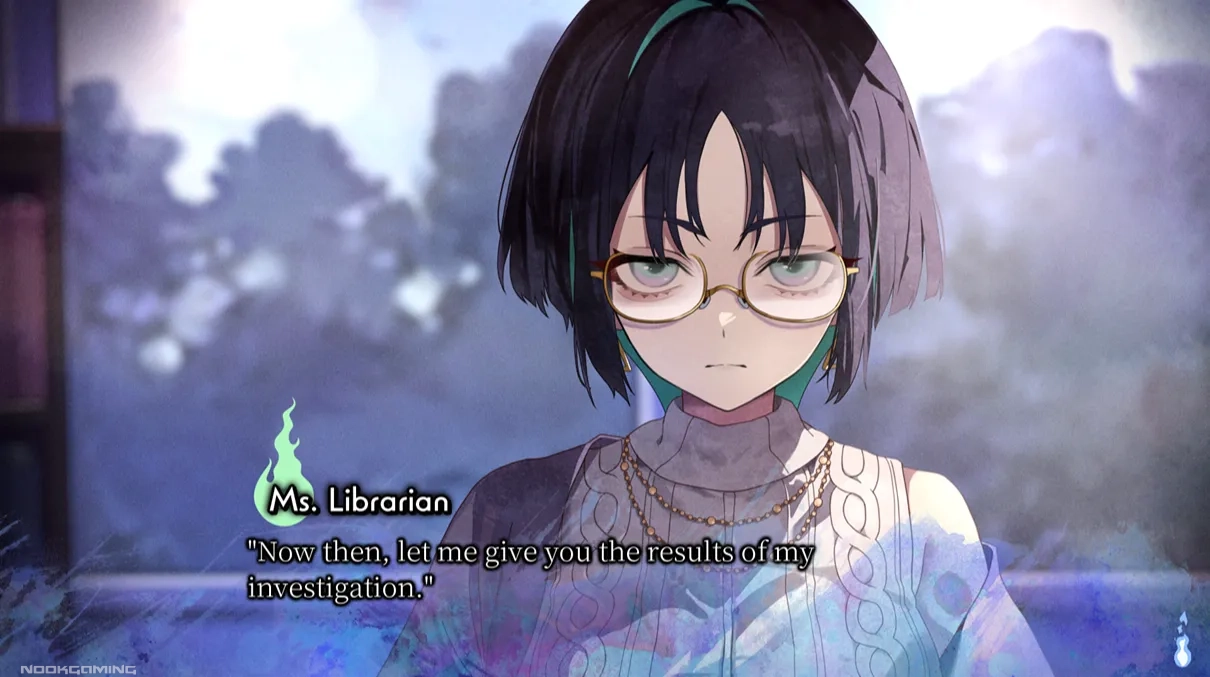
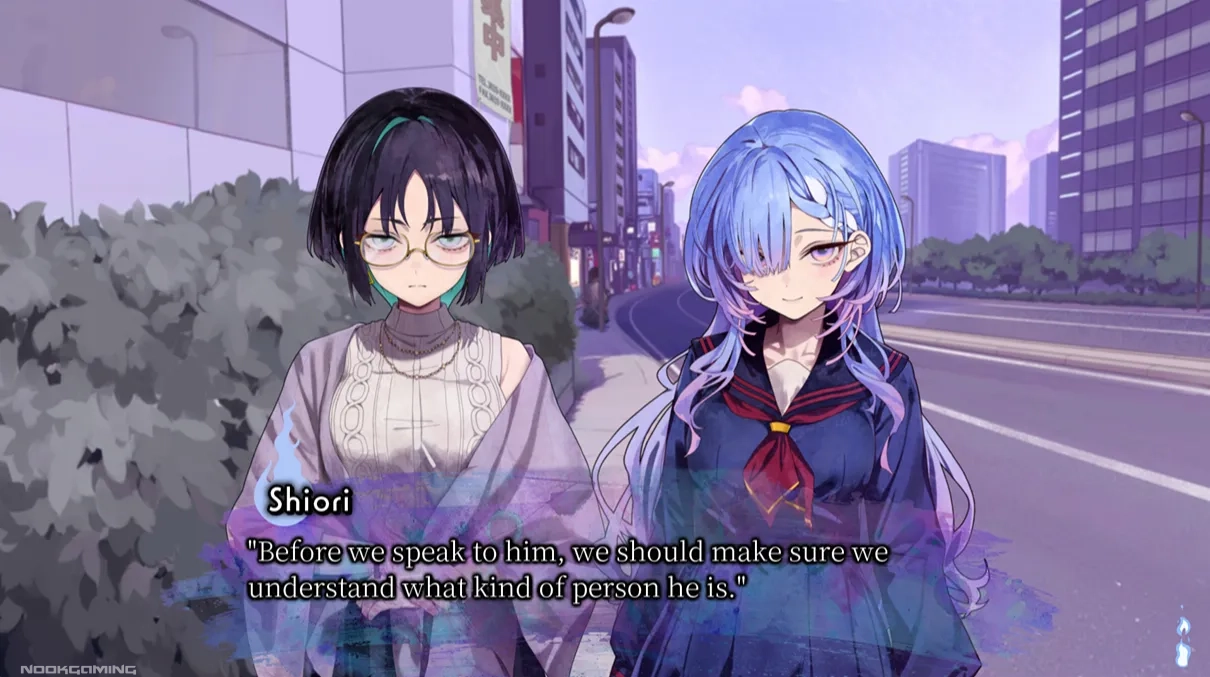
Shiori is far from the only ghost in town. You later meet her friend Gyakuro, a gyaru ghost who wanders around town and often hangs out by the convenience store. Another major character is a ghostly librarian who serves as a guide for both Shiori and the player to the lore of the world and ghosts. For example, she shares that every ghost has a trigger that can cause them to go mad and lash out violently at anyone unlucky enough to find themselves in the vicinity. Naturally, her trigger is talking in the library. Shiori also frequently crosses paths with Kashima Reiko, a chuunibyou ghost who is an expert on local urban legends.
I enjoyed the cast of Kugayama Shiori’s Death Diary. The main characters all have strong personalities that play off Shiori in fun ways and add a lot of dynamism to the story and dialogue compared to Shiori monologuing to the mute protagonist. The other ghosts also have their own subplots to follow. I found following these subplots interesting and that they helped make the other ghosts feel like proper characters with their own lives (unlives?) rather than plot devices to feed you information and advance Shiori’s story.
Playing Dead
The beginning of Kugayama Shiori’s Death Diary is heavy on black comedy, as Shiori decides the best way to regain her memories is to kill herself in various ways and document the experiences. It’s more mildly amusing than laugh-out-loud funny, and most of the humor comes from the juxtaposition of the mundane and macabre, though there are a few bad endings that are quite silly. Still, it allows Shiori a chance to show off her mischievous side and to talk about what it’s like for her to be a ghost with no memories.
Later on, you delve more into the mystery behind Shiori’s lost memories. While I didn’t experience any mindblowing reveals, it’s a solidly constructed mystery that does a nice job tying several of the side characters’ subplots into Shiori’s story. It also strikes a good balance between dropping hints and obscuring the truth. There was enough for me to ponder so that I was interested to see how things unfolded, and the mystery felt neither too obvious nor overly contrived. My one complaint is that the reveal of the final villain’s motivations was underwhelming because they were somewhat arbitrary and removed from Shiori, but I still overall enjoyed the mystery.
Despite the comedy-focused start, Kugayama Shiori’s Death Diary also succeeds in building up emotional stakes. Part of this is that Shiori is charming, charismatic, and easy to root for. She’s empathetic and kind but also has that mischievous energy that can drag you into the sort of fun adventures you might not have had the courage to pursue alone. And for both Shiori and the other characters, a major theme is regret. In Japanese folklore, ghosts often exist because they have lingering regrets that prevent them from passing on. Kugayama Shiori’s Death Diary doesn’t pull punches here. The regrets tying down Shiori and the other ghosts are tragic because they are often unfair and saw bad things happen to good people, and that pain continues to exist with the living as well as the dead. Once you’re a ghost, there’s no going back, but there’s still catharsis to be found in accepting the situation and finding a meaningful way to move forward.
Haunted Maze
Although the main story is linear, Kugayama Shiori’s Death Diary features a lot of choices and branching. This is both a positive and a negative. There’s plenty to find if you’re the type who enjoys exploring. Besides the normal and true endings, there are 10 bad endings to find. Some of them are interesting, others are ridiculous, and a couple feel like they were tacked on to quickly emphasize Kugayama Shiori’s Death Diary’s structure and have no real content. You can also follow up on the urban legends Kashimo Reiko shares and see if there’s any truth to her hearsay.
On the other hand, sometimes the structure of Kugayama Shiori’s Death Diary makes it less-than-obvious how to continue the main story. The effects of your choices aren’t always immediately apparent, and in one case, I had to go back to a scene an hour earlier to avoid tripping a flag for a bad ending. There are also choices that require you to choose quickly or wait and not choose at all, which might not be something you’d expect to matter. The bad endings do have clues about what you should do differently, but a few of them are quite vague. Of course, you could always use a guide, but that might undercut some of the fun of exploring things on your own.
Wail of the Banshee
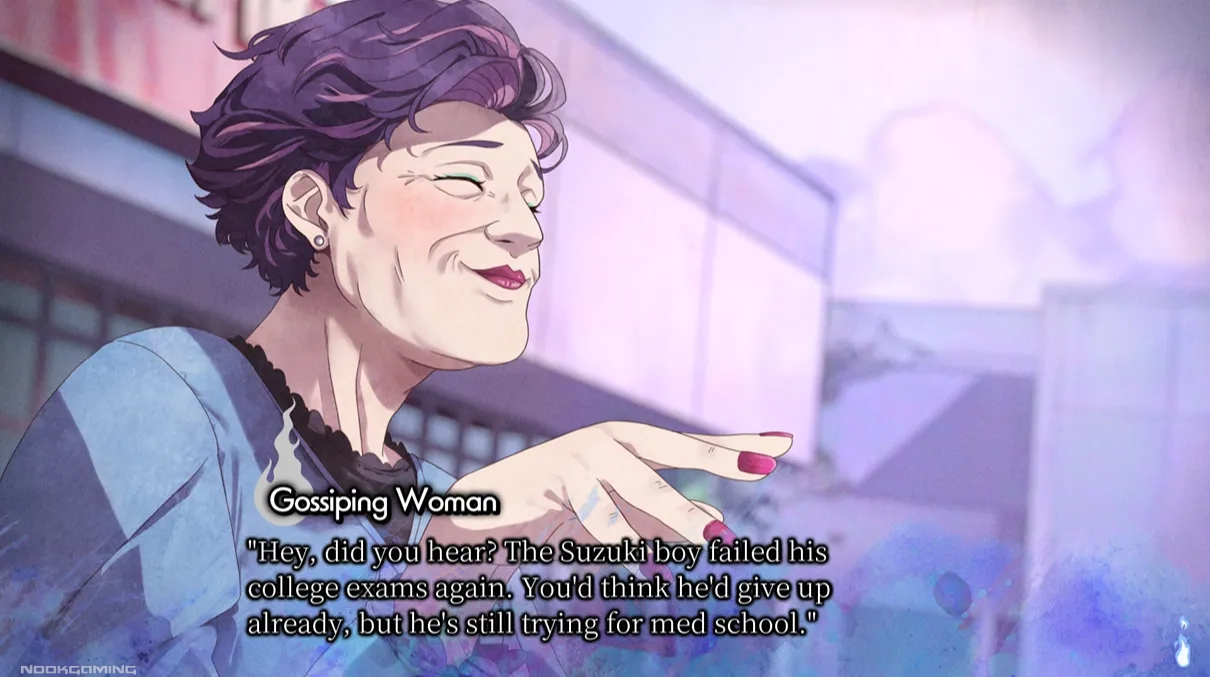
I can’t discredit the role of the voice cast in enhancing my enjoyment of the characters. Ojika Nao as Shiori is the star, and she pulled me in both with Shiori’s bubbly personality in the fun moments and her anguish when confronting painful memories. Other characters like the librarian and Gyakuro were appropriately level-headed and mature or casual and carefree respectively. Even the minor characters were voiced with gusto. For example, a gossipy old woman brought some serious judgy boomer energy to her lines.
Kugayama Shiori’s Death Diary features comedy based around and shows the aftermath of Shiori’s many deaths, some of which are suicides. Since death and suicide can be heavy topics, the opening screen features a content warning. For those who hate the sight of blood, there’s also a filter that turns all the blood pink, Danganronpa style. I didn’t think that Kugayama Shiori’s Death Diary was gratuitously bloody or gory considering the content, but it’s nice to see these accessibility features included for those who might prefer them.
Verdict
Kugayama Shiori’s Death Diary mixes a striking ghostly aesthetic and black comedy with a solid mystery culminating in a satisfying emotional payoff. If you don’t mind or enjoy exploring its maze of choices and branching, it’s a quality read.
KUGAYAMA SHIORI’S DEATH DIARY IS RECOMMENDED

If you’d like to learn more about Kugayama Shiori’s Death Diary, you may be interested to read our interviews with Hayashi Ryousuke (Visual Novel Director) and Interview with Pellet (Visual Novel Art Director/Lead Illustrator). These cover several topics, including how Generative AI was used with photos for backgrounds which is a hot topic.
If you are looking for another visual novel, you may enjoy NICE TO MEET YOU, AGAIN. We have covered a wide variety of visual novels both original to English and localized from Japanese, which you can check out here.
Thank you to Laplacian for providing a PC review code for Kugayama Shiori’s Death Diary.
A veteran of Oregon Trail and Battletoads, Wes has been playing and talking about games for as long as he can remember. He’s down to try almost anything, and he especially enjoys games with gripping narrative experiences.