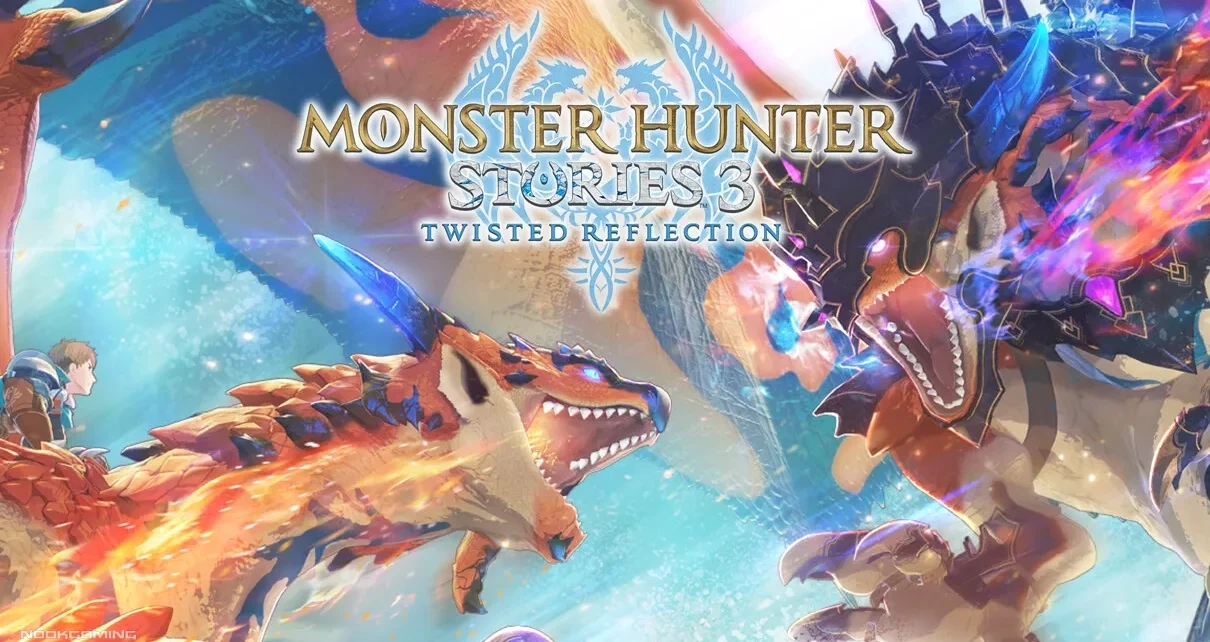
Monster Hunter Stories 2: Wings of Ruin became a surprise favorite of mine in the year it was released. It combined a lot of the mainstays of the mainline Monster Hunter games with the fun of a turn-based system while also cleaning up the faults of its predecessor in terms of tone and game balance. To my surprise, however, it didn’t receive much post-launch support or an extra DLC story. Four years after its release, we now know why: they went all in on making yet another sequel instead. Hopping over to current generation hardware, Monster Hunter Stories 3: Twisted Reflection promises an even darker story with an even bigger world.
Ratha-you and Ratha-me
In the centuries-long interim between Stories 2 and Stories 3, the world has changed in some fairly significant ways. For starters, Riders, people who bond with monsters to protect the environment instead of hunting them, have become normalized and commonplace, existing alongside hunters as if it’s no big deal. This timeskip also naturally follows with it an almost completely fresh cast, whereas Stories 2 before it used a mixture of new characters and old returning ones from the first Stories. This extends to a new branch of Riders called Rangers, task forces who align themselves with different factions to keep the environment in check. However, all is not well as the lands are being slowly eaten alive by a phenomenon called The Encroachment, where the earth and any living inhabitants are crystallized and killed. Two nations called Azuria and Vermeil are now at the brink of war thanks to this, as space and land are steadily dwindling.
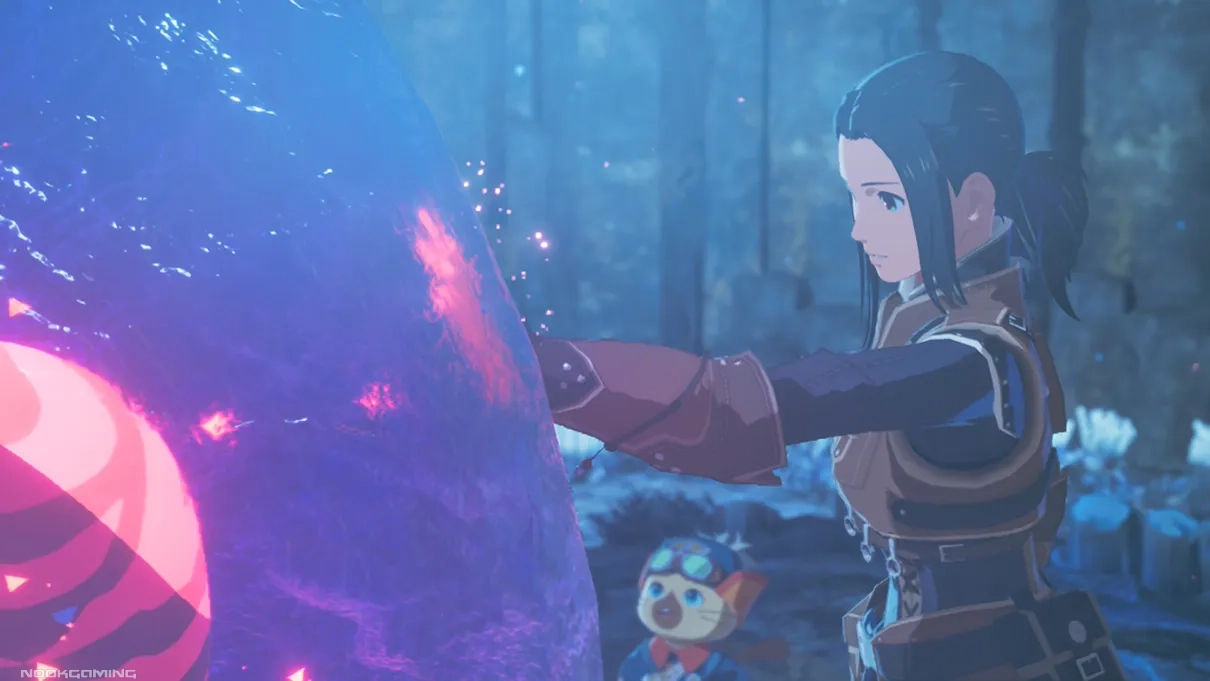
The Stories universe, in its usual unwillingness to give Rathalos a break, has also killed off all but two of them, twins born of the same egg that is also an omen of disaster. One twin is destined to kill the other, which left alone could spell calamity for everyone. If you’re thinking this sounds really familiar, it’s because Stories 2 already had a similar premise, with the birth of a special kind of Rathalos also foretelling disaster. While I’ll save my thoughts for the actual execution of this for later, I will say that I think it’s pretty boring that this is the third consecutive Stories game that puts a Rathalos at the forefront of the plot. I get it, Rathalos is essentially the series’ mascot, but Monster Hunter is also a lot bigger than just Rathalos, so mixing it up after three games would be nice. After all, who would like it if Pikachu was forced at the forefront of every Pokemon story and forced into your party every time?
So how does the player character fit into this? Unlike before, where they’re some nameless person from a random village, the player character here is royalty and a major player in the story’s political theater. Since Monster Hunter: Rise, the series has been steadily making the player character more and more chatty. This was brought to culmination in 2025’s Monster Hunter: Wilds, where the player character took on an active voice and emotional role in the game’s story. Monster Hunter Stories 3 takes a page from this, where the player character is now an active speaker in the main story with their own agendas and opinions that affect the plot. They’re also the owner of one of the twin Rathalos, making them that much more important.
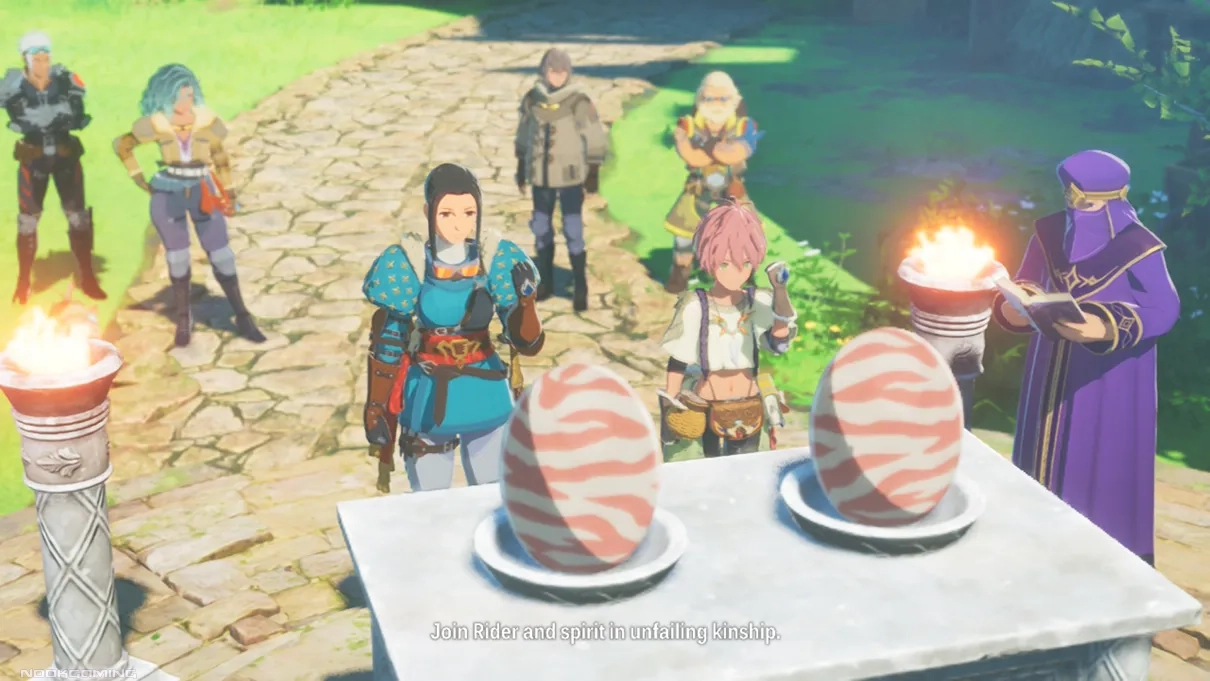
The main protagonist in particular is one I’m mixed on. Not only are they even older than before, but they’re a reasonably accomplished Ranger and even royalty before the player can even initiate control over them. Perhaps this is an attempt to do something different after two Stories games starring unsuspecting teenagers from small towns, but I find it ironic that silent protagonists manage to feel more characterful and distinct than what we have here. Even though the player character this time says a lot and “technically” undergoes character development, I found I enjoyed the roles and perspectives of the silent protagonists a lot more. The Monster Hunter universe is oftentimes one built on abstraction and interpretation, where hard questions exist but the actual answers are left to the player’s own feelings. The main player character winds up treading all over this, while also just not being all that compelling in their own right.
Playing at Politics
Since Monsters being used by humans has become more commonplace, so too has their use in warfare. What was originally a choice of culture has left humankind with abundant control over the balance of nature, for good and for ill. The question as war looms on the horizon is whether humans now have too much control. I think these are appropriate questions to ask when examining the Monster Hunter Stories universe for what it is. Previous Stories titles examined the exact nature of humans who chose to bond themselves with monsters, as well as humanity’s role in balancing out the forces of nature through more interpersonal relationships between the player character and a small handful of others. The practice of Riders has become so commonplace that monsters are now viewed as potential weapons for warfare, rather than partners in life. It’s a cynical turn of events, but a realistic and appropriate one, I feel. While the morality of this is intriguing, it’s bogged down severely by the game’s half-hearted and unnecessary attempts at political drama.
In the first few hours of the story, there are tense scenes involving political dinners with royalty and characters acting out to have policies changed or challenged. It’s not very interesting, but at first it seems committed to the idea—at first. These politics are dropped stone cold as the game quickly becomes the third Monster Hunter Stories game about investigating the cause of natural disaster. Any mention of politics past the prologue feels like a shallow attempt at making the story seem more grown up than it is, which is disappointing when both prior Stories games, despite their appearance, handled their subject matter more gracefully. They also weren’t rushed like this game feels. Remember the twin Rathalos destined to cause calamity? They’re barely in the game, and unlike before you don’t even so much as get a boss fight with it, and they’re instead dealt with in the space of a few cutscenes. The setup here is more like an excuse to keep everyone else around at all times, making characters who were rotated in and out before more like active party members here. That would be great news… if the main cast wasn’t so by-the-numbers.
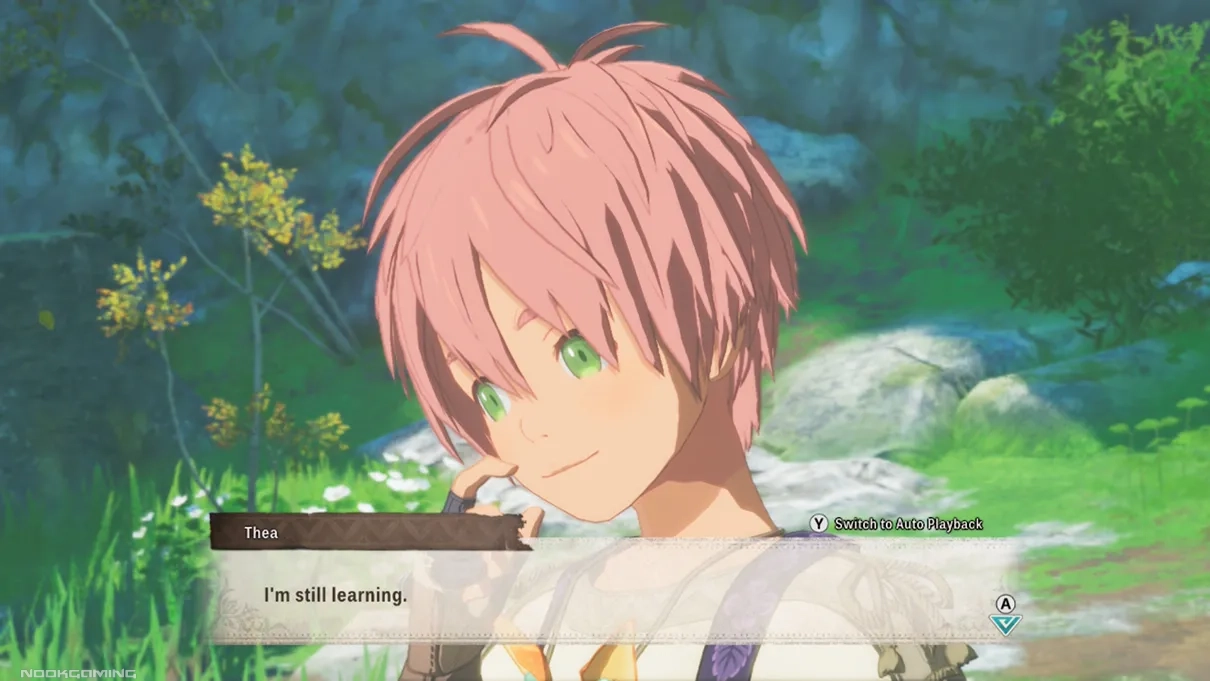
You’ve seen these archetypes hundreds of times before. There’s the royal main protagonists who’s caught between their duties and their actual passions, the hyper-competent childhood friend keeping secrets (Simon), the over-eager assistant who tries and fails to keep the protagonist on-task (Rudy), and the royalty from a rival nation who actually isn’t as bad as they seem (Eleanor). About the only character who actually felt fresh was Thea, and that’s because she’s framed more as being a character from the first two Stories games. This might come off as being dismissive of the game’s writing merits, which admittedly it has a few of, but that doesn’t really subvert the fact that you’ve probably seen this exact story ad nauseum. The few twists it applies aren’t enough to really escape this, and most of the main twists are easy to see coming. The execution is competent, but the actual foundation of its story leaves it without many sparks.
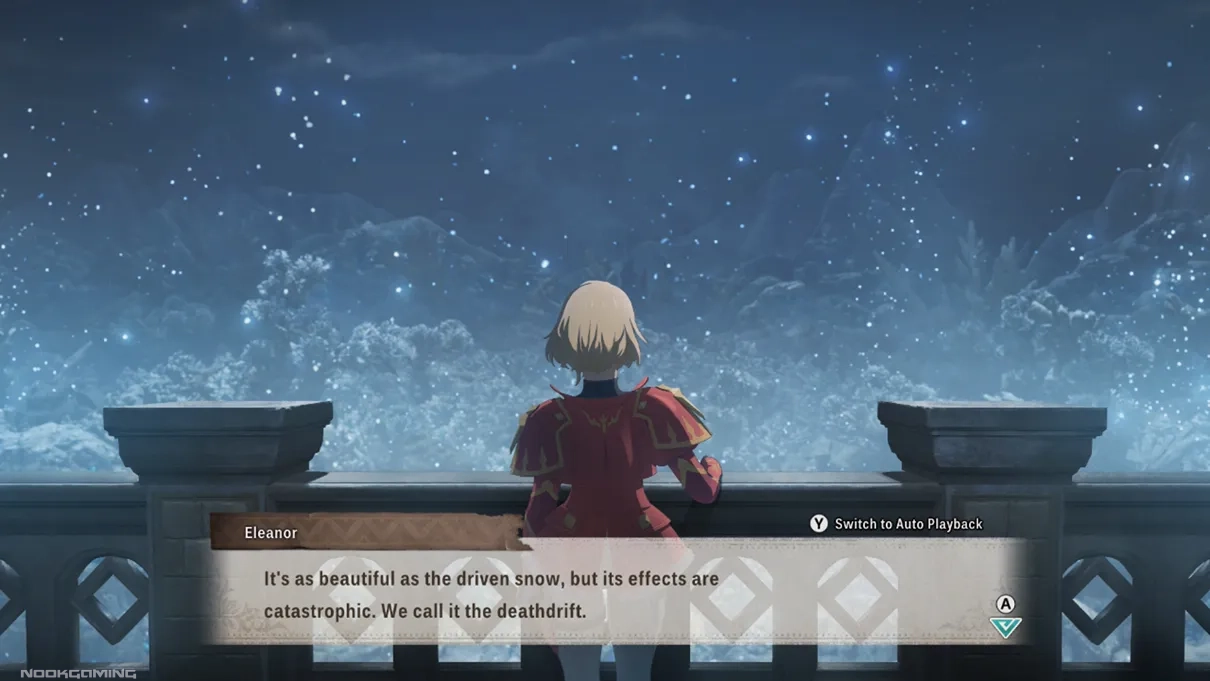
It’s an all-around more generic story about royalty who isn’t good at being royalty that you’ve likely already seen a hundred times before. While it’s fair to say that the narratives of Monster Hunter Stories 1 and 2 weren’t amazing either, they at least used the perspective of Monster Hunter as a series to try and tell stories that only it was capable of telling. Stories 3 doesn’t do that, and despite the initial promises of a deeper and more politics-driven narrative, it under-delivers and ultimately leaves the spirituality of Monster Hunter out in the cold in the process. It’s also got a big issue with tonal dissonance, as despite the impending threat of The Encroachment, the actual game design really encourages you to take your time with things.
Further highlighting this peculiarity is that Stories 3 has the dubious dishonor among the Monster Hunter series, spinoff or otherwise, to not feature a proper postgame. While every other Monster Hunter title, including the first two Stories titles, always feature a postgame where the environment becomes relaxed after the primary crisis has been averted, Stories 3 stands as an exception to this.
It’s A Mad Monster World
The most immediate difference between Stories 3 and its predecessors is the size and scale of its various maps and biomes. While the first two games were by no means small scale (Stories 1 in particular is impressively large for a 3DS game), Stories 3 offers maps that feel like they’re on the level of the ones featured in the mainline games in terms of details and scope. Although it’s somewhat disappointing that exploration between areas isn’t totally seamless, it’s still fun to jaunt around the scenery in search of new monster dens to raid or new monsters to battle.
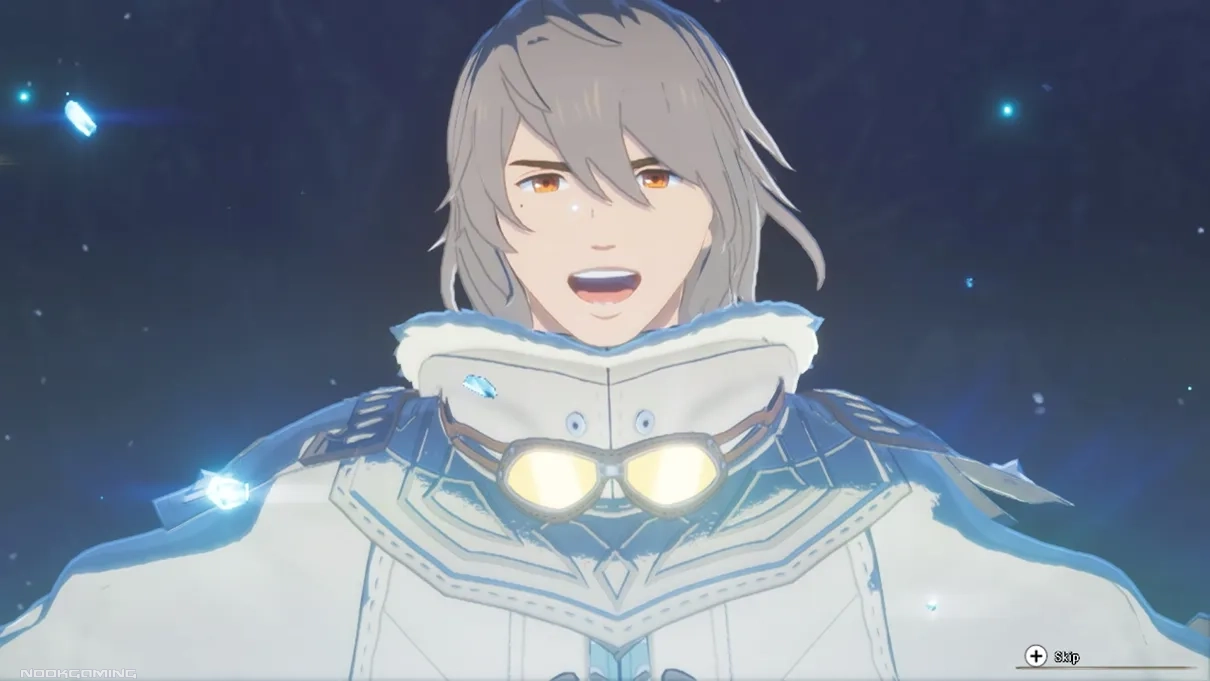
Field exploration can also now be conducted at night, which causes more powerful monsters to spawn and makes the world as a whole more dangerous to explore. If I had one small gripe with this, it’s that I think it would have been more interesting if this was triggered by a day-night cycle so that exploration could have a more proactive risk-reward element to it. The current system of passing the time of day at a camp is fine, it’s just kind of boring. As for night time battles themselves, they’re fun and play nicely with the higher overall difficulty of the game. They also importantly play into another system which we’ll get into later.
Unlike previous games where you had to awkwardly fiddle with the monster menu to use their field skills, now switching between monsters is seamless and some will have access to multiple abilities at once. For example, Tobi-Kadachi can’t fly, but it can climb up flat walls and glide in the air, meaning it’s still good for seeking higher vantage points. Maps are also generally well-designed as a whole, with there being a much greater emphasis on verticality and finding nooks with secrets inside of them, be it for a quest or to find a rare monster. Sidequests are fine, but pretty boring. They give you something extra to do while out exploring, but it’s the usual “fetch me [x] supplies” or “go to [y] point to deal with a troublesome monster for me.” Not offensive by any means, but kind of dull. It’s a checklist to keep in mind while out exploring, which is kind of fun since engaging with the map is fun for its own sake, but it’s a checklist nonetheless.
All You Can Beat Buffet
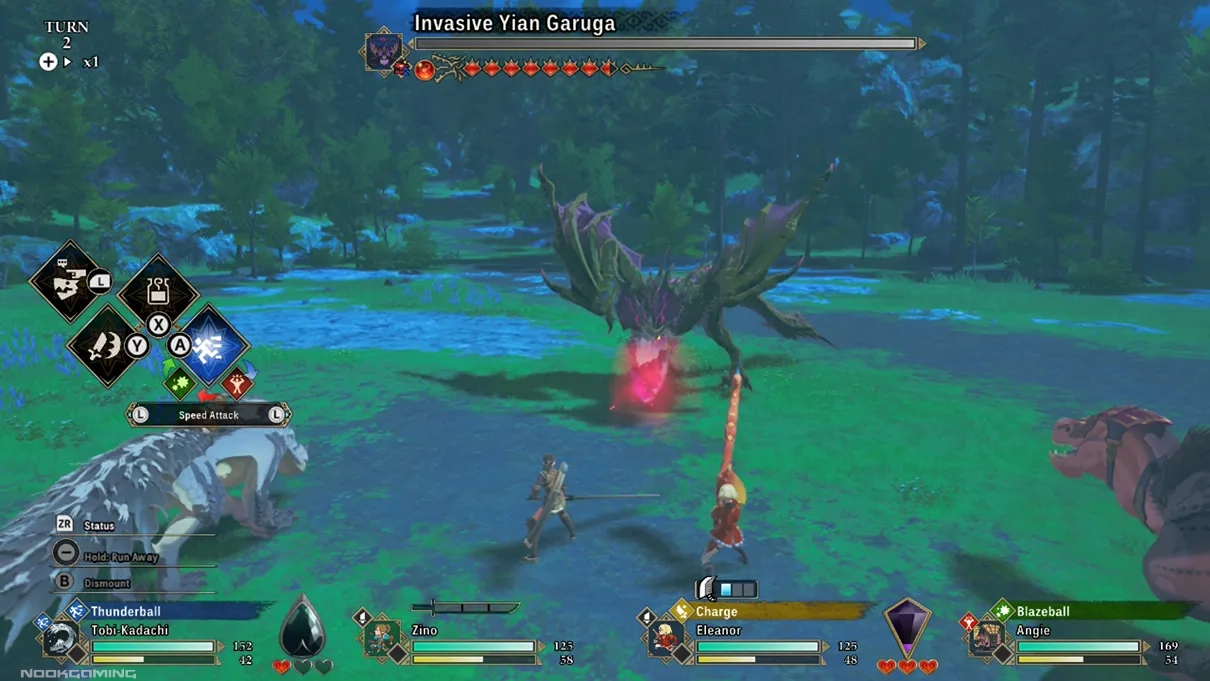
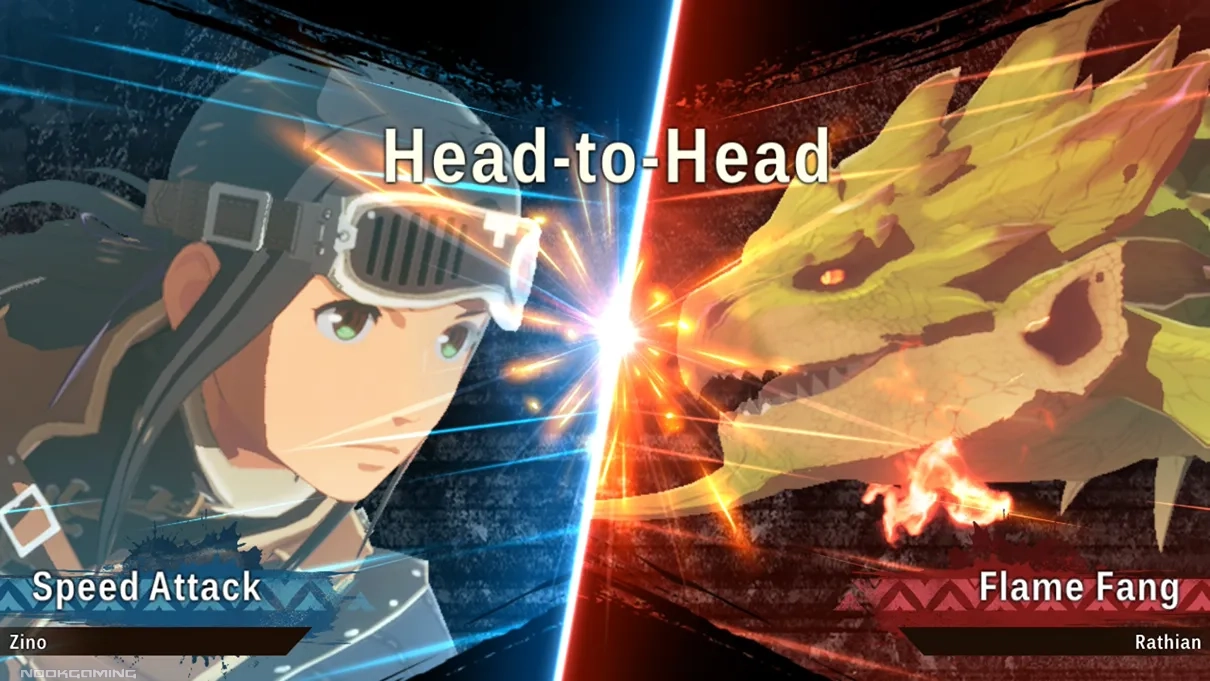
Monster Hunter Stories 3: Twisted Reflection features the same general gameplay as the previous two titles. Rather than high octane action combat like in the mainline games, you’re instead playing in turn-based combat that has a few splashes of Pokémon and Shin Megami Tensei for extra flavor. While your team will consist of a group of four, you only have direct control over your player character. Your monster and teammates will attack and strategize independently based on the current battle conditions, and AI is reliable enough to where it’s not actually a problem for the most part. While you’ve got lots of moves that can attack, buff, debuff, and cause status conditions, the Stories’ games true distinguishing factor comes in its Head-to-Head and Ride On mechanics. When a monster attacks a single party member, they can clash in a Head-to-Head, where depending on the attribute of the attack (Speed, Power, or Technical), the character can gain a massive advantage over the monster in what is essentially an ultra-technical game of rock-paper-scissors. Monsters each have a different attribute they attack with, and those attributes change based on the monster’s current status, such as being enraged or having a certain body part damaged.
By winning Ride Ons, players will slowly build up the Kinship Gauge, where after building it up, the player can engage in a Ride On and take direct control over their own monsters. Monsters also have their health restored and become stronger, and it makes it far easier to win things like Head-to-Heads. With a full Kinship Gauge, players can also unleash Kinship Skills, which are essentially unique Limit Breaks for every monster in the game. They do tons of damage and look really cool to boot. By combining forces with your monster, you can outright cancel out an enemy monster’s attacks by picking the right attribute in a Head-to-Head, though this doesn’t come up enough to ever compromise the game’s surprisingly excellent balance. To my delight, Stories 3 is the hardest game in the series thanks to smart rethinks to weapon balance and the overall difficulty of boss battles. Weapons are now individually weaker, but make up for that through expanded tactical implications and the player being able to carry up to three of them at once.
The Sword and Shield from the previous game has been replaced with the ultra-popular Long Sword weapon from the mainline games. While the Long Sword doesn’t deal that much damage on individual attacks, it makes up for this through its unique Stance system, allowing for counterattacks against enemies or follow-ups when an ally attacks. The Great Sword is the same as ever, where you can charge and launch massive strikes against enemies, while the Gunlance works on a cooldown and ammo system like the main games. The Bow meanwhile lets you coat it in different buffs or elemental attributes. It’s all good stuff and while I didn’t ever fully leverage every single weapon, you’re always left with a sense that your tools could be useful, and that’s an important distinction to make in high difficulty games like these.
As mentioned earlier, Stories 3 also lacks a proper aftergame like every other Monster Hunter title. Instead of being presented with higher ranked quests and monsters to battle like before, players are instead dropped right before the final boss where they are encouraged to instead clean up any loose ends. Given the amount of content on offer in this game, it’s doubtful that most players will fully clear out the game before rolling the credits, but it’s still deflating for a number of reasons. For one, it’s disappointing because you can’t see the world or its characters after the climax, meaning there’s no chance to see how the characters have evolved since the conflict like before. The second far more annoying bugbear with this comes in the form of Ratha, who like other Monster Hunter Stories games is a permanent fixture on the player’s party and can never be removed during the main story. I didn’t like this choice in either of the prior two entries, but at the very least this restriction was lifted in the aftergame, where all content from then on can be tackled with whatever party the player wants. Since Stories 3 doesn’t have an aftergame, you can imagine where one of my frustrations might lie.
Many Many Monsties
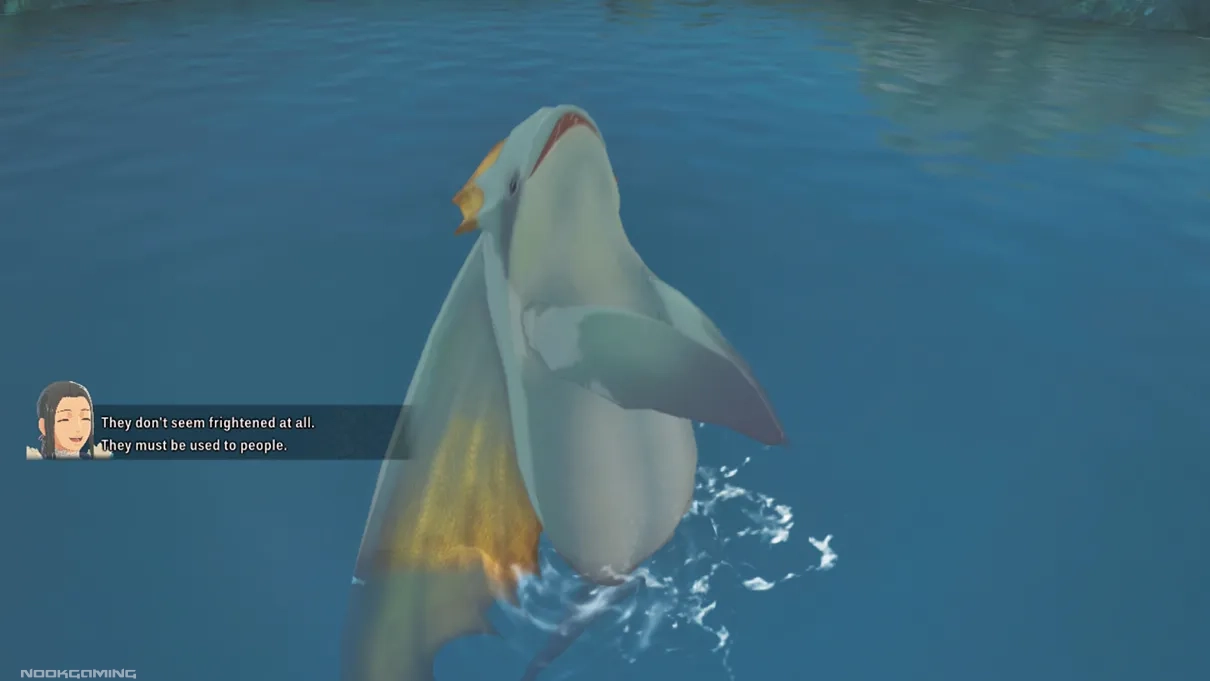
While the roster for Monster Hunter Stories 2 was broadly focused on the ones introduced in the mainline games Monster Hunter Generations and Monster Hunter World, Stories 3 naturally focuses on the ones introduced throughout World: Iceborne, Rise, and Rise: Sunbreak, as well as a few monsters handpicked from the much more recent Monster Hunter Wilds. My compliments towards this game are much the same as the ones I had towards its predecessors, with lots of fan favorites like Lagiacrus, Zinogre, Nargacuga, Mizutsune, Brachydios and more besides. As part of the storyline where monsters are on the verge of extinction, you won’t have access to this right away. Instead, the new Habitat Rank feature takes center stage in how you steadily gain access to rarer and more powerful monsters to fight and add to your team. After defeating a territorial monster, often found at nighttime, players will obtain an egg of a rare monster. While they can be kept on their team, they can also be released out into the wild, where that specific species will then begin to repopulate in that area.
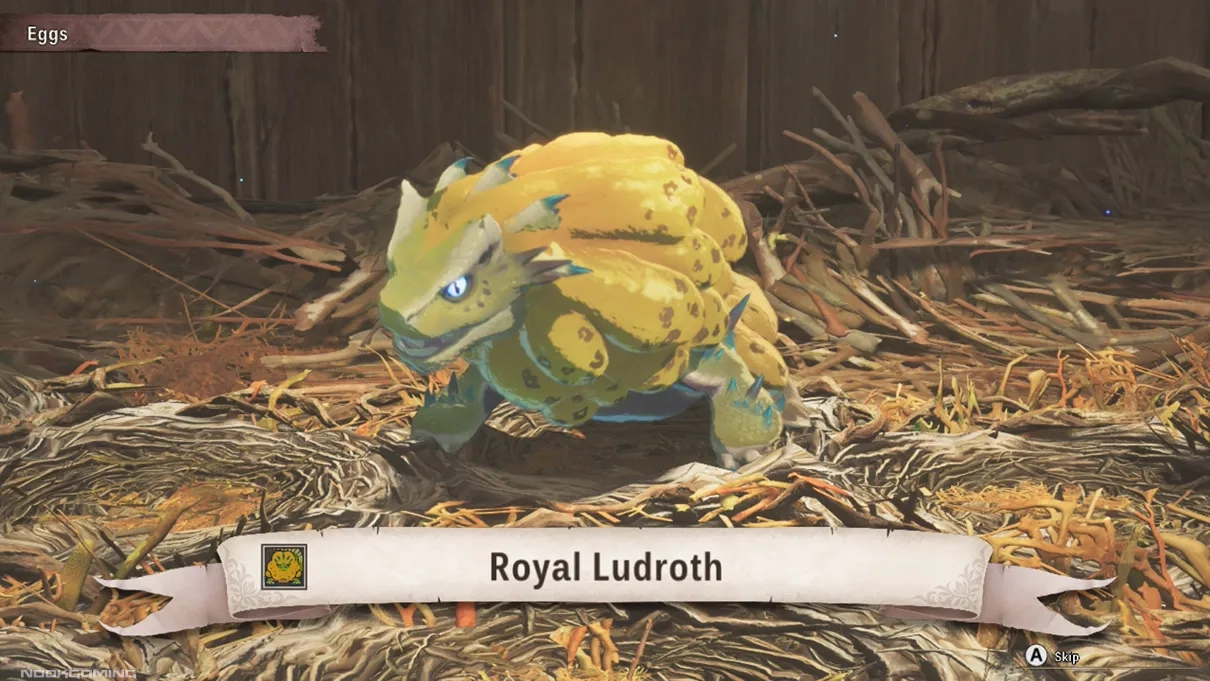
The gameplay loop is like an especially involved form of a digital farm simulator. It’s grindy in all the ways that you would expect from Monster Hunter, but it’s also satisfying because battles are rewarding and this game makes some tweaks that speeds up the process. Most notably, players can instantly end battles with weaker monsters by simply attacking them on the overworld once they become strong enough. Monster dens are also smaller and tend to contain more rewards, making the backtracking process much smoother while still retaining that sense of tension as you raid their nesting grounds for a particularly powerful monster egg. It doesn’t just stop there, though, as you can also edit a monster’s genes by using another monster as a base. This can augment their stats, what skills they have in battle, as well as their elemental affinity. So you can play around with it and make sacrilegious results like a Khezu that shoots ice or a Lagiacrus that can breathe fire.
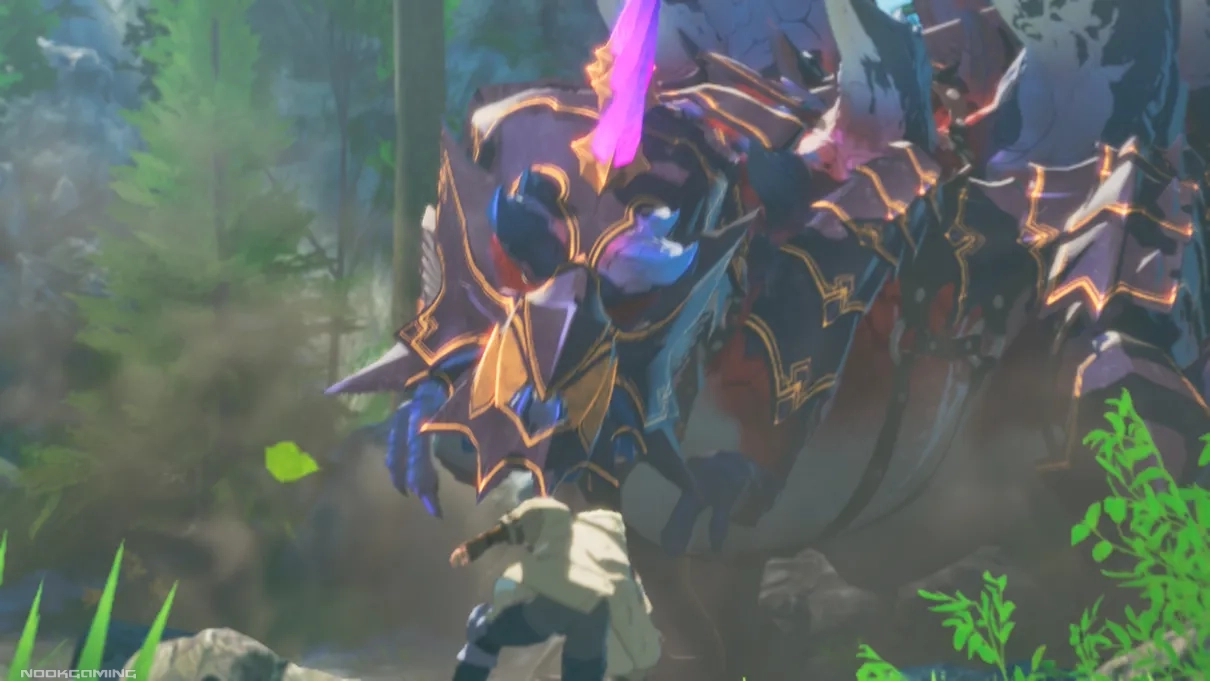
Playing into these new systems are the Calamitous Elder Dragons. While in the previous games, Elder Dragons were primarily battled through aftergame quests, here they are instead major environmental disruptions that spawn once the player has met certain conditions while exploring at night. A select few are also fought as part of the main story. Elder Dragons naturally include some of the newer ones like Malzeno or Namielle from Rise: Sunbreak and World: Iceborne respectively, but there’s also a few surprising and niche picks like Yama Tsukami, who hasn’t appeared in mainline Monster Hunter for nearly two decades. I’m of two minds on this new approach to Elder Dragons; on one end I think it offers a nice splash of non-linearity to the game’s difficulty, but on the other end it also undoubtedly means that simply getting the right to fight them at all is now a grindfest, where their spawn locations and whether they spawn at all are dependent on how many monsters you slay.
A New Generation
Like the gameplay, Monster Hunter Stories 3: Twisted Reflection feels like a huge console-quality game in terms of graphics. While Stories 2 was also an excellent looking game, Stories 3 really ups the ante through larger environments made visually compelling through its fuller rendering and detailed topography. Mountains look lush and steep with lots of care given to natural elements like trees and blades of grass, and the other biomes look similarly rich. This is also where the game’s superb animations come into play, with the player character realistically reacting to things like slopes, running into other people in towns, or falling from great heights. While Stories 2 was not a badly animated game by any stretch, this difference in presentation makes it feel like Stories 3 was given the same tender loving care as a mainline Monster Hunter outing. The same applies to its gorgeous hand-animated cutscenes, which are both more sophisticated than in previous games and occur more frequently. Although, because of the gameplay style, it gets somewhat repetitive visually since you spend much more time in the same areas.
Thankfully, the humor that the Stories games are known for also tends to shine through here. Kinship Skills, like in previous games, can either be cool-looking or funny. While watching Simon tear up a storm on his Legiana is awesome, sometimes you also just wanna watch a Brachydios envision a weird training montage as it winds up a killer punch. These kinds of charming details are everywhere during gameplay, and while I bemoan that this didn’t translate into the main story, it’s at least nice that it managed to survive somewhere.
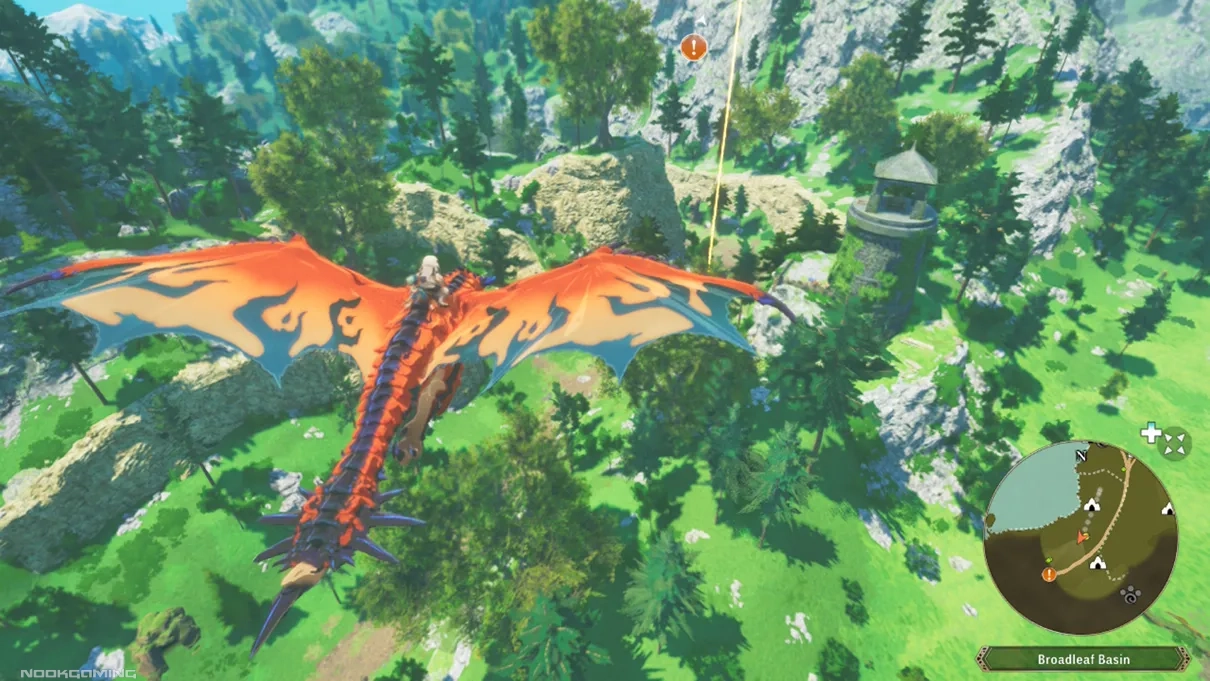
Unfortunately, the game isn’t the most technically polished. Framerate on the Nintendo Switch 2 version is poor, monsters pop into the environment conspicuously, and animations at many points don’t play nicely with hitboxes or collision detection, leading to a lot of awkward-looking moments. Along with the abrupt endgame and the lack of postgame, this kind of thing makes the game feel unfinished in places. It needed an extra round of polish and it seems like it just didn’t get it for some reason.
Verdict
Monster Hunter Stories 3: Twisted Reflection is a good game that I’m ultimately left conflicted on. While it’s the biggest, most polished, and most mechanically thoughtful a Stories title has ever been, it’s also at the cost of what I feel was the series’ unique personality. While the series has been aging with its audience ever since the previous game, Stories 2 struck a much more resonant emotional balance, embracing something more somber and thoughtful while still respecting the oftentimes silly and satirical nature of the original Stories game. Stories 3, in its push to appear as more grown up, abandons a lot of that in favor of an okay but more generic narrative that doesn’t manage to leverage what makes the Monster Hunter series tonally unique.
On the gameplay side of things, Stories 3 is broadly a success. Changes to combat keep its simplicity, while the more punishing boss battles still push it towards being something where you really have to think more than before. It’s also perhaps the most beautiful Monster Hunter game ever made, with tasteful watercolor visuals applied to superb modeling and animations. There is plenty of good here, despite my prior complaints. That said, Stories 3 only feels like half a victory, where it has its own accomplishments but feels dragged down by some of the same things currently plaguing the mainline games. It doesn’t feel finished, performance is wonky, and despite the want for a more involved narrative, in the end it misplaces what made Monster Hunter really work in the first place.
MONSTER HUNTER STORIES 3: TWISTED REFLECTION IS RECOMMENDED

If you are looking for another JRPG with memorable monsters, you might want to check out or review of Dragon Quest VII Reimagined.
Many thanks go to Capcom for a Nintendo Switch 2 review code for Monster Hunter Stories 3: Twisted Reflection.

A hobbyist who took up the pen to write about their favorite pastime: games. While a lover of many genres, Isaiah Parker specializes in Platformers, RPGs, and competitive multiplayer titles. The easiest way into his heart is to have great core gameplay mechanics. Self-proclaimed world’s biggest Sonic fan. Follow him @ZinogreVolt