HD-2D RPG is a style that needs little introduction at this point. Starting out in 2018 with the first Octopath Traveler game, it enjoyed much success and acclaim over being a style that combined old game formats with modern visual techniques and qualities of life. Since that original game, we’ve seen the HD-2D style in a number of other styles, such as a strategy game, a forthcoming action-RPG, several acclaimed remakes, and even a few mobile outings. It’s perhaps fitting that we close out 2025, what may be the busiest year yet for HD-2D, with a prequel to Octopath Traveler. Octopath Traveler 0 promises a massive new story in a familiar world.
Player – Yer a Chosen One
Out the gate, Octopath Traveler 0 presents an especially massive change in game format from previous Octopath releases. Rather than start the game as one of eight established characters who have their own backstories and motivations, you instead control a player-created avatar whose backstory and personality are up to you. While the game quickly establishes them as an important player in the happenings of the continent of Orsterra, they’re more like a proxy to several vignettes involving powerful rings that cause havoc across the world. These rings help to bolster the three pillars of human greed: power, fame, and wealth, and granting their wearers unimaginable strength used to fulfill their desires. Ordinary people who don’t have these things are caught in the crossfire of the “champions” who possess these rings, either living under them in fear or senselessly slaughtered by their machinations. Before setting off on their journey fueled by vengeance, the player character is one such victim.
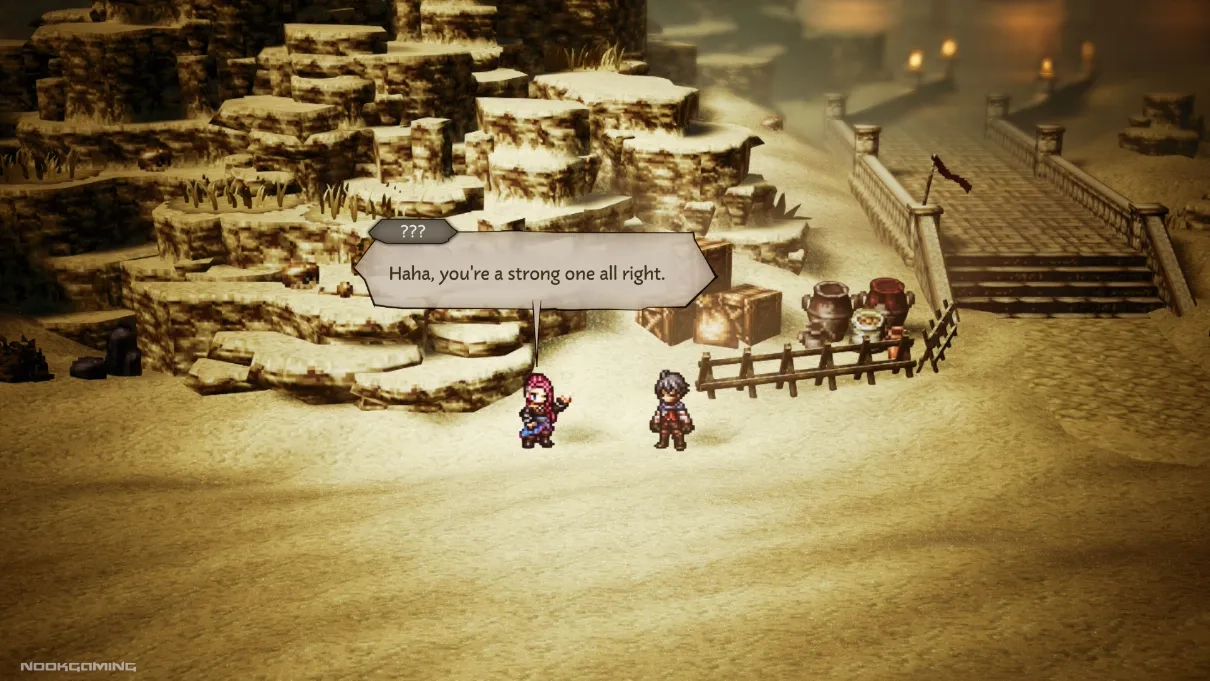
During an annual celebration, the player’s home of Wishvale goes the way of many starter RPG towns and is promptly obliterated by the villains, with most of the townsfolk winding up mercilessly killed as well. The player character is one of the few lucky survivors of the incident, along with characters like Stia and Phenn, who from there dedicate themselves to rebuilding the town and searching for survivors of the incident. Survivors have been spread far across the continent, and due to their own traumas and guilt over what happened, aren’t easy to convince to come back. While the opening itself is standard fare for an RPG, what I really like about it in Octopath 0’s case is how it’s all presented. There’s a sort of indifferent sense of callousness to the way the residents of Wishvale are killed off. Even important ones whom you spend time getting to know first don’t get any parting words or go down in some blaze of glory, they instead die as people.
This is something that carries into the rest of Octopath Traveler 0’s story, too. It’s a very dark game in both contents and theming (how it didn’t get an M-for-Mature rating in the US is anyone’s guess), but it carries everything out in a way that never feels gratuitous, either. Even when characters are being killed left and right, and when villains clearly cast themselves as being some of the worst people to ever live, it shows just enough for emotions to land, while never drawing things out in a way that feels tiresome. I’ll talk about this more in the next story section, but this also grants Octopath Traveler 0 a very powerful sense of tension thanks to its total willingness to kill off just about any character, no matter their supposed significance or level of power in the story. The rare moments that a character manages to survive a near-death incident feel appropriately shocking and earned, and moments where characters put their lives at risk had me actively worried for their safety.
A Colorful Rogues’ Gallery
In a sort of reversal of the premise of the other numbered Octopath Traveler titles, each story of Octopath Traveler 0 instead focuses broadly on a villain or a group of villains. The allies you meet along the way are characters who are similarly affected by the villains’ plans, and usually serve as the other main character of each story. The villains consistently steal the show in Octopath Traveler 0 thanks to their hammy personalities, being genuinely smart most of the time, and being twisted in a way that makes bringing them down always feel cathartic. Every time they show up on the screen, you can expect a significant twist to follow, and the aforementioned quality of characters never feeling safe means that you never know who’s next on the chopping block. I can’t spoil that for obvious reasons, but suffice it to say that quite a few character deaths left me actively upset because I really liked them and wanted to see how they may have developed further. That may sound like a negative, but it’s actually a glowing positive. That courage to kill off very likable characters lends a very strong sense of weight and sorrow to the plans of the villains, and makes it feel as though they have a more direct impact on the player themselves.
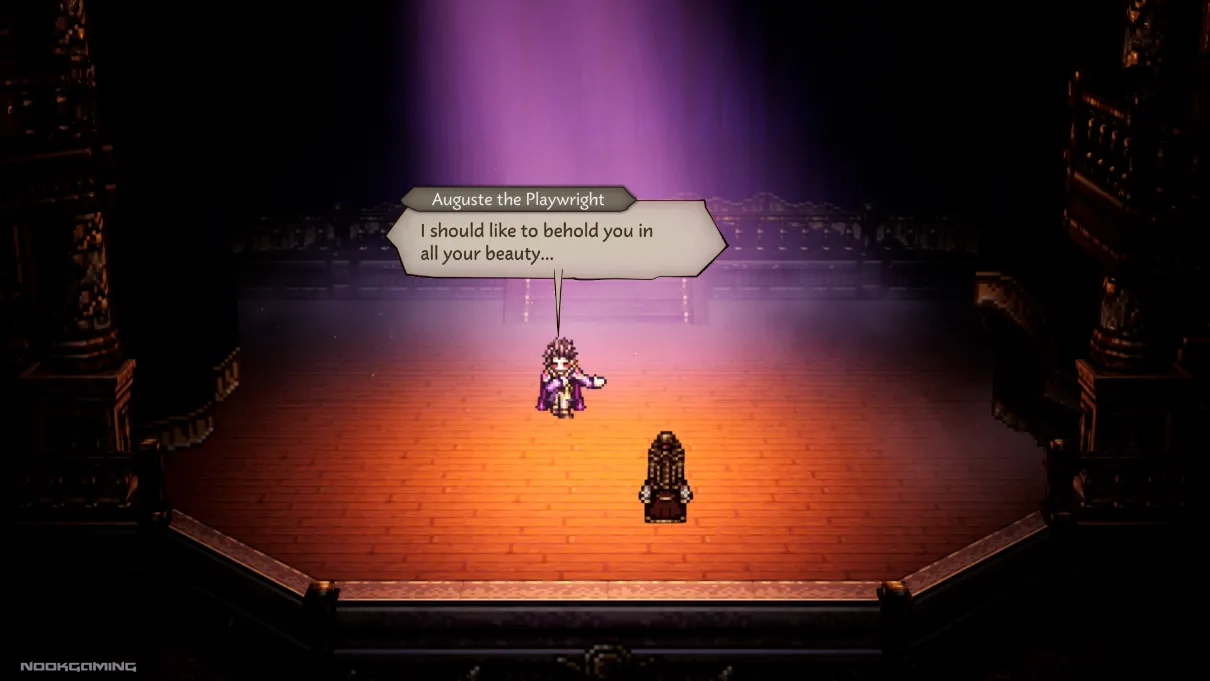
Some of the larger than life villains include Auguste the Playwright, a man as obsessed with theatrics as the game itself; King Pardis III, a king of a country in the lower regions of Orsterra who wants to play being a god; Tytos the Thunderblade, a man of the church who manipulates peoples’ faith for his own ends; and many more besides these. The cast of Octopath Traveler 0 is ridiculously big, with each individual story usually having at least 10 or so important characters throughout it. Characters who may have survived the previous story will usually come back later on as their respective situations develop yet further, and they may see development that takes them down a decent or dark path. It makes me think the writers for this game were more than a little inspired by the likes of A Song of Ice and Fire, and I think it’s all the better for it.
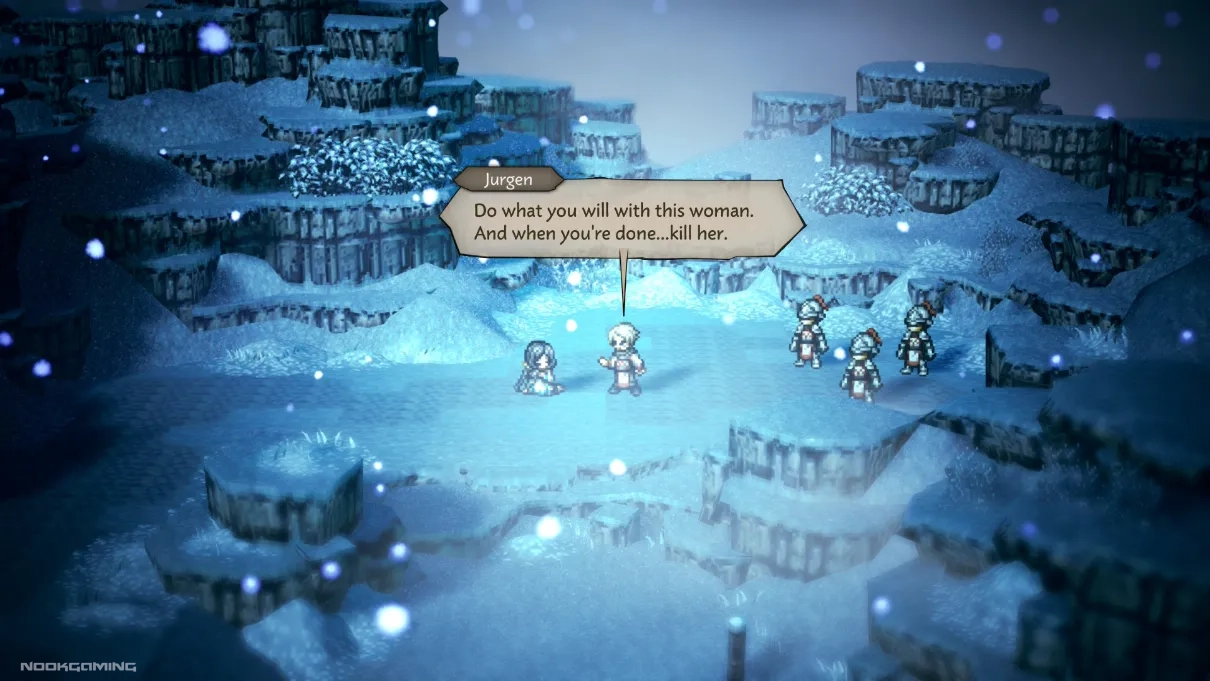
Where the player fits into all this is also quite interesting. While I do wish there were more moments where we could have picked our own dialogue, I think what is there is effective. Rather than have a lot of dialogue options where you can see what characters might have to say, Octopath 0 opts for having fewer but more impactful moments where this is the case. For example, a moment that occurs in one of the earliest stories happens when you’re given the choice to lie to an important character about what’s going on with their lover, and what you choose to say in that instance can completely change the following scene. Likewise, a misanthrope you meet later on will have their mind slightly changed depending on what answer you give them when you’re asked why you fight.
I adore the story of Octopath Traveler 0. I can’t sing its praises enough in how it sunk its teeth into me and simply never let up for the entire duration of my playthrough. It’s quite a turnaround from the original game’s story, which I often felt was too dry for its own good. Here, however, it not only respects that game with its prequel status, but meaningfully expands upon its own story and lore. It’s to a point where I’m now left tempted to reevaluate my thoughts on that game as well, but Octopath 0, as both a companion piece and standalone, is brilliantly written.
Starting from Zero
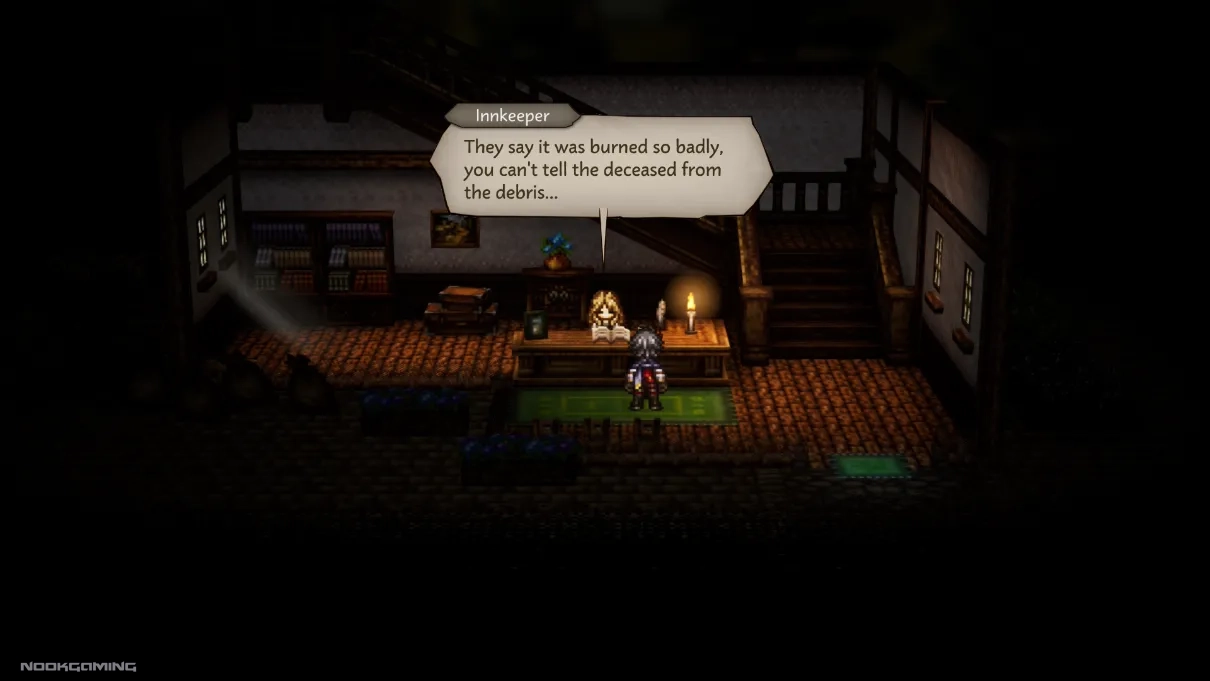
After Wishvale’s destruction in the prologue, you’re tasked with rebuilding it and changing it into whatever image suits you. This of course includes clearing away all of the rubble left behind in its destruction, as well as gathering supplies to build new homes, buildings, and attractions for it. While I got little out of the actual townbuilding part, since usually I’m just not into that sort of thing, I grew quite fond of the progression systems attached to Wishvale. Rather than immediately hand the player a lot of quality-of-life features, they’re instead unlocked through and contextualized by the slow rebuilding of Wishvale. The ability to listen to music or read various documents throughout the game is contextualized by the creation of a museum, the ability to battle and refight superbosses is contextualized by the creation of an arena, and the ability to travel directly to dungeons or danger zones is contextualized by granting your town a certain prayer via the story. So on and so forth.
This also applies to NPC recruitment, where you won’t see things like a shop open up in Wishvale or a pub open up until you find and recruit the respective characters for that. Recruiting NPCs and playable characters is fun in the way unspinning a ball of yarn is. While many characters will only require you to have a high enough score in one of the three virtues (Fame, Power, or Wealth), others may require a specific item or for you to defeat them in battle. Specific items usually come in the form of a cooked food or a rare item that you’d have to buy from a town or two over. This then continues with party members, as when inquiring more about their respective stories, you’ll need a specific item to get them to open up further. For someone like Tressa, you’d need to learn how to cook and have the supplies for ‘tressalad’, a meal first made when you meet her in her character story.
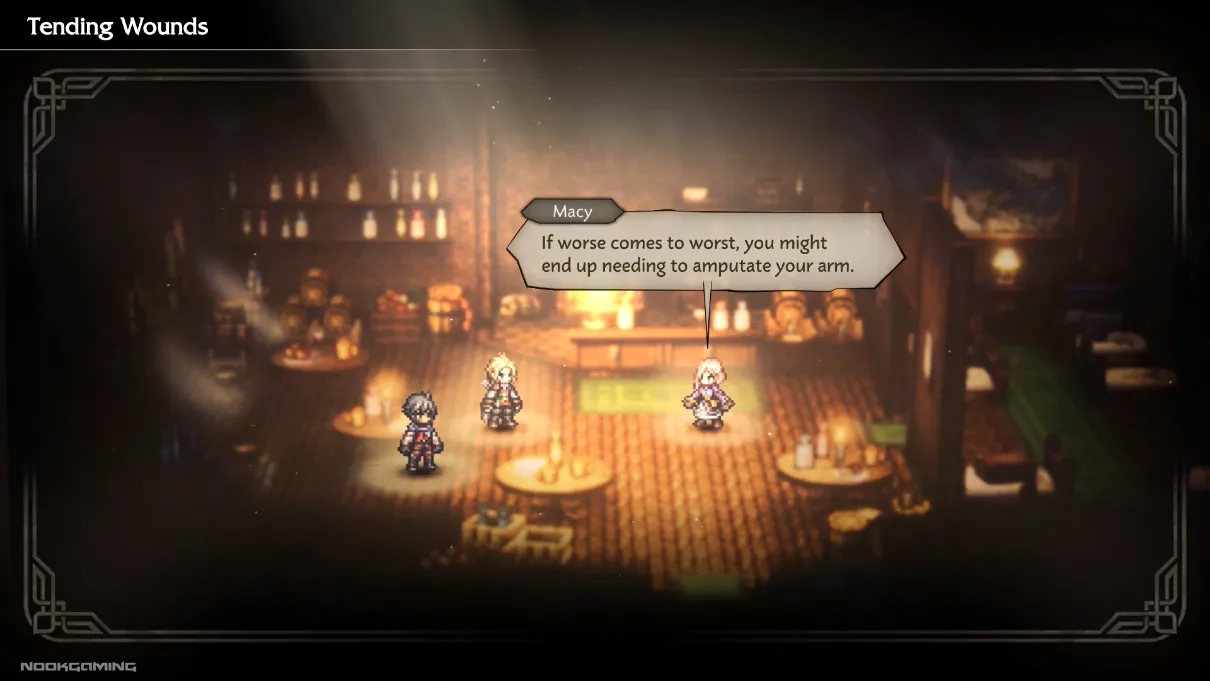
Places you build also require materials that you’ll find while out exploring. I don’t feel positively or negatively about this, but I do think it’s an acceptable splash of reality to the townbuilding aspect. I do think something would be missing if there wasn’t a bit of friction involved in the process of rebuilding and replacing what was lost in Wishvale, and I do especially appreciate that you can only rebuild or do certain things as you gather up more characters. It’s a nice way to combine narrative with gameplay progression, and I still ultimately think that the customization of Wishvale is sufficient enough to hook people that are into that kind of thing. I also appreciate that it’s painless to find out which materials are where, and the challenge instead comes from exploring the right places to find them.
Wishvale’s storyline, by contrast to the rest of the game, is notably more optimistic and cheerful despite the grim way it opens up. I was naturally invested in the storyline since it’s my hometown and I like most of the characters it centers around. It wound up being the first storyline I had completed, but even after that I enjoyed exiting the other main stories for a bit to return and chat up the new residents. Party Chat, a feature returning from the first two games, also made this part more fun. As the story progresses and as you find more optional and mandatory party members, I got to see all the different ways they would interact. Some of these interactions were somber, but many of them wound up being quite funny, and a nice pacebreaker from the generally serious tone the game had otherwise.
Eight Versus One, Jump ‘Em!
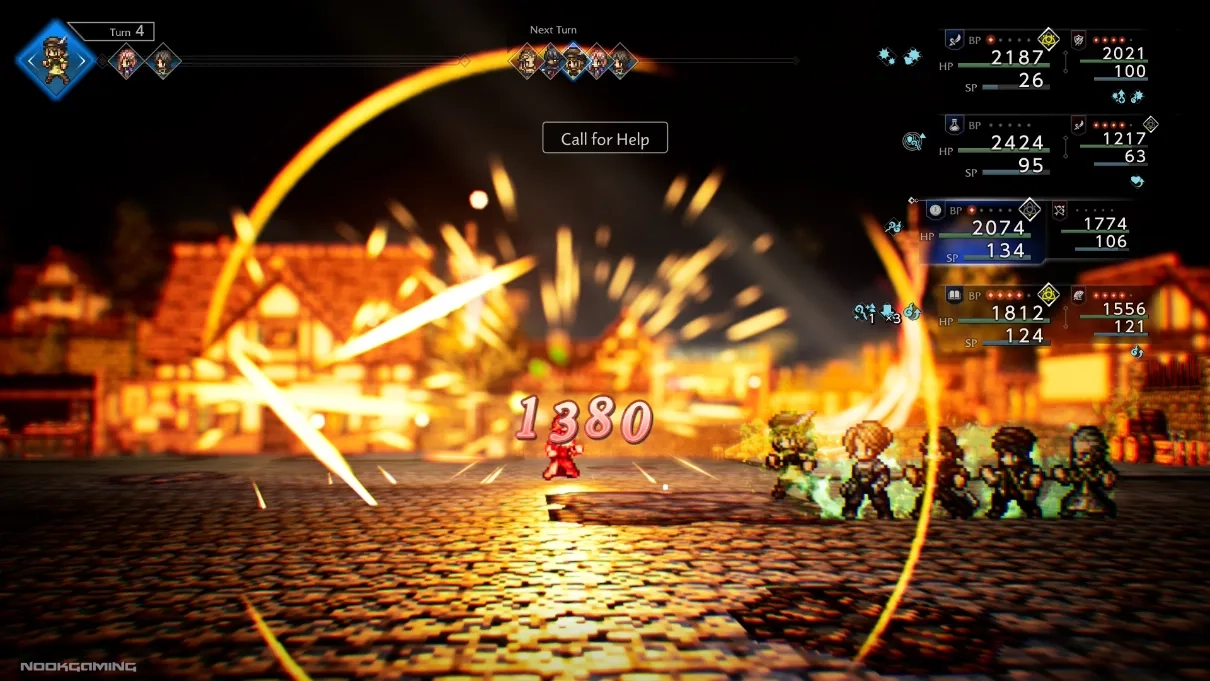
Octopath Traveler 0’s combat is a linear evolution of the combat system from previous games. Like before, you’ll fight in turn-based gameplay managing your HP and SP pools to beat foes down by exploiting weaknesses. Octopath’s main two distinctions still remain found in their “boost” and “break” components. “Boost” allows the players to stock “Boost Points” over each turn, to which the player can use up to three at once to enhance the potency of their attacks or abilities, or to strike multiple times with regular attacks. “Break” is the associated number of points associated with enemies before their defenses are broken and they remain stunned for upwards of two turns. Combat then becomes an act of carefully balancing party health with dwindling down the enemy’s break meter, and this is made more complicated by things like ultra-powerful attacks that can only be disrupted by inflicting break upon them.
Each character Job (of which there are eight) comes equipped with two weapon types, and usually one or two different types of Magic that can be learned naturally. These skills can be expanded further with “Mastery” items, of which a character can have up to three Masteries equipped at a time. Masteries also allow you to mix and match which skills you have, though they can still be limited by things like what weapon types a character has for their Job. A Thief, who uses a Sword and Dagger for their main weapons, still can’t use skills that require an Axe instead. This means that good team synergy and sensible teambuilding is still necessary to take on most enemies, expanded further by Octopath Traveler 0’s bumping up the active party count from four to eight.
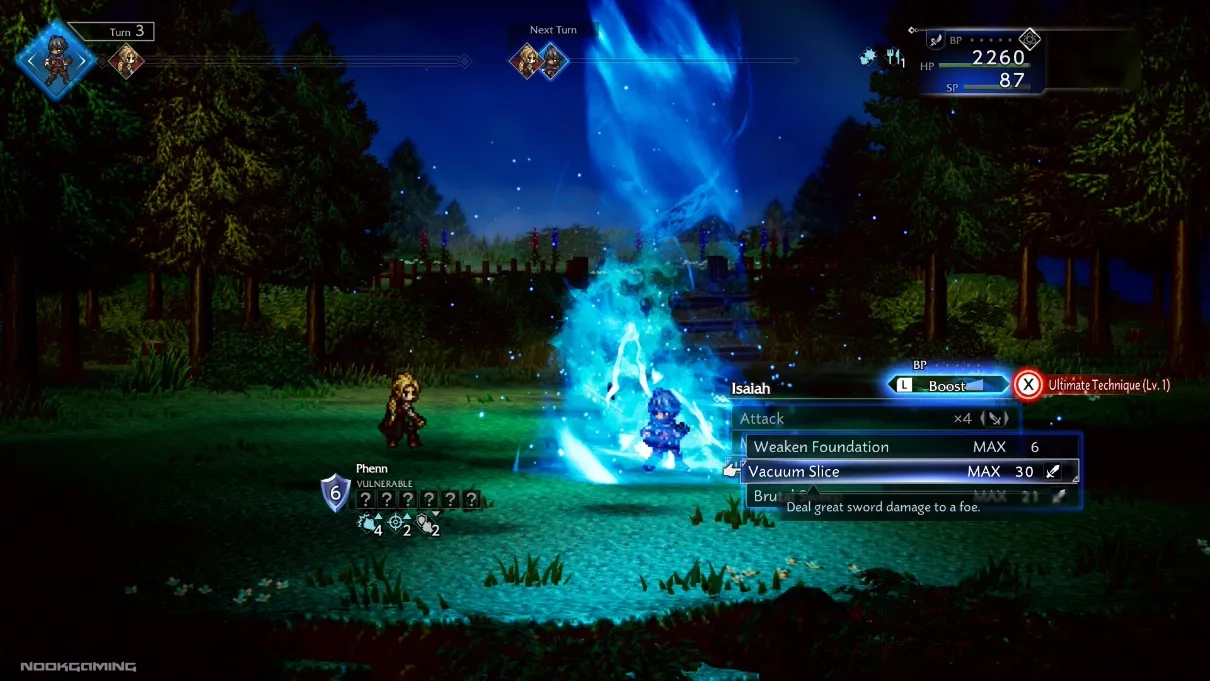
While only four characters will act and take damage in a turn, they can be swapped out for anyone paired off with them who’s waiting in the back row. This greatly incentivizes synergistic teambuilding on both a micro and macro level, as every character has passive abilities and skills that can benefit the front or back row member in meaningful ways. While there’s a lot left to be said about the combat, I feel the progression systems do an excellent job in allowing for a broad degree of customization and approachability to how someone plays the game. Thanks to the freeform nature of exploration, players can also be rewarded heavily by playing smart and sneaking into high-level areas to snag especially strong goodies and so on even earlier.
It’s also thanks to this that Octopath Traveler 0 has a strong item economy. Many RPGs tend to run into the issue of money losing its value before long because it’s easy to stockpile a lot of it, but I never hit that snag here. Since I had to make sure all of my characters were up to par, it meant I was buying equipment for at least eight characters at a time, so I had to make considered choices on who to prioritize buying things for, and in what ways. While you can settle into a comfortable rhythm before too long, I was grateful at how often I felt I needed to make interesting and impactful decisions in both combat and team management in this game.
Smash the Limits
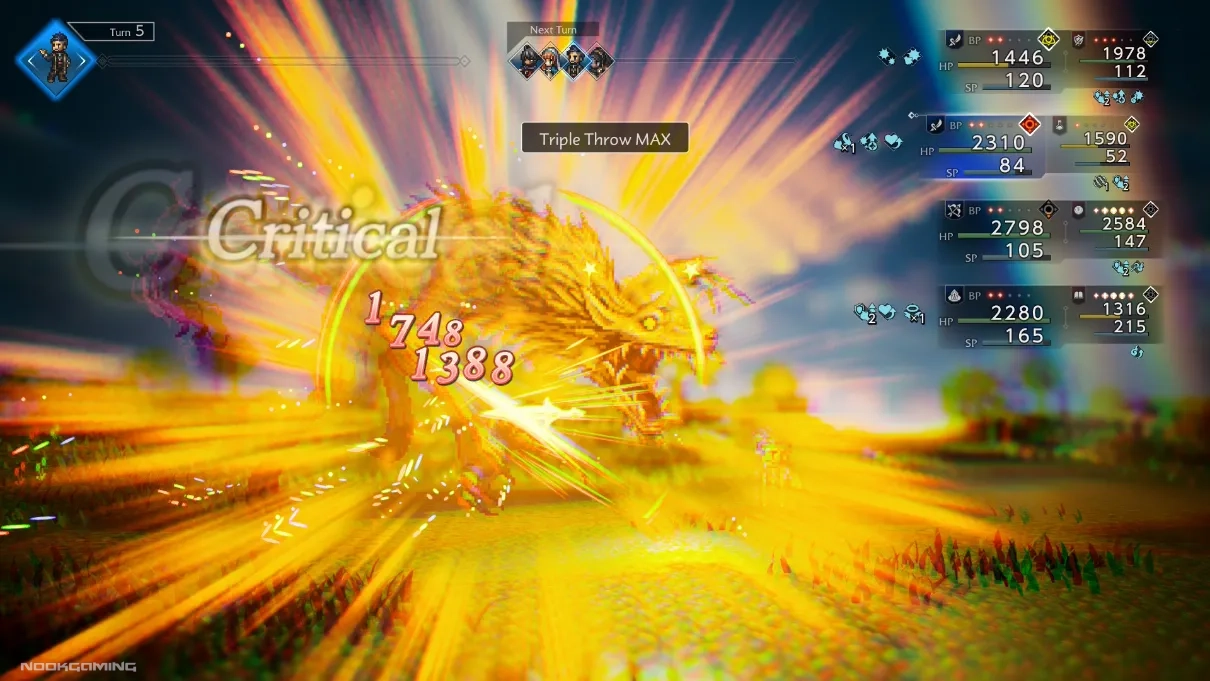
Unlike before, every character minus the player is locked to their respective Job type. Each also has a set of unique skills and an Ultimate Technique they’ll unlock upon unlocking all of their skills and passive abilities. Ultimate Techniques are essentially Limit Breaks, allowing characters to do ridiculous amounts of damage or cast a buff to help out the party. One character might have a buff that lets them evade every physical attack for a few times while simultaneously provoking every enemy, while another might cast a support skill that raises every party member’s attack and defense while lowering the enemy’s. The player character will be granted a small variety of Ultimate Techniques, granted to them upon completing each storyline in the game, though they can still only use one at a time. It’s fun to clutch out an encounter using these techniques, though I do feel they’re slightly overtuned in the early game.
Once players are at roughly Lv. 35 or so, hitting the damage cap (9999) becomes quite common, and bosses you meet later on will quickly exceed those numbers. The challenge then becomes finding ways to exceed the damage cap in a few turns, either through use of multi-hit skills or through specific character abilities that will let you break the damage cap temporarily. While most multi-hit skills are more practical for their ability to whittle down enemy Break numbers, some will have secondary effects that increase their strength if certain battle conditions are met. For example, the Swiftbolt skill increases in strength the sooner its user acts in a turn. Pairing a slow Scholar with high magic power with a faster character like a Thief or Dancer will allow you to switch off the Dancer when it’s their turn, meaning the Scholar can strike with Swiftbolt for maximum damage. Planning these attacks around bosses who have all sorts of ways to trip you up can be rewarding, as while having eight characters might at first seem like overkill, it’s not long before the game makes you totally aware of why that’s the case.
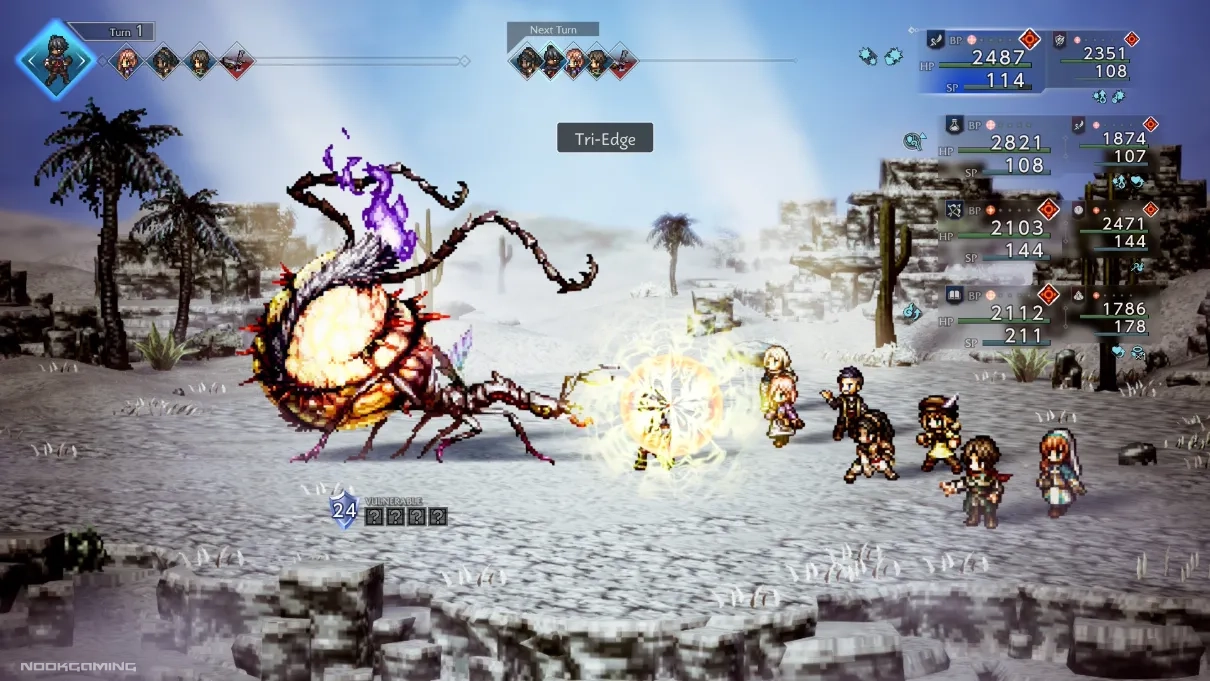
Basically, Octopath Traveler 0 puts up interesting boss walls and demands that the player find various cheeky ways to overcome its deliberately placed limitations. It’s got all the hallmarks you would expect from a Team Asano game, and I think the balancing here grants it a much better sense of momentum and rhythm compared to the likes of Bravely Default or the original Octopath Traveler. If I had one complaint, it’s that I wish the difficulty curve was a little sharper. To its credit, once it gets hard, it stays hard, but I do wish a few of the earlier game bosses put up more of a fight. Outside of that, once it really kicks into high gear, boss fights and encounters can be exhilarating to fight and smash through with good strategy and pre-battle planning. I never got tired of it, even considering the game’s immense length.
Exploration and Path Actions
Like both games before it, Octopath Traveler 0 takes on a pseudo open-world style, where you can go most places whenever you please, but each storyline you find plays out linearly. Certain dungeons and a small handful of towns will also not open up to you until after certain story requisites have been fulfilled. Otherwise, the game is perfectly content in letting you roam into areas far above where your level is. Have a means to enter a tower filled with strong bosses when you’re only Level 35? No problem, champ. Have fun getting slaughtered. It helps that the world itself is positively massive in scope and places to find, to a point that I was surprised I was even finding new towns after pushing the 50 hour mark. Unlike the first game, there’s also sea exploration, further opening up possibilities in exploration and intriguing landmarks to find. Most places are worth visiting thanks to their dungeons having bonus boss fights that contribute to townbuilding, as well as treasure chests that contain useful loot.
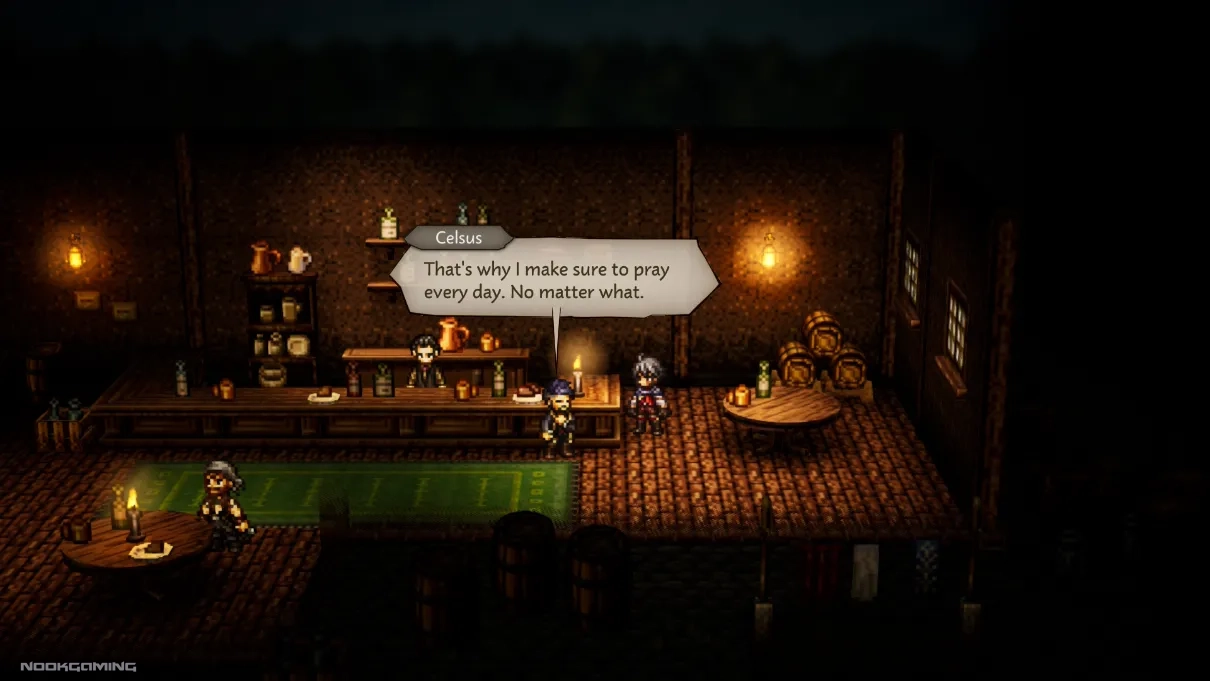
Towns themselves are big and fun to mess around in thanks to Path Actions, all of which are performed by the player character this time around. Path Actions include:
- Contend: Battle a townsperson to take their items.
- Impress: Battle a townsperson to recruit them for their services in battle.
- Inquire: Obtain information from the townsperson.
- Invite: Bring a townsperson back to Wishvale.
- Hire: Obtain a townsperson’s services in exchange for money.
- Entreat: Ask a townsperson for their belongings, which you might receive for free with some luck.
- Purchase: Buy items off of a townsperson, which you can haggle down if you’re of a high enough level to do so reliably.
All of these are very useful for keeping on top of your progression, and each town has some associated characteristic that shines through these. The battle-loving town of Victors’ Hollow is filled with high-level NPCs who make for strong allies, but will put up a heck of a fight before you earn their services. The shady town of Valore is filled with people who have good intel on locations and items, but only if they’re willing to actually talk to you. Meanwhile, the town of Grandport is a center of commerce for merchants, making it the perfect place for you to haggle some loot off of the locals. While I try to do a clean sweep and perform Path Actions on every NPC before I initiate a story in a new town, this is usually interrupted by NPCs who are way out of my level range. Though many times, this would encourage me to get cheeky and get what I want from them anyway: This feels rewarding when I win against them, and makes it a nice thing to laugh at when I predictably get wrecked instead.
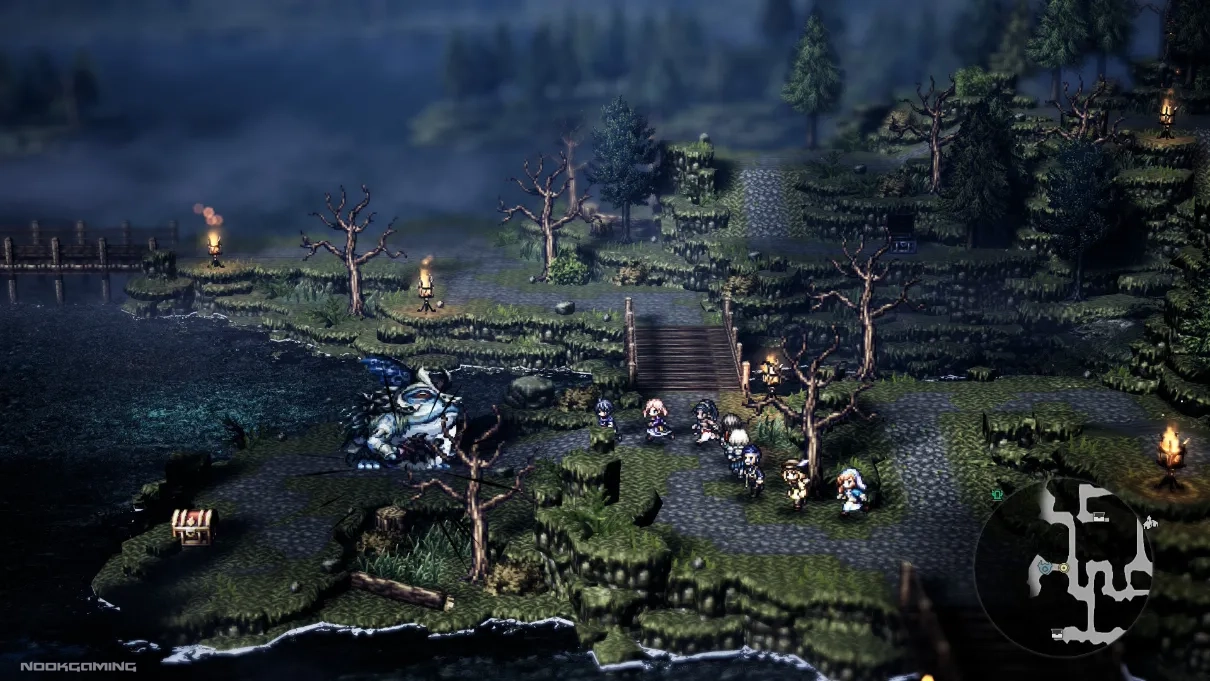
Path Actions are a fun marriage of story and gameplay, as much of this NPC interaction helps illuminate quite a lot of the setting in ways that can be sad, weird, funny, or uplifting. I was surprised at how much there was to gauge from certain one-off NPCs, and how much they told me about seemingly innocuous details in the setting. This was always the strong suit of Octopath Traveler, so I’m happy to say that it’s as fun as ever here.
Viva la HD-2D
Octopath Traveler 0’s visuals are alright, but they are noticeably more rudimentary compared to past HD-2D outings. This is partly because it’s very directly built off of the original game and the mobile title, and as such there wasn’t much room for improvement without changing too many things. That said, it still looks pretty nice and is very atmospheric thanks to a strong mixture of colors and post-processing effects to sell each location you visit. While not as ornate as the likes of the recent Dragon Quest remakes, I feel this game makes up for that in its sense of scope and through the various gameplay quirks it uses to communicate the story and history of each location instead.
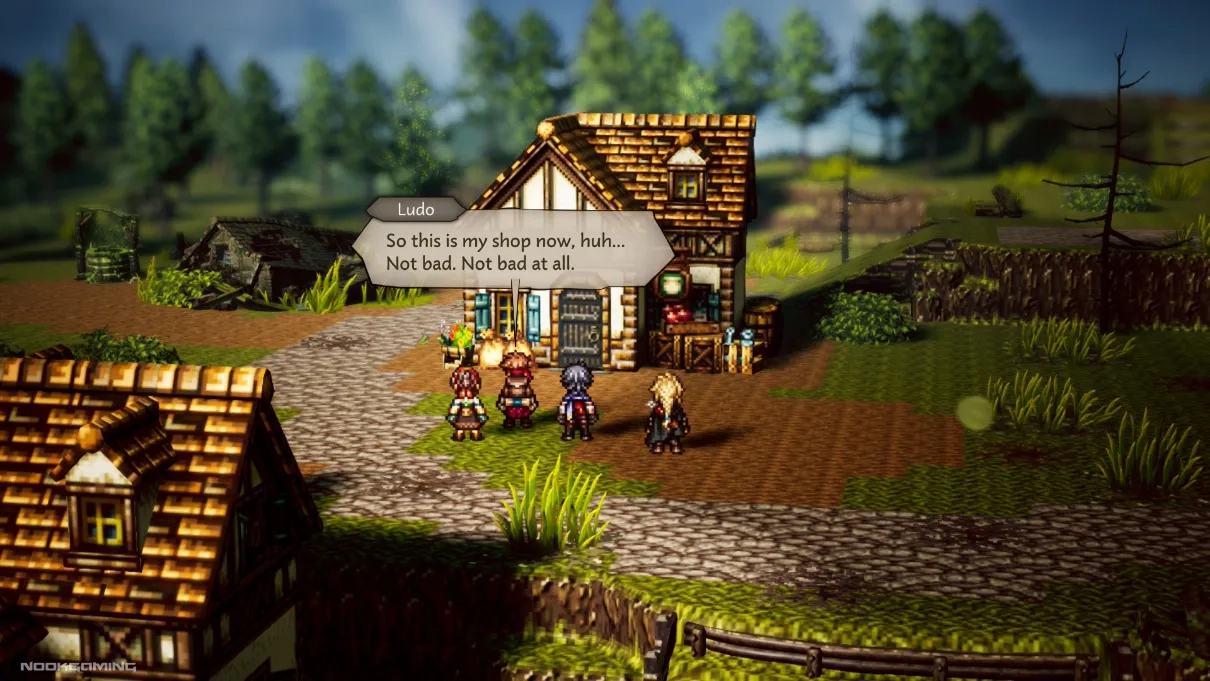
Where the game truly shines with its presentation is found in the great music and voice acting. In part because of the very heavy story moments, actors give very guttural and emotive performances that really sell their grief and desperation at the events unfolding around them. Meanwhile the villains (especially the likes of Auguste) give extremely hammy performances that are just “marvelous!”, as some of them might say. The game’s story plays things up in a way that’s often like watching theater, so the lively performances do a lot in bringing that aspect of its presentation up to scratch.
Yasunori Nishiki also delivers another smashing score, combining band and orchestra to deliver an incredibly lively and sensational soundtrack. Basically every major villain and certain story elements has a motif that is remixed at least once, making their presences feel all the stronger. It’s also filled with lots of cool details, like several cutscene themes seamlessly transitioning into different boss themes, or area motifs combining with a villain’s theme as you approach the climax of their story. In particular, I have to give a big shoutout to the theme of Wishvale, which changes and evolves as its state changes. Its third theme, which plays at an especially powerful story moment, instantly became a favorite of mine.
Verdict
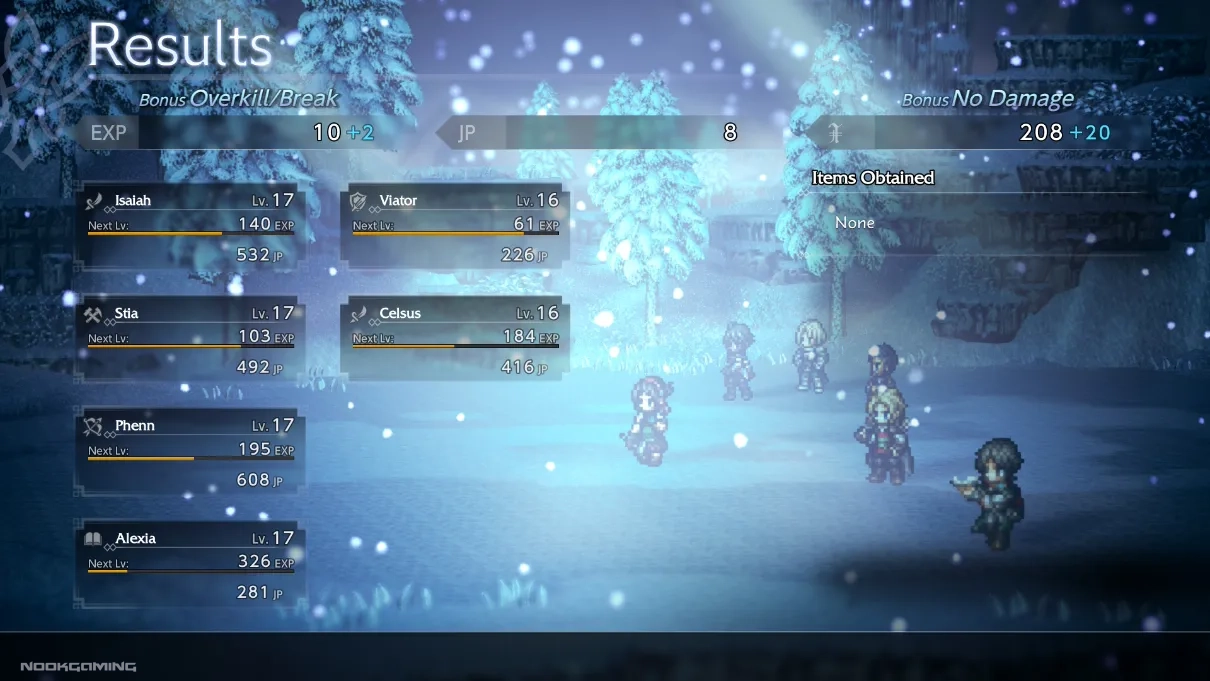
The enormity of Octopath Traveler 0 is something that must be seen to be believed. Official developer comments about the game’s playtime being around 100 hours weren’t made with exaggeration, and even with that, I never felt like so much as a minute of my time was wasted. The stories it tells are grand and sweeping, and all fit snugly into a greater work that feels sort of like a playable epic. Octopath’s core gameplay in exploration, combat, team-building and mid battle strategy have also evolved considerably. The eight-character system and high number of party members means that just about everyone is going to approach it differently, and that’s before getting into the open world and exploratory elements, which have also been noticeably improved.
What ties this all together is the high quality of its writing. It’s probably my favorite video game narrative since Dragon Quest VII (which still sits as my favorite in general), combining lots of interesting themes and talking points with a flair for the theatrical. It’s over the top in ways that feel deliberate and serve to heighten the emotions felt by the characters, who themselves are very compelling. While I would never say story is the sole reason you should play Octopath Traveler 0, it is the greatest factor in why all of its systems synergize so well. From top to bottom, I loved this game to pieces. It’s to a point that, after a while, I began to ask “How in the world are they supposed to top this?”
OCTOPATH TRAVELER 0 IS A MUST BUY

If you are looking for another RPG in the HD-2D style, you might want to check out our review of the remake for Live-A-Live.
Many thanks go to Square Enix for a Nintendo Switch 2 review code for Octopath Traveler 0.

A hobbyist who took up the pen to write about their favorite pastime: games. While a lover of many genres, Isaiah Parker specializes in Platformers, RPGs, and competitive multiplayer titles. The easiest way into his heart is to have great core gameplay mechanics. Self-proclaimed world’s biggest Sonic fan. Follow him @ZinogreVolt