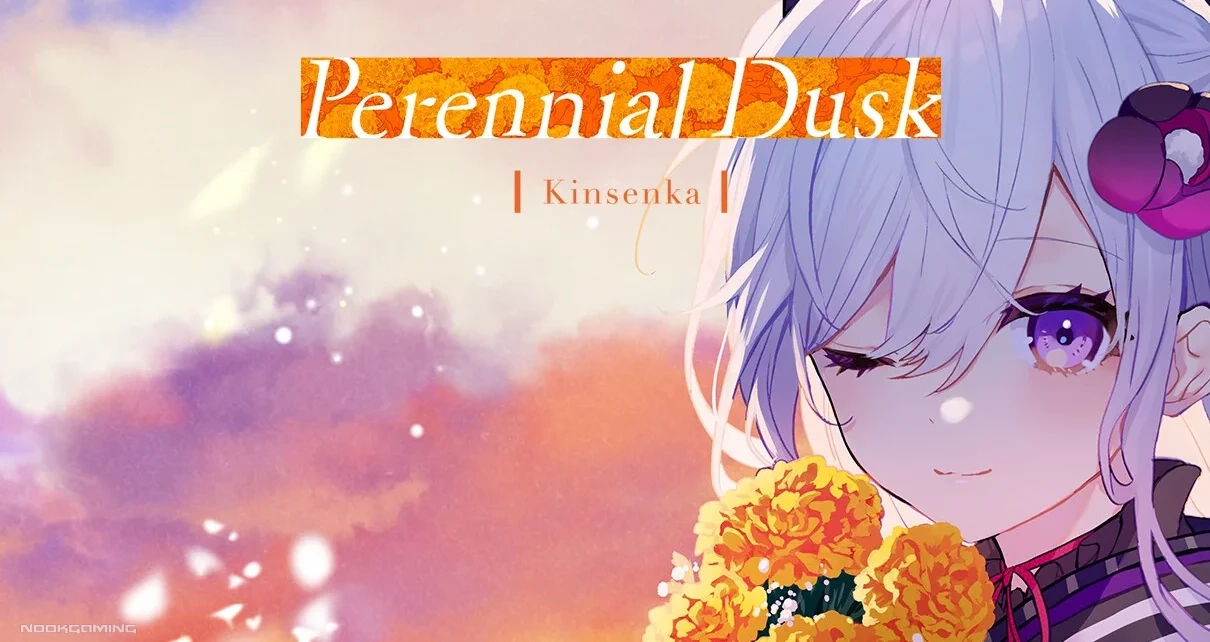
Perennial Dusk -Kinsenka- is the latest release from Frontwing and scenario writer Urushibara Yukito, who is known for Irotoridori no Sekai – The Colorful World and Sakura, Moyu -as the Night’s, Reincarnation-. A tale of seeking meaning in suffering in a world of eternal twilight, Kinsenka has an interesting setting and a memorable story. Unfortunately, they’re buried under terrible writing.

A Silent Heart
Tachibana Sai was born without a heart. No matter what depths of despair or heights of elation life throws at him, he feels nothing. Desperate to experience any kind of human emotion, Sai prowls the streets at night, dismembering schoolgirls and asking their corpses why his heart remains silent. Unsurprisingly, his activity draws attention from some unsavory types, and Sai soon finds himself in the crosshairs. But then something miraculous happens. He sees a white-haired girl in a kimono, Benio Matsuri, and feels something stir inside his silent heart. Is this love? Is this pain? Sai resolves to stay by her side until he understands and quickly finds himself drawn into a world of twilight and curses.
Benio Matsuri is part of the Benio family, a mysterious syndicate of exorcists hidden in a world called the Twilight Prison. When humans pass on, their memories are preserved in the Twilight Prison, taking form and acting out scenes from their lives in a frozen eternity. However, those who die with a heart full of pain and regrets become maledicts, malevolent spirits that lash out at anyone unlucky enough to encounter them. The footsoldiers of the Benio family, curse bearers, use supernatural powers gained by mastering the darkness in their own hearts to exorcise maledicts and return their spirits to the Twilight Prison. While the Benio family might sound like unsung heroes acting in the shadows, you quickly see that life in the Twilight Prison can be brutal, and the leader of the family, Benio Tsui, seems just as dark as the maledicts the family fights against.
Into the Twilight
The world of Perennial Dusk -Kinsenka- is interesting and an excellent stage for its themes about finding meaning even in a life where suffering and misfortune are unavoidable. The worldbuilding is well-executed too. The Twilight Prison is conveyed through the characters’ experiences in it and the background art as much as through loredumps, which are appropriately moderate in both frequency and length. Plus, the Twilight Prison is a world that not even Benio Tsui fully understands, and Kinsenka is content to leave some things a mystery.
The characters are more of a mixed bag. While I liked the cast in theory, I thought most of them were either poorly characterized or not given enough significance in the story for a major character. To take Tachinaba Sai as an example, when you first meet him he comes off as twisted and sadistic. Of course, this is a tough ask for a viewpoint character, and so this is quickly discarded and replaced by a cold and analytical personality. Perennial Dusk -Kinsenka- offers a few lines about how the girls he murdered had bullied his little sister, but this is never explored, and his sister isn’t a character you ever meet. It comes off a cheap attempt to garner some unearned sympathy. Kinsenka does ultimately make an attempt to reconcile Sai’s character, but it relies too heavily on leaving you in the dark and explaining everything through flashbacks at the end. This can work, but it also requires effective foreshadowing. You should be able to think back and notice how the signs had always been there hiding in plain sight. I didn’t feel this way about Sai’s character arc and so I found the execution unsatisfying, even if I liked the idea.
The Benio Family
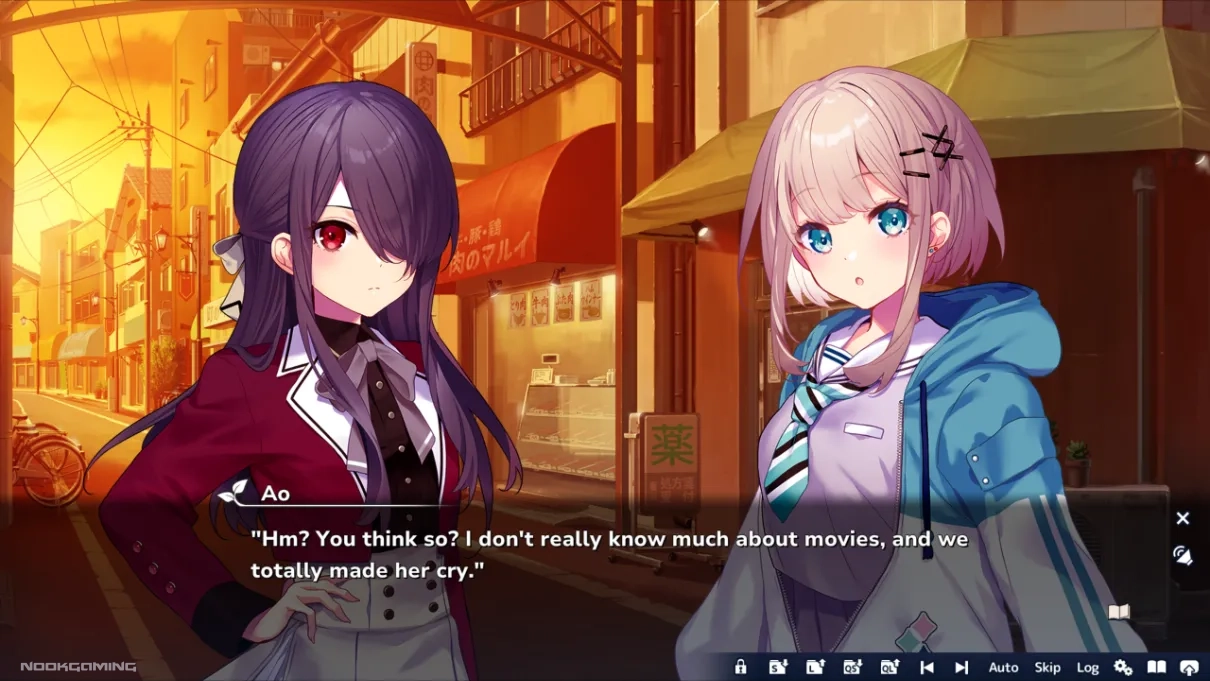
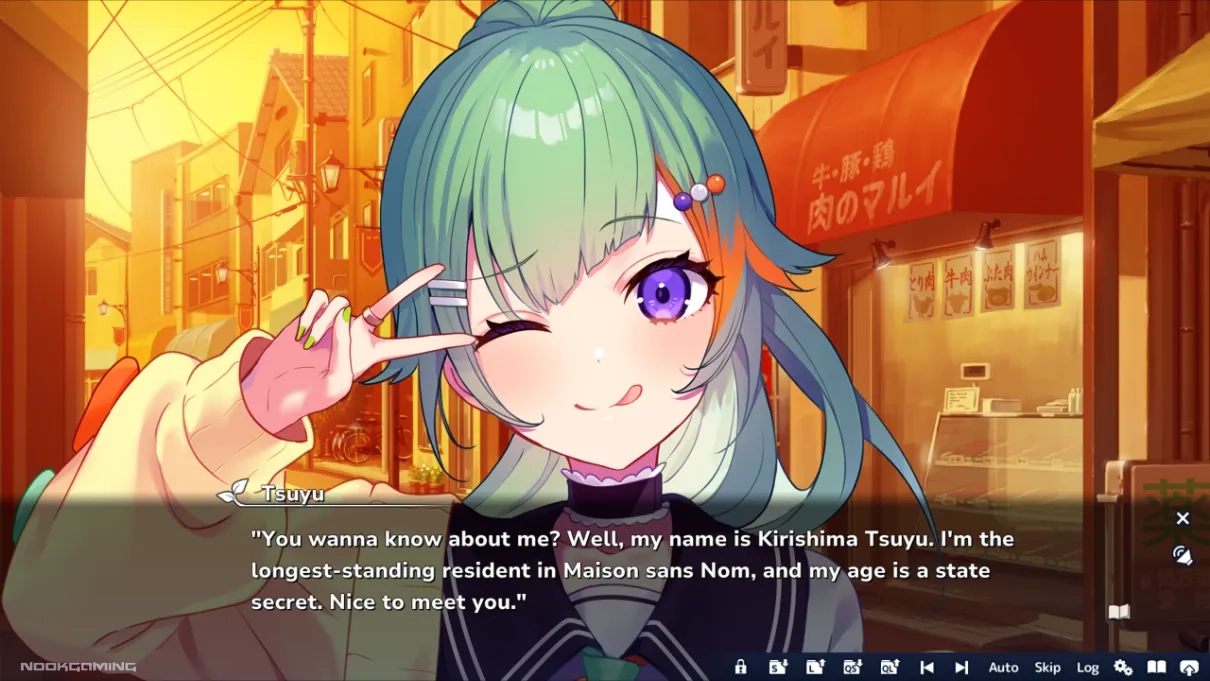
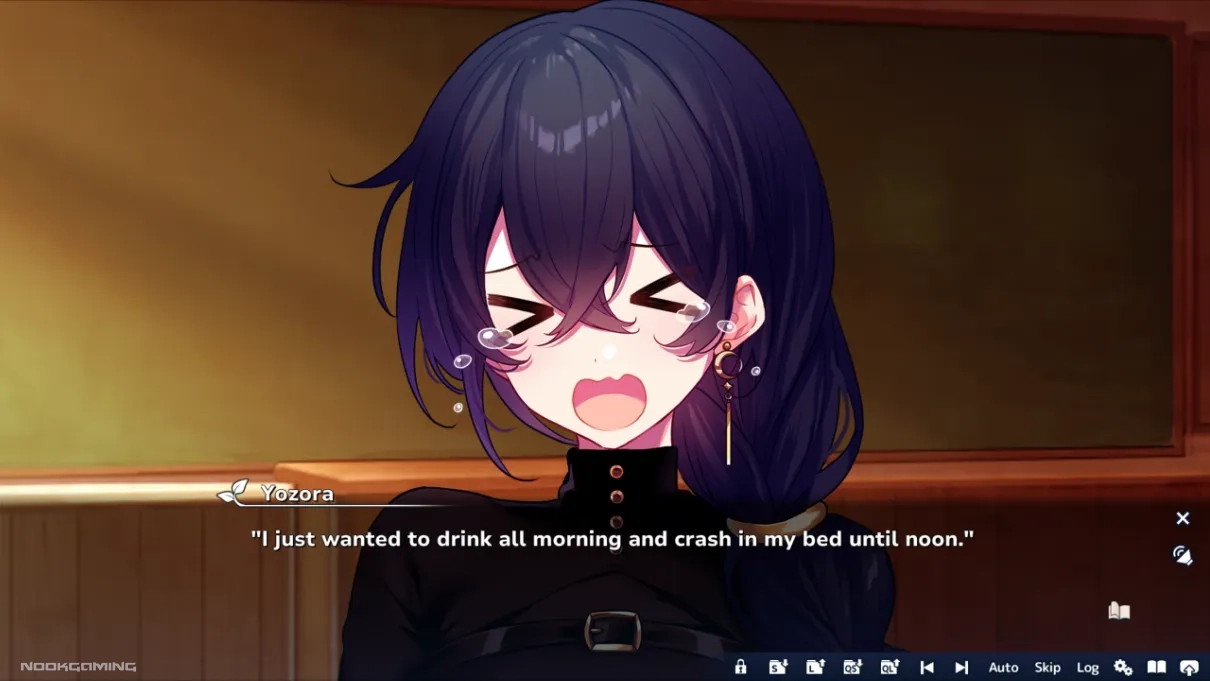
The rest of the main cast are the residents of a dorm called the Maison sans Nom where Tachibana Sai resides during his stay in the Twilight Prison. Kanbara Tatsuki is the yang to Sai’s yin: physically strong and earnest but lacking in guile. Ando Meme, Ao Tsukahara, and Kirishima Tsuyu are curse bearers in training. Meme and Ao are friends who seem to exist to meet the cute girl quota, while Tsuyu is a flashy crossdresser whose goal is to bring cuteness to the world as a streamer. Rounding out the group is Kandori Yozora, an irresponsible “adult” charged with shaping the students into hardened soldiers for Benio Tsui.
Besides Sai, Tatsuki is the other primary viewpoint character. He’s more likeable than Sai and is more consistently characterized. His arc is ultimately subservient to Sai’s story though, and never fully reaches a satisfying moment of agency and impact. Yozora is the best-written side character, having an interesting, self-contained story and showing real growth. Ando, Ao and Tsuyu are like those “and the gang” characters in shounen anime who have cool powers and quirky personalities but never get to do anything meaningful. They mainly exist to drive the banter and Kinsenka’s unnecessary and unfunny comedy skits.
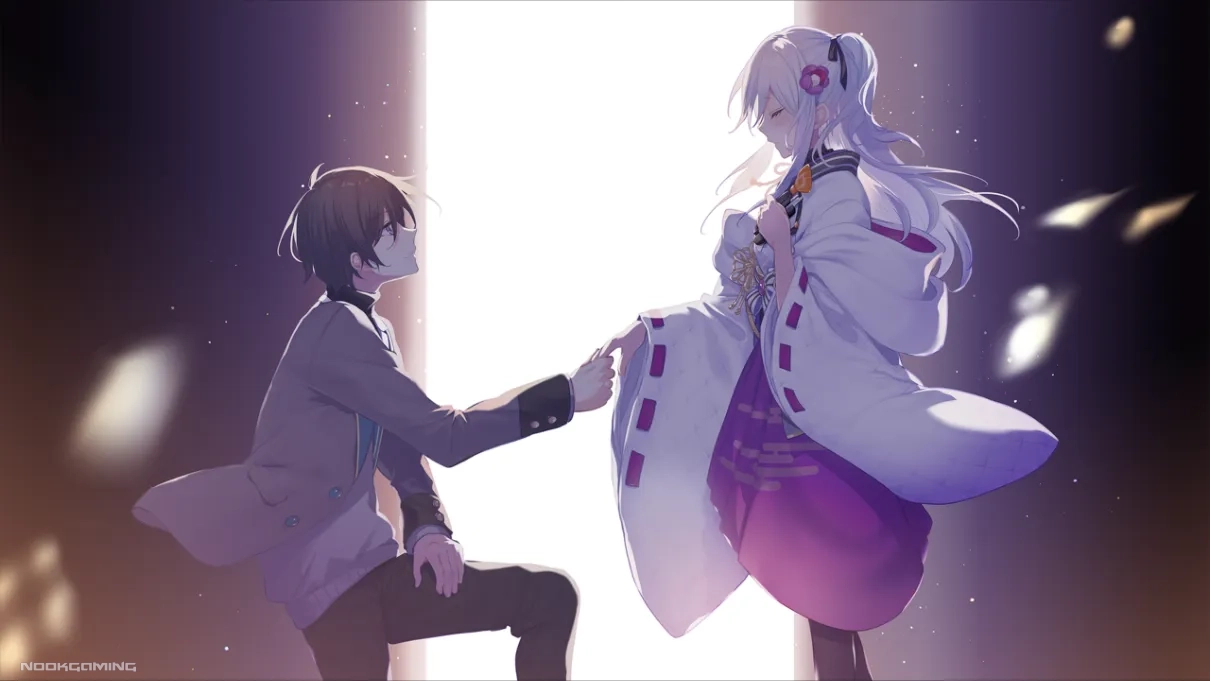
Benio Matsuri also lives in the Maison sans Nom, but in a near catatonic state. Sai soon discovers there is another personality inside her, given the name Nobody by Tatsuki. Where Matsuri appears gentle and kind, Nobody is brash and capricious, though also playful. Matsuri in the present is more plot device or prize to be won than character. Most of what you see of her is in flashbacks. Nobody was my favorite character. Once she opens up, she’s quite charismatic, and learning about her both makes her sympathetic and makes her motivations and actions believable. Unfortunately, her arc is also subservient to Sai’s, though not as badly as Tatsuki’s, and she ultimately does have a place in the story.
Meanwhile, Benio Tsui serves as the main antagonist. Her obsessive and paranoid rule over the Benio family creates a brutal and oppressive environment for her followers. I liked that she both feels like an immediate threat and has deeper machinations looming ominously in the background even when offscreen. That said, Kinsenka falls prey to the narrative pitfall where much of its evil is so gratuitous that it’s almost hard to take seriously. This is a story about suffering, and so the characters must suffer, true. “The human heart is but a vessel for pain.” But Perennial Dusk -Kinsenka- takes you through long and graphic descriptions of wanton cruelty at the hands of characters who behave with the kind of insane malevolence you’d expect to see from a cartoon villain. Oh, except if it’s a character you’re supposed to sympathize with doing it like Sai and his schoolgirls, then it’s written off with a cheap excuse and quickly forgiven or forgotten.
Red Light, Green Light
If my criticisms of Perennial Dusk -Kinsenka- were limited to some lackluster characterization and Sai overshadowing the rest of the cast, I would still recommend it. The bigger problem is that it’s badly written throughout. In fact, Kinsenka might be the worst paced visual novel I’ve read. As I mentioned, it wastes time with unfunny comedy skits along with stupid lewd jokes that would be more at home in a moege, but thankfully there aren’t that many of these and they fall off in the second half. Sadly they’re replaced by something worse: interminable flashbacks. Most of the second half of Kinsenka consists of repetitive, drawn-out flashbacks. It’s especially frustrating because every time it feels like the story might pick up some momentum, you’re thrown into yet another flashback. This reaches its nadir at the climax. Right as the characters set out to confront the final obstacle, the present is put on the back burner for several more hours of flashbacks. To be fair, they do have some necessary context, but this needs to be conveyed in a way that doesn’t feel like it derails the main plot.
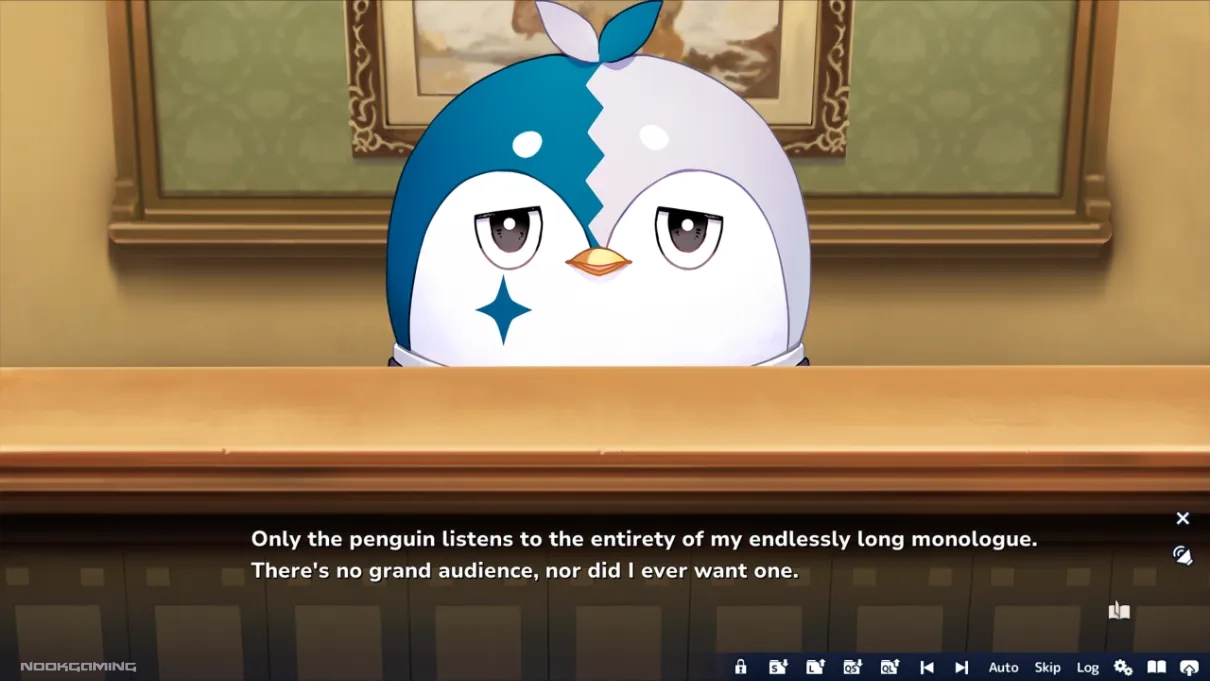
The flashbacks might have been more bearable if they didn’t consist almost entirely of characters giving rambling, long-winded internal monologues about their thoughts and feelings. Perennial Dusk -Kinsenka- seems to think that powerful emotional moments are built up by having characters repeatedly tell you how they feel when it should be showing you just as much through their actions. Kinsenka also presents every line as if it’s a narrative and emotional climax, embellished and drawn-out with evocative descriptions covering every bit of minutiae. But good storytelling needs ebbs and flows, both in the larger narrative and from line to line. If everything is the climax, then nothing is, and the result is that Kinsenka feels both flat and exhausting to read. Oh, and hopefully you like Sai telling you he has no heart, since he says it at least 100 times.
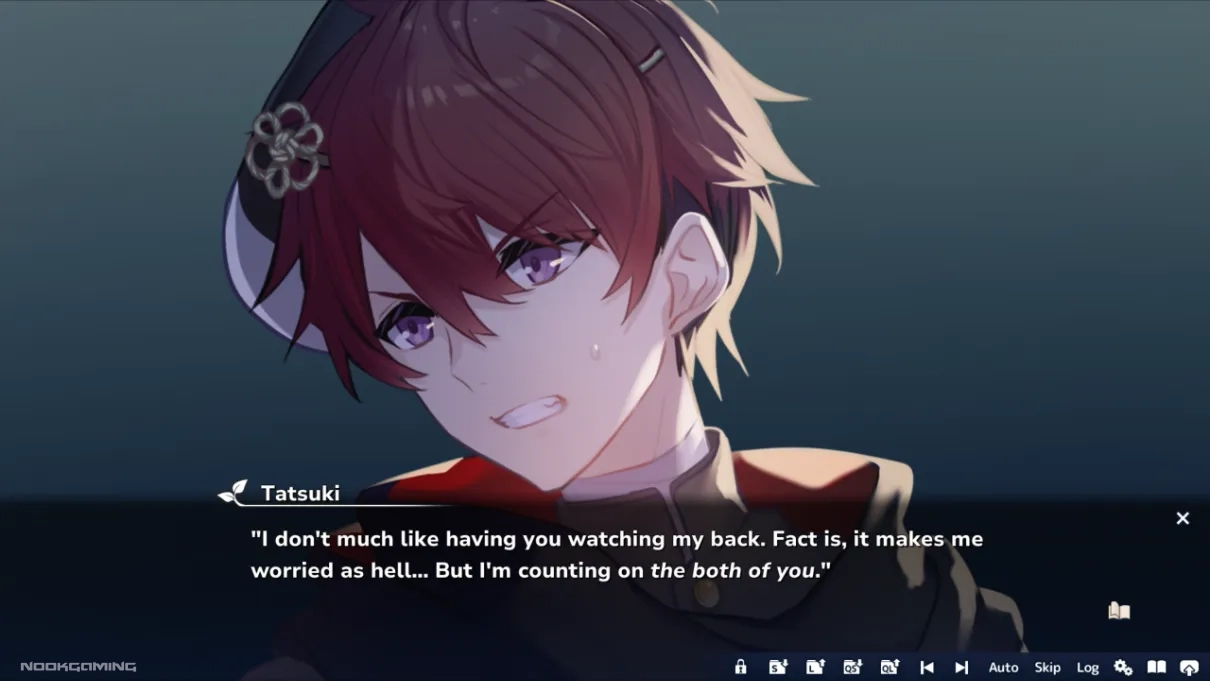
Kinsenka might not have needed so many flashbacks if the narrative didn’t become so convoluted at the end. While the residents of the Maison sans Nom begin to grow into a found family, Kinsenka decides this isn’t enough and makes a large effort to tie things together through some grand threads of destiny, which of course requires visiting the past to see the roots of those threads. Maybe it would have been enough to let the relationships the characters developed over the course of the story stand on their own merits. Not every connection has to be something fated, especially in a story about how the universe can be random and cruel.
Having slogged my way to the end, I would ultimately still say that Kinsenka contains a memorable story with compelling themes. It’s an age-old question: how does one find meaning in the randomness and unfairness of evil? If someone is destined to a life of suffering and misfortune they can’t escape, can this life still be worth living? If you could erase all the pain in your heart, would you? Or would that also erase who you are? Kinsenka explores several possible answers to these questions through characters with different philosophies and beliefs, and ultimately arrives at conclusions that are powerful, and at times beautiful. Sadly, I just don’t think it’s worth navigating the rest of the mess to get to these kernels, even if they have merit.
Art, Sound, and Extras
I liked the art and character designs in Perennial Dusk -Kinsenka-. There’s an interesting mix of traditional and modern clothing, and characters have distinct features matching their personalities. For example, the upbeat and outgoing Ao has a round face and features while the more reserved and prickly Meme is angular. The CGs are evocative too, though it would have been nice to have a few more for what ended up about a 20 hour read for me. I found the soundtrack to be average. It has all the things you expect: piano noodling for the quiet scenes, light music for daily life in Maison sans Noms, and silly upbeat lounge music for the comedy skits to name a few. It’s the kind of soundtrack that I find works well enough as an accompaniment to my playthrough, but which is quickly forgotten after.
Kinsenka includes voicing for all its characters, including Sai and Tatsuki. This was very welcome, since male protagonists are usually unvoiced. For some reason though, Sai and Tatsuki are still unvoiced during their turns as the viewpoint character. They’re clearly not self-insert protagonists, so this felt like a waste. Otherwise, the voice acting seemed fine, though hearing everyone ham it up during the comedy skits was a bit much given how poorly it fit the overall tone of the story. It was also neat to hear the difference between Benio Matsuri and Nobody, since both are voiced by Iwami Manaka.
Verdict
While Perennial Dusk -Kinsenka- has an interesting setting and memorable story, they’re too deeply buried under terrible writing for me to be able to recommend it.
WAIT FOR SALE ON PERENNIAL DUSK -KINSENKA-

If you are looking for another visual novel, you may enjoy Putrika 1st.cut:The Reason She Must Perish. We have also covered a wide variety of visual novels both original to English and localized from Japanese, which you can check out here.
Thank you to Frontwing USA for providing a PC review code for Perennial Dusk -Kinsenka-.
A veteran of Oregon Trail and Battletoads, Wes has been playing and talking about games for as long as he can remember. He’s down to try almost anything, and he especially enjoys games with gripping narrative experiences.