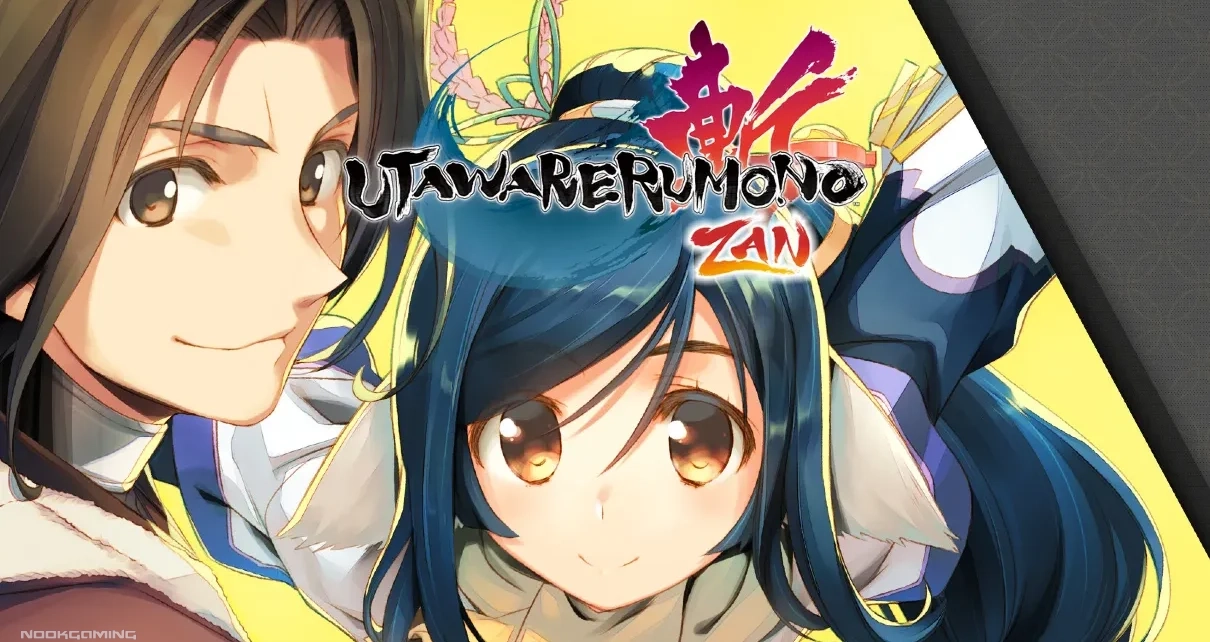
Utawarerumono: ZAN is a 3D hack-and-slash Musou-style anime action game, originally released in 2018 by Aquaplus in collaboration with Tamsoft. It tells a heavily abridged version of Utawarerumono: Mask of Deception’s story, following the same overall plotline but with a heavier emphasis on fights due to the shift in genres. The game was initially released exclusively on PlayStation consoles, but it eventually got ported onto Steam in December 2025 with Shiravune and DMM Games as the publishers. Its sequel, Utawarerumono: ZAN 2, has also been announced for a future international release.
I’m a big fan of the Utawarerumono series. It is no understatement to say that the first game’s story elements and art direction eventually paved the way for me to discover more about my tastes, my interests, and general bias for specific examples of aesthetically pleasing non-human features. And even though I do feel like it’s generally well-received as a visual novel series and one of the more popular titles in the genre, the large gap between releases, such as the two Mask sequels, Monochrome Mobius, and the upcoming Utawarerumono: Shiro e no Michishirube, does act as a reminder that it’s still overall a niche interest in an already niche hobby. So when I heard that it got an action game spin-off almost 8 years ago, I was in shock. In the first place, it felt counterintuitive for a narrative-heavy title (with occasional turn-based strategy gameplay segments) to forgo that entire identity and go all-in on a beat ‘em up style that probably wouldn’t be too fleshed out, given that it’s basically a spin-off for people who are already fans of the series. On the other hand, there was that sort of mysterious allure to seeing beloved characters from the games do superhuman feats like the visual novels describe them doing.
At that point, I realized that thinking like that pretty much sealed the deal. I had to try it out for myself and decide whether the concept was too good to be true or if it was actually a fun alternative to the main games. It was once again time for me to revisit the mystical land of Yamato.
Fighting the Gigiri: Requiem
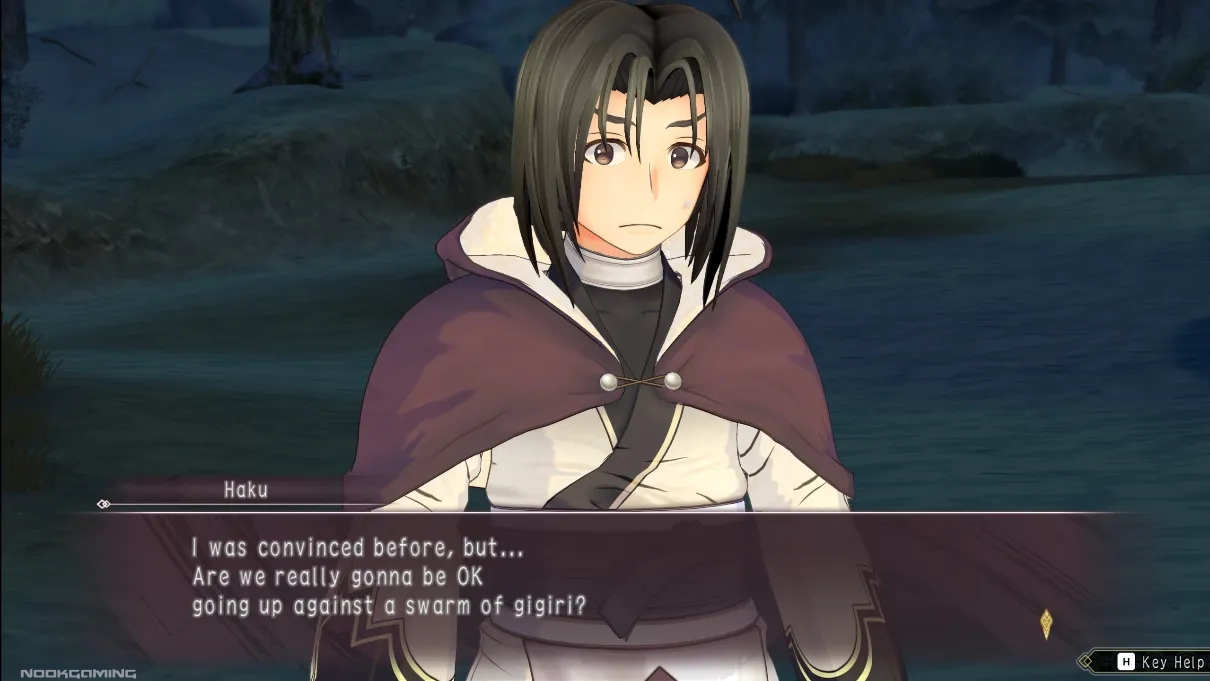
The story of Utawarerumono: ZAN mostly follows the plot of the second game, Utawarerumono: Mask of Deception. It starts with an amnesiac man waking up in an unfamiliar snow-covered landscape, who, after exploring the area a bit, unfortunately catches the attention of a gigantic insect monster who seems intent on turning him into a snack. Luckily, a strong, hooded woman was around to help him out of his sudden predicament. She introduces herself as Kuon, and upon hearing about the amnesiac man’s problematic awakening, decides to name him Haku. Together, they start travelling around the nation called Yamato in search of Haku’s missing memories. Little did they know that their journey of self-rediscovery would inevitably get them involved in a crisis that threatens to swallow up the entire country.
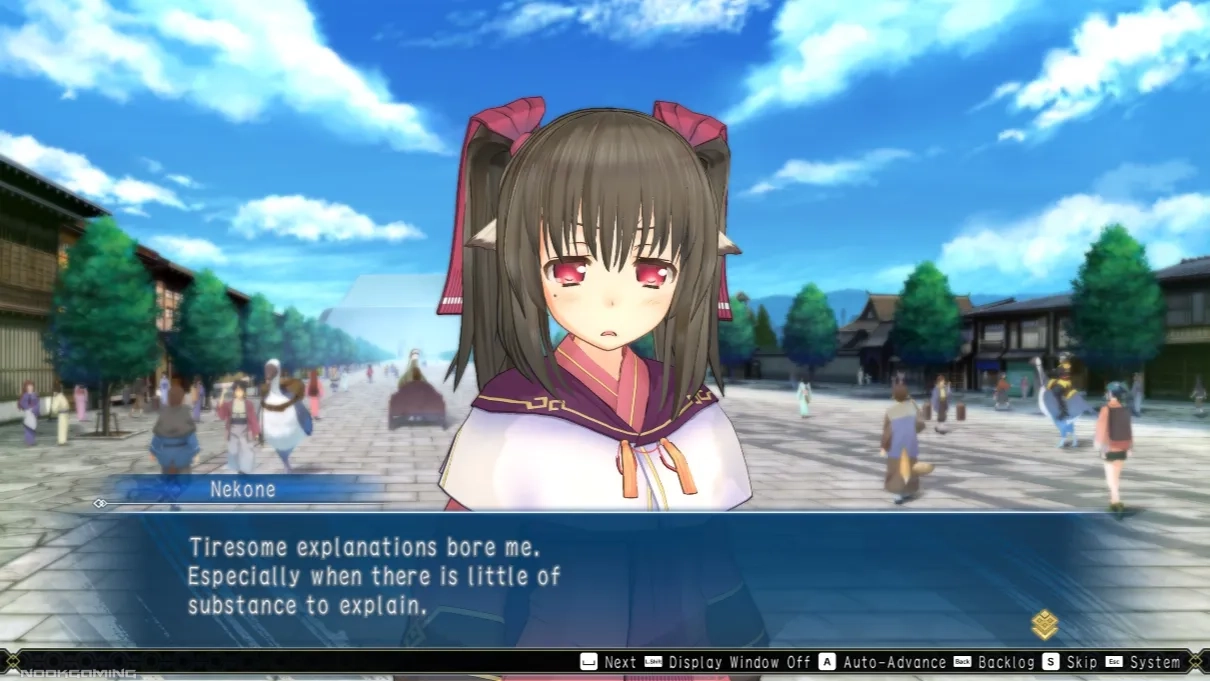
While the storyline of ZAN does follow this overall plot progression, there’s a lot less meat compared to the original. It skips through most of the dialogue, only really focusing on story beats that feature initial character introductions and details that are important for setting up the next stage. It loses out on what makes most of the characters charismatic due to the oversimplification of their narrative roles and the absence of scenes that prominently feature the cast’s quirky dynamics. Essentially, if you aren’t familiar with the game already due to having played the original, ZAN runs the risk of presenting scenes that would have been impactful if the reader was given enough time to become emotionally invested in the story.
On the brighter side, it serves the role of a memory refresher pretty well. It regularly features important scenes that serve as a backdrop for the game’s various stages, which, to be fair, are mostly points that you would want to remember if you were to dive back into the series. Save for a few important interactions that are only in-text due to the nature of visual novels, ZAN does have most of the important events that lead to Mask of Truth’s plot, so you won’t be missing out on the most obvious details related to Haku’s memories and role in Yamato’s crisis. Additionally, these scenes are presented using visually pleasing 3D models that are different from the original game’s assets. It’s a nice way to reexperience wholesome scenes with the cast, and of course, by extension, heartwrenching ones as well.
Breaking Free from Tile-Restricted Movement
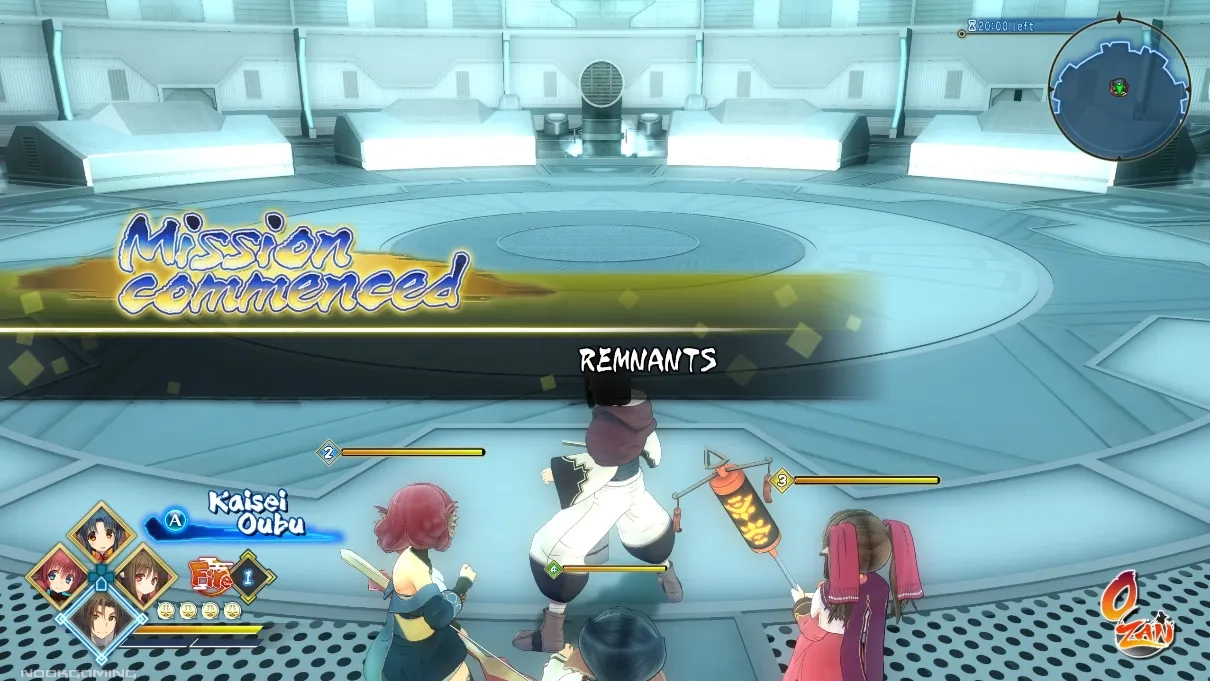
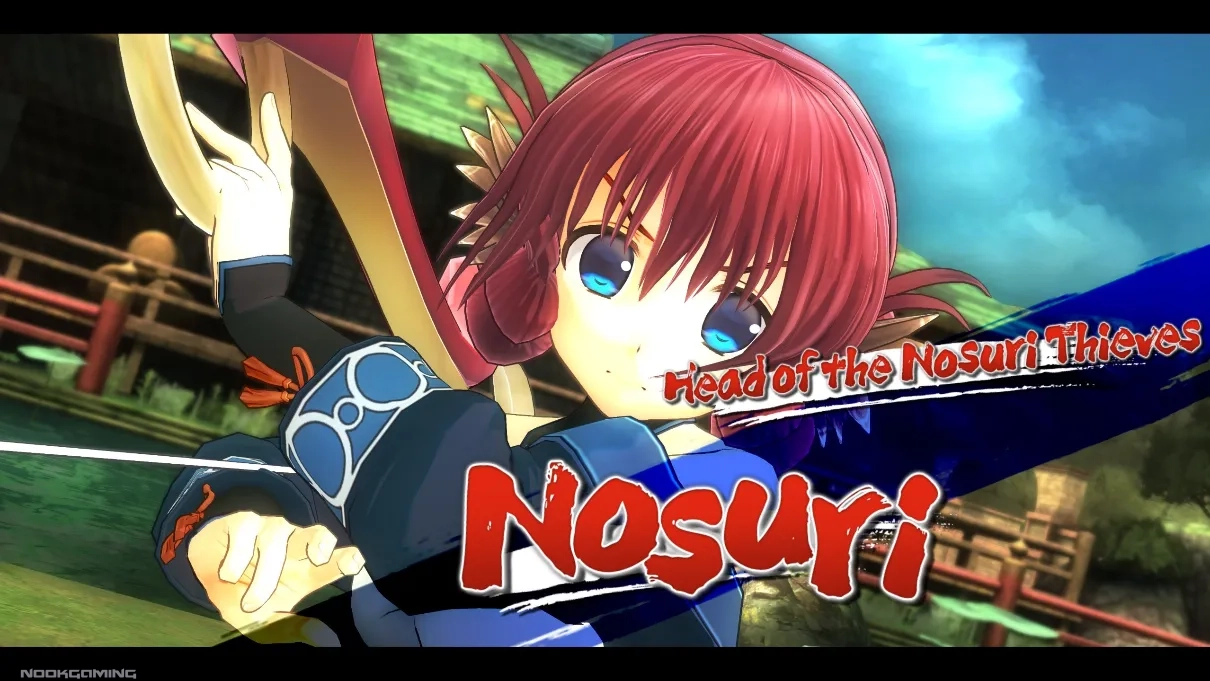
Utawarerumono: ZAN is a hack-and-slash Musou-style anime action game, which means that it takes inspiration from titles like Koei Tecmo’s Dynasty Warriors franchise and implements a one-against-many beat ‘em up arena fighter where you have to fulfill specific objectives to clear various stages. For Utawarerumono: ZAN specifically, this usually involves clearing a series of main objectives to advance the in-stage events, with side objectives being available to clear at certain points for additional rewards and overall completion. The stages in the game follow a similar pattern: braindead grunts will usually swarm the field with a few elite units scattered in between as difficulty markers, then the stage ends upon beating a specific boss enemy or completion of the narrative objective (such as securing supplies). There are some unique objectives between, such as surviving a certain length of time or picking up specific loot, but they all stick to the same button-mashing heavy gameplay loop that Musou games are known for.
Speaking of buttons, the basic controls are pretty intuitive for the genre. Using the XBox/PC controller layout, X and Y serve as your two main combo inputs, with B being the character’s special move that costs Zeal to use (or chain technique, as named in-game) and A as your jump input. There’s a bunch of other stuff that you can do with the left and right bumpers and triggers alongside the directional pad, but looking past the specifics, the game feels as good to play as other games in its genre. If anything, I feel like what it has here in terms of simplicity becomes a bit detrimental for its potential for complex gameplay, as there isn’t much creativity present when it comes to the gameplay experience aside from character choices, party builds, and items. You just follow one general combo loop and stick to it as best as you can while avoiding enemy gimmicks, which generally are pretty predictable, save for a few notable ones.
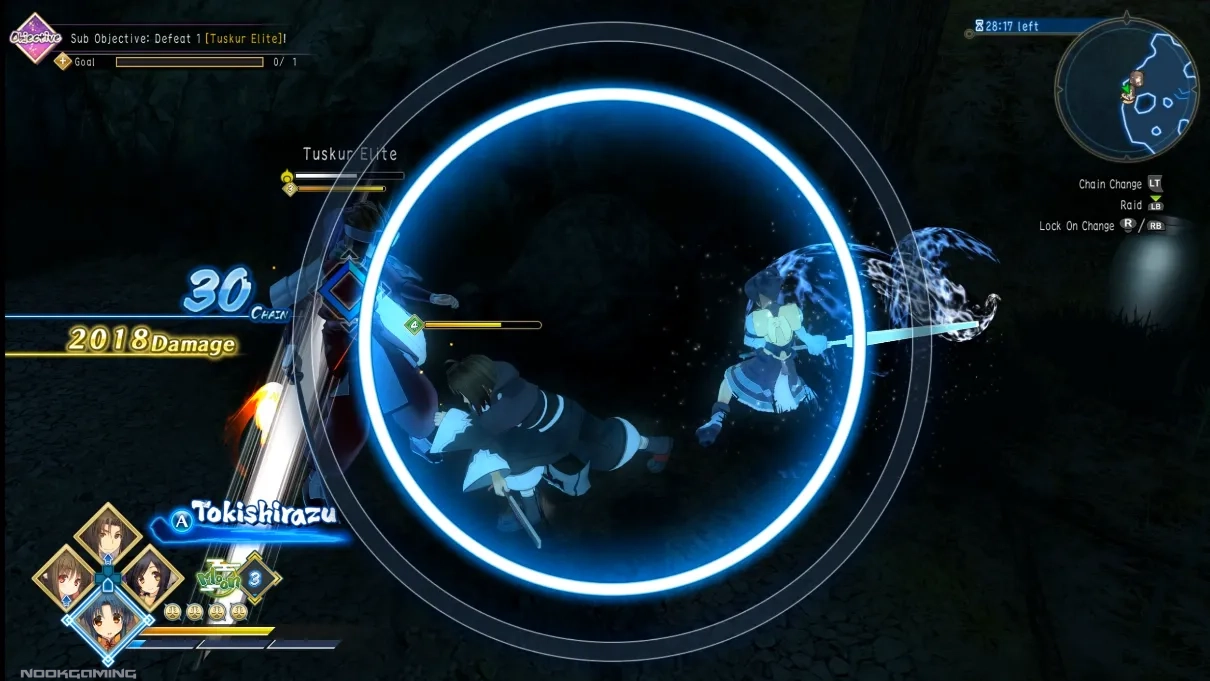
There is, however, a uniquely Utawarerumono mechanic that they decided to incorporate into ZAN’s gameplay: True Chains. When performing a character’s chain technique, similar to the original series, blue circles will start appearing on the screen that, if you hit B with the correct timing, will increase the damage of your technique as well as recover a bit of your Zeal. Using this quick-time event to your advantage has always been one of the things that make or break a difficult run in the trilogy, and although it’s less important in ZAN due to the removed turn-based restrictions, it’s still a cute stylistic feature that introduces a bit of skill expression in what would otherwise be an attack button mashfest.
Four People Make a Party
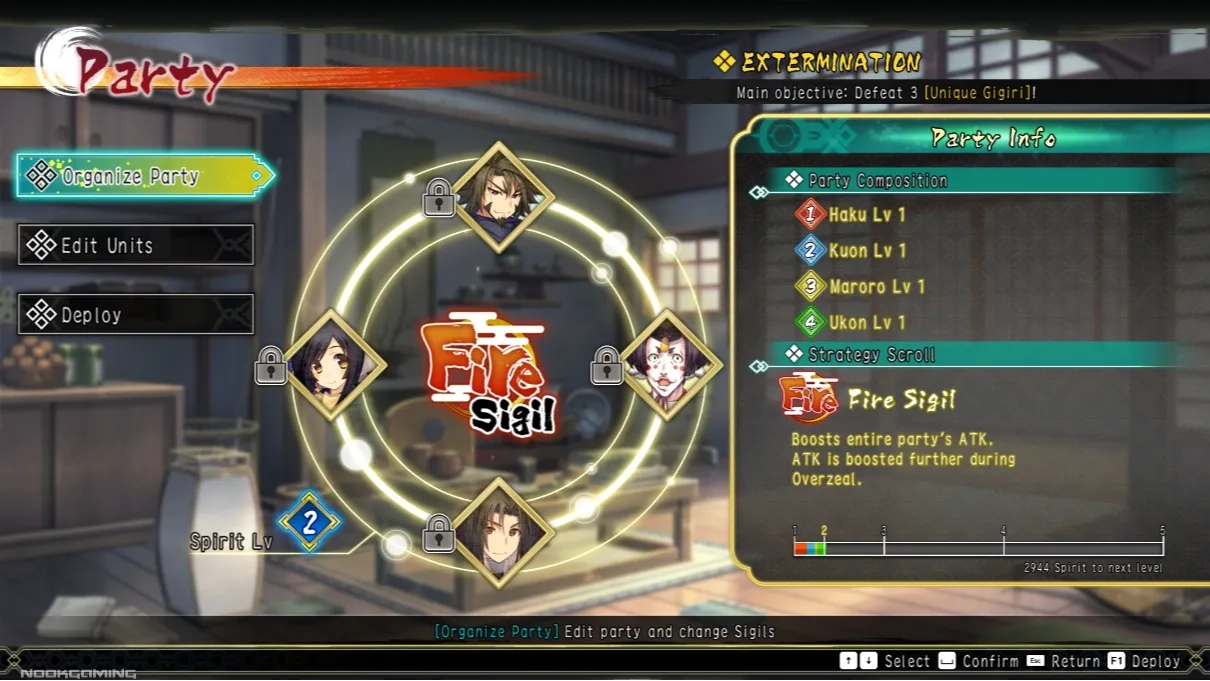
Instead of selecting a single character to bring to each stage, Utawarerumono: ZAN allows you to select up to four that you can switch into and out of as you clear your objectives. This is done through the Party screen, which is accessible only before starting your selected stage. Each party also has the option to switch sigils, which give permanent buffs in a stage that the party can take advantage of as they accumulate more combo counters, enemy defeats, and/or skill uses. Overall, the difficulty of a stage is determined by how well you can build your party setup according to the type of player you are and, on a smaller scale, how well the game’s AI can make use of the party members you select to deal with a stage’s gimmicks as you can only control one character at a time.
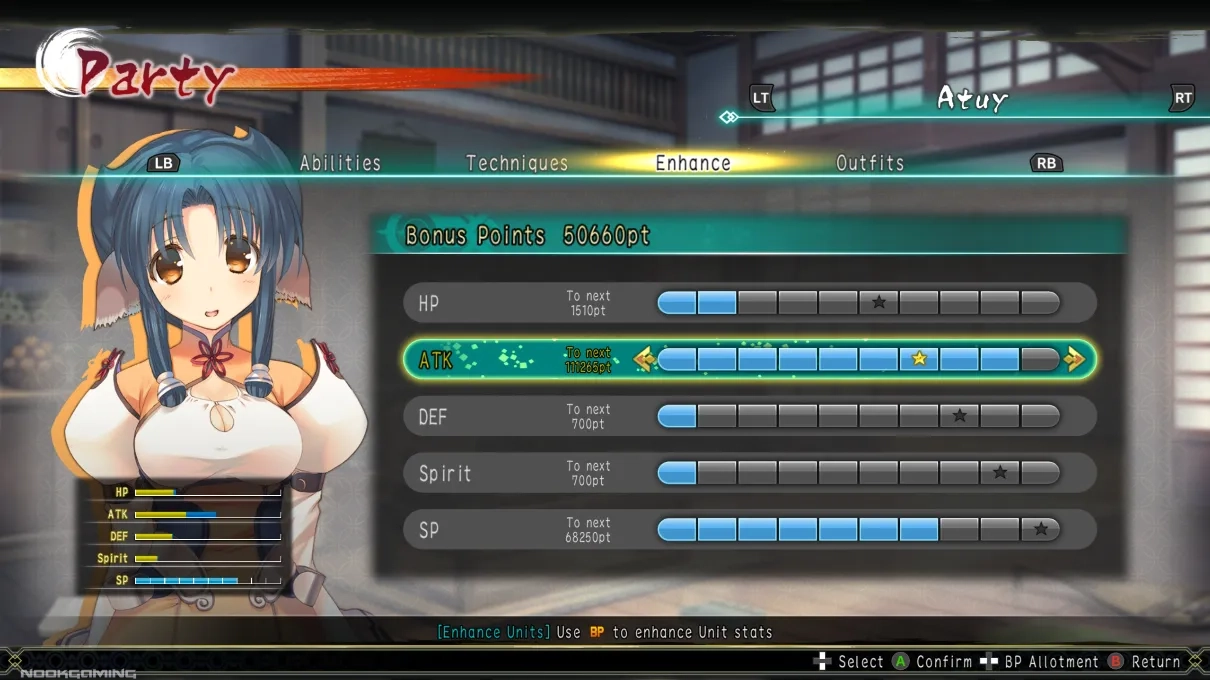
Utawarerumono: ZAN also makes use of a simple RPG progression system where each character has their own specific passive skills, item sets, chain techniques, and upgradeable stat lines that players can grind for as they play through the game’s post-story content. The items are procurable through an in-game shop that makes use of gold rewarded from mission clears, while stat lines are upgradeable through a resource called BP that the player accumulates alongside gold. Overall, it’s pretty straightforward and doesn’t have a lot of flexibility when it comes to builds, as it mainly plays with effects such as stat boosts, hp recovery, and Zeal-related mechanics. You can also change their outfits to the alternative color schemes unlockable through in-game achievements here.
There are some unique mechanics related to combat, such as piercing that forgoes the ability to stagger an enemy through defense breaks in favor of consistent damage per hit, but I found them unfeasible to use in the long run and felt that they were gimmicks more than anything. Some excel for specific gameplay styles though, such as the Salvation Scroll which helps with full reviving, and the Mercy Scroll for ramping up Sigil Effects fast.
Less Talking, More Fighting
Regarding the type of content that Utawarerumono: ZAN has, the game definitely leans closer to its Musou-style inspiration than its visual novel roots. To give an example, including the gameplay and story reading sections, it takes around 4 to 5 hours in total to clear the game’s main story scenario. To fully unlock all the achievements in the game, it will take you almost thrice the amount of time you spent reading to grind for all the relevant items in-game across thirty-one free battle missions, thirteen story recollections, and another thirteen for the stages’ harder versions. This doesn’t include the twelve (possibly more if you have the character DLCs) character trials that you need to do to unlock each character’s third chain technique. Considering that there’s only eighteen chapters in the main scenario, that’s a lot of post-story battle content for little narrative value.
Now the question is: are the post-story missions fun enough to warrant hours of grinding? If you’re a fan of beat ‘em ups and Utawarerumono, yes. If you only like one of the two, it might be a bit of a hard sell. Although it doesn’t feel as grindy as other titles in the genre, the sheer repetition can make or break your enjoyment of the game, especially if you’re not particularly fond of its established gameplay loop. It’s good as an appendix to an already existing Utawarerumono experience, but as a standalone game, the mechanics are a bit too simplistic for it to break out of its “spin-off” classification. You need to have some sort of investment in the main series to fully enjoy it.

Utawarerumono: ZAN as a PC Port
Since Utawarerumono: ZAN was originally a console game, the controls feel best when you use an actual controller to play it. The game itself recommends the use of a controller when you boot it up, so if you have it readily available, I definitely suggest giving that a spin instead. There are keyboard controls for the game, but similar to most console to PC ports out there, they feel a little bit clunky to play. For example, it has to be a crime to have the default attack buttons be on the mouse when you move using the WASD keys, and to switch characters using the arrow keys. Sure, you can rebind the buttons, but having that many things to press will eventually make you stop moving or attacking due to needing another hand to execute a specific function. That’s pretty counterintuitive for an action game.
On a bit of a side note, for those who might be interested in trying out the game solely as an alternative to reading Utawarerumono: Mask of Deception, you would be doing yourself a great disservice as the experience is incredibly different. Utawarerumono: ZAN feels like something you boot up to unwind from reading a text-heavy game like the original trilogy; missing out on the character interactions and general worldbuilding that ZAN glosses over undermines the charm of the mostly Slice of Life atmosphere that Mask of Deception is known for. There’s a reason why it spends so many hours just on character interactions. If there’s anything it has going for it, it would definitely be the relatively beautiful 3D models and stages. It felt incredible seeing these visual features brought to life in a different way.
Verdict
Utawarerumono: ZAN is a fun spin-off to Utawarerumono: Mask of Deception, but it is a spin-off nonetheless. While the Musou-style beat ‘em up gameplay is a fresh take on the Utawarerumono franchise, its limited mechanics and willingness to forgo the charms of the original make it more of a fanservice game than an alternative retelling of the game’s plotline. The 3D models implemented in the game definitely do shine a very pleasing light on the beautiful artstyle of the series, but the substance of the title is mostly contained within that visual presentation. With very simple mechanics and a highlight reel of a storyline, it does a mediocre job for both ends of the spectrum it’s trying to appeal to. I recommend playing it only if you’re a fan of both the genre of the game and Utawarerumono as a series, as having interest in only one side will greatly diminish your overall time spent on the game. It’s a nice, compact reminder of in-game events leading to the next installments, at least!
WAIT FOR SALE ON UTAWARERUMONO: ZAN

If you are looking for another Musou title, check out Warriors: Abyss.
Many thanks go to Shiravune for a PC review code for Utawarerumono: ZAN.

Visual novel reader that wishes there were more than 24 hours in a day. Gacha victim, TCG enjoyer, and VTuber simp. Still trying to live happily.