Indie gaming has grown to cover a pretty wide variety of gaming genres in the last decade. One such style I’ve noticed has been scarcely represented in the indie game world though is that of the 3D combat-heavy action game, often called the “character action” game. Which leads us to today’s topic, a title exploring that relatively underserved section of the indie gaming world: Homura Hime.
The game is developed by Crimson Dusk, a relatively small indie team out of Taiwan, and published by PLAYISM. It combines several elements of character action games with some bullet hell elements and a Japanese fantasy artistic and musical style. As someone who is a bit of a fan of games that combine bullet hell mechanics with other genres, Homura Hime caught my eye back when it was announced in 2022.

Infernal Monarch
This game stars the titular Homura Hime (usually referred to by that name in full despite it more or less translating to “Flame Princess”), a red-haired swordswoman who operates on behalf of an entity known as Jinguu. Her mission across the game is to do battle with powerful beings known as archdemons, effectively corrupted souls that inflict great damage to their surroundings, both nature and man alike, and exorcise them. She’s joined by her adorable aide Ann as she explores various different realms themed around older Japanese imagery, mythology, folklore, and fantasy.
Apart from each chapter’s focal archdemon and a small number of NPCs, much of the limelight of the story and cutscenes up until its final act focuses on Homura Hime and Ann. The former is generally a somewhat more stoic character, which contrasts with Ann’s somewhat more jovial demeanor and cuter appearance. I wouldn’t describe the characters as a particular strength or focus of the game and there isn’t a ton of personality to speak of, but they have their moments (such as when Homura Hime is noticeably bothered when someone calls her face scary). There’s a greater focus on the “action” part of this game than the “character”.
Carry The Weight
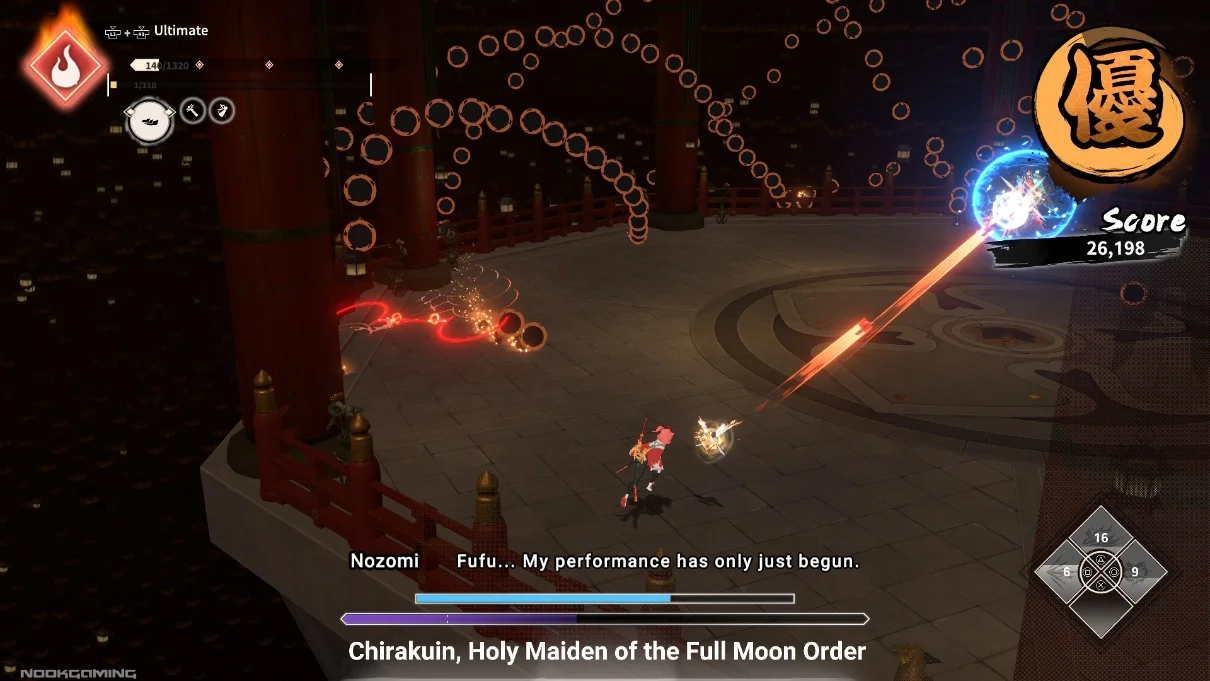
While I’ve enjoyed my share of games out of Taiwan that combine bullet hell elements with other genres, there’s one particular action game series out there that is much more world famous for implementing that idea into a 3D action game, that being NieR. Within just a couple of minutes of playing Homura Hime, I immediately noticed it had remarkable similarity to NieR Automata, a game Crimson Dusk have admitted as being an influence. How this game feels and how it weaves controlling your character in combat with enemies shooting swaths of deadly colored spheres during combat feels almost a bit too similar and derivative in practice for my liking.
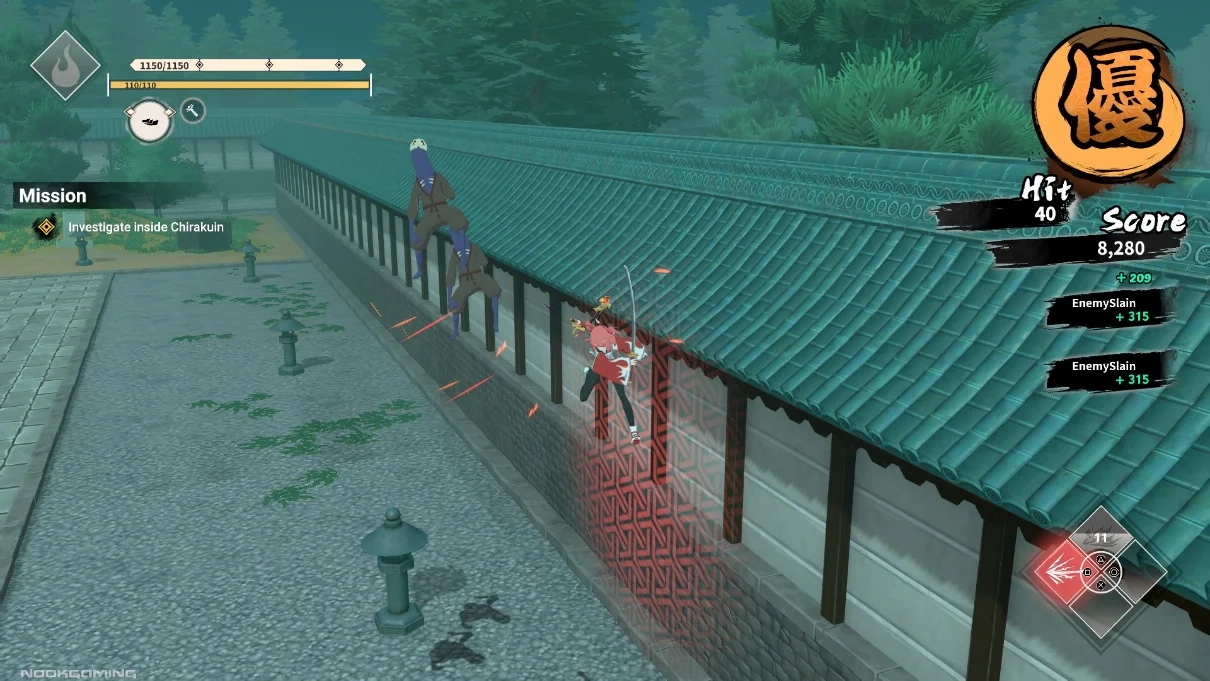
Granted, Homura Hime operates more linearly than an RPG in its structure. While you still accrue resources to spend on unlocking upgrades (mostly stats, equipment, and skills), most of its chapters consist of an extended level setpiece wherein you will be pursuing an archdemon, with combat consisting of baked-in waves of enemies serving as obstructions. There’s a lot of alternating between platforming sections and forced combat sections with enemy mobs.
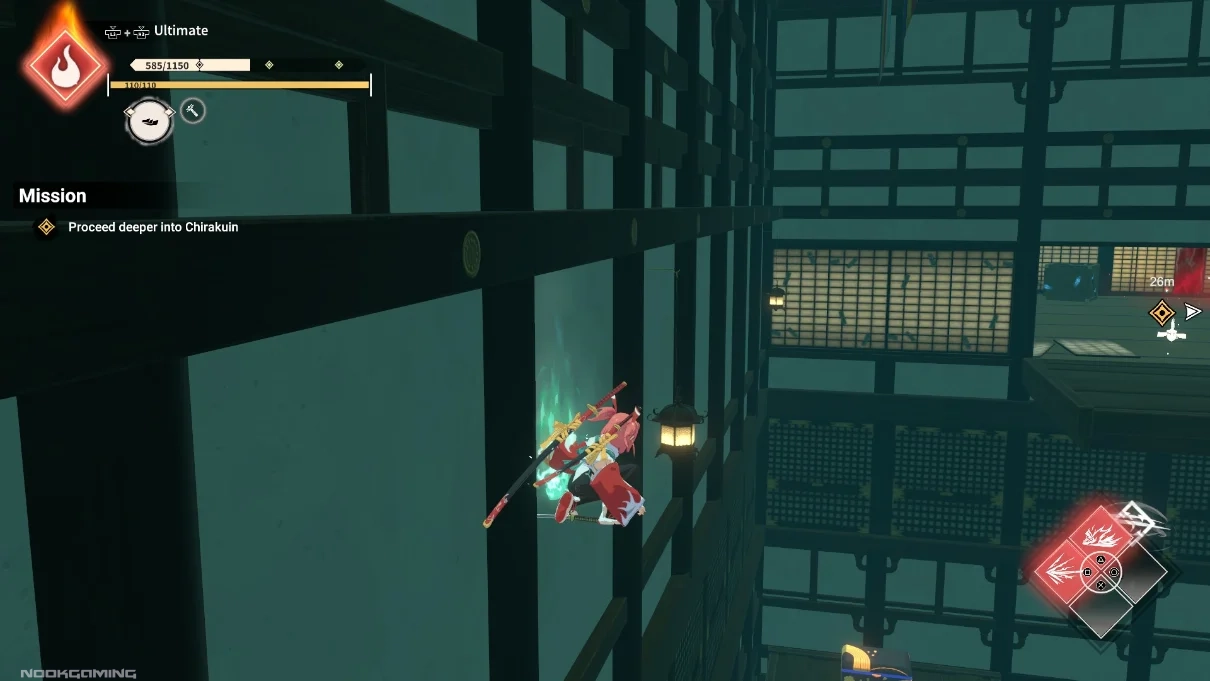
I didn’t exactly love doing much of either. Homura Hime has a mid-air dash for mobility, but most of the platforming of this game consists of either rather simple jumps or performing context-sensitive actions rather than offering especially engaging movement. It’s built off very straightforward platforming sections that feel fairly unspectacular to perform correctly and kind of annoying to fail, thus they have a low enjoyment ceiling. It doesn’t help that the boundaries of where you can and can’t jump to aren’t always the most clear. Enemy waves are fairly fun at first to try to juggle mooks and dance around attacks, and there are a few mechanics that make it hard to ever feel overwhelmed, which keeps them from being frustrating, but they get rather repetitious and monotonous after a while due to relatively limited enemy variety and the game not really introducing creative new obstacles.
Homura Hime’s big boss fights are its biggest highlights. Boss fights are a lot more grand, using more elaborate patterns and bespoke attacks that make the encounters considerably more standout. These make for quite the spectacle, and I found it a bit unfortunate that the levels leading into them were often rather long.
Parry Me
While it’s easy and even at times reductive to compare games with similar ideas and mechanics, Homura Hime straight up borrows from much of NieR’s (and especially Automata’s) playbook such that it’s hard to separate my feelings about it from that game. In addition to swinging around your sword with light and heavy attacks and dodging big ole spheres, your aide Ann provides you with a sort of magic long-range weapon that works incredibly similarly to the magic of Grimoire Weiss or the gunfire of YoRHa’s Pods. I felt like I was playing a worse version of Automata or Replicant 1.22, games I already have a share of issues with combat-wise in terms of its subtler mechanics. The Japanese fantasy theming and linear level structure help to separate it a bit, and there are some of its own unique sections to certain stages (e.g. a level that features an extensive rail grind section), but given how often you’re forced to engage in combat with basic enemies it’s still a more combat driven game where the combat just kind of left me wanting.
Homura Hime largely feels pretty good to control. Motions are smooth, animations are flashy and satisfying, and there are a lot of options available to you. Crimson Dusk clearly demonstrates that they learned a lot of lessons from the greats of the genre on how to make a character generally feel right to control. A neat aspect of this game in particular is that it rewards you for engaging in melee combat by allowing you to allot special skills to use by pressing a skill button and one of four bound special attack buttons (which I used the face buttons for). These can be recharged either by hitting enemies with your sword (ranged attacks won’t do) or by performing parries on enemy attacks. And it is unfortunately with the game’s parry system that I think it really begins to fall apart.
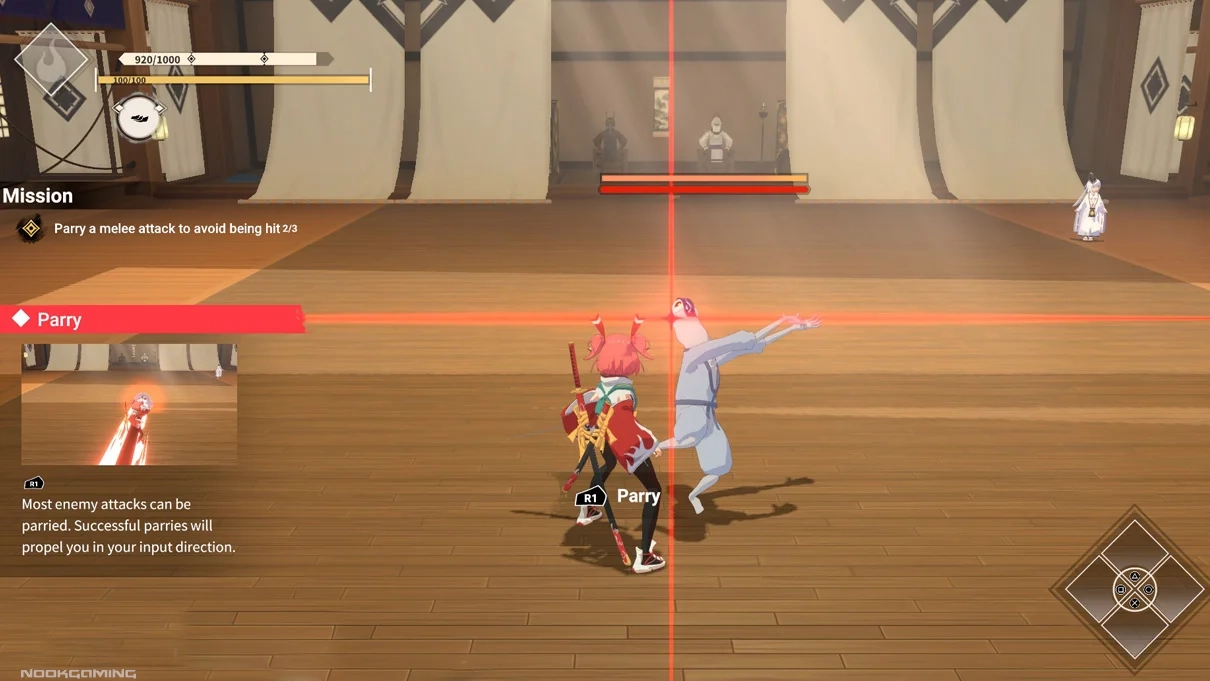
By the time the game was announced in 2022, parry mechanics had already become a codified mainstay in character action games, especially with the likes of Fromsoft’s titles (particularly Sekiro) and Platinum Games’ titles like Metal Gear Rising and, yes, NieR Automata. By 2026, they’ve started to become a bit more derided, and it takes considerable care and refining for the mechanic to make them feel like the special sauce of combat rather than a crutch anymore. To my dismay, Homura Hime feels a lot more like a case of the latter. Parryable attacks (which are a majority of what enemies throw at you, indicated by a red flash) can be instantly parried with the press of a button, with basically no end lag after use and a deploy time longer than it takes to press the button again by default. This weightlessness to parrying, coupled with the very loud sound every parryable attack makes, makes it pretty easy to just mash when anticipating enemy attacks, which eliminates any real need to learn the timing and any sense of failure.
The game lacks any real sense of reward or punishment to the finer mechanics of its combat. There are a bunch of attack combos and skills you can learn and equipment you can put on that all generally don’t feel that impactful; most of the time, I only ever shuffled around equipped skills and accessories because I was bored of the stale mobs of enemies and the effortlessness of combat, rather than any curiosity or sense of need to get an edge. If the game wasn’t artificially easy enough due to how mindless the parry system feels, you also get an item (dango) that lets you immediately revive to full health when you die. The game gives you several, and they cost a fairly low amount of money by the end of the game for a one-time invalidation of death. And if you want to make the game even easier, there are accessories that make it so you heal after successful parries, which you will be performing a lot of already. After getting the basics down, I think I died more due to occasional glitches than from genuine combat failure, even on the higher of the two difficulties available at the start.
Homura Hime absolutely gets most of the basics and surface-level stuff down quite well, but underneath it is a game that sadly squanders its true potential of being an enthralling action game due to its overall lack of much tension behind its spectacle.
Are We the Bad Guys?
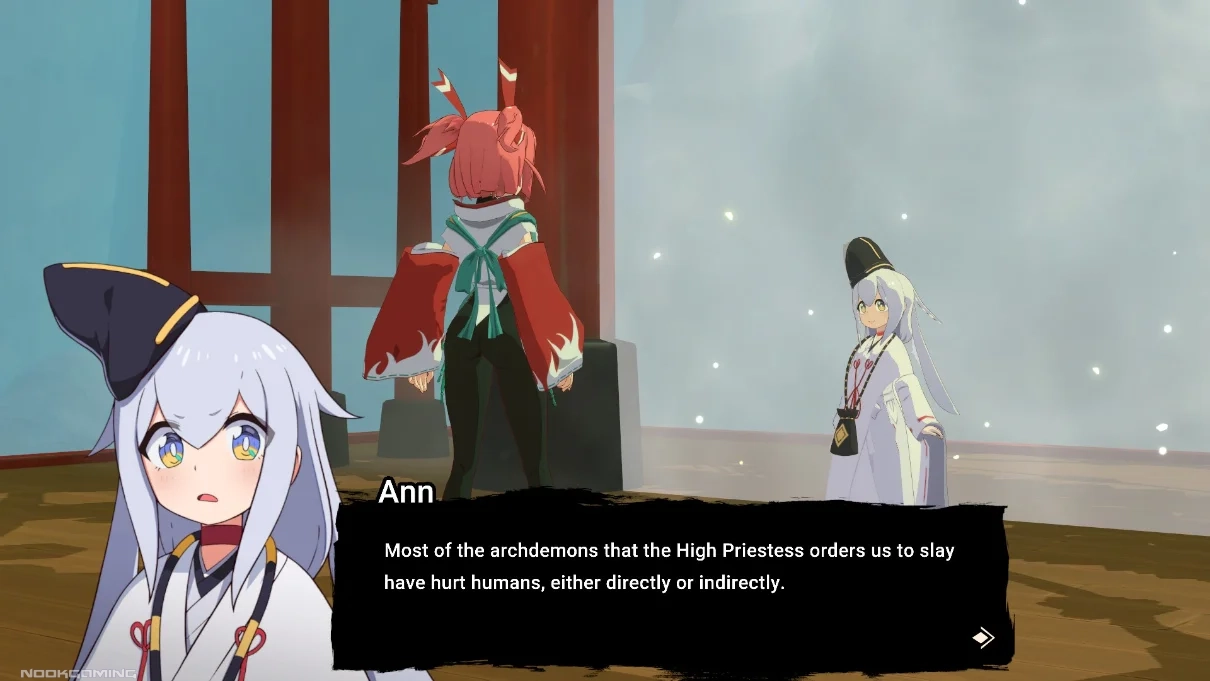
Homura Hime’s story doesn’t help its case much. Within a couple of chapters, you start to feel a disconnect as our protagonist’s mission has her eliminating archdemons who feel increasingly sympathetic. She does start to take notice of this, and there is a bit of a theme to the narrative of choosing between one’s mission/orders and doing what one feels is right. The problem is it’s rather superficial and lacking in qualities that meaningfully separate it from any of the myriad of other stories on this subject. Not to get too spoilery, but several twists come about as the game approaches its final act, and they feel considerably contrived for the sake of having a big shakeup rather than something that fundamentally made me more invested. Several plot devices are handled in ways that felt…a bit overly convenient, if you will.
Part of the issue is also that the game feels like it doesn’t have enough variety to gameplay to match how much space it allotted for story, which hurt my investment in both. It’s harder to enjoy having to trudge through more repetitive gameplay to get to those story beats, and it makes those story beats hit less by the time I get to them when I’ve grown numb to the game on the whole, creating a rather negative feedback loop. The final act is definitely more boss-dense, but the non-boss sections just felt like they were really dragging the game out by this point, both in gameplay and in story. Homura Hime isn’t especially long, clocking in around nine hours for me, but the dragging story, largely unmemorable level design, and overly loose feeling to combat had me checking out several hours before then as I sought to finish the game out of a sense of obligation rather than excitement for its conclusion.
Well, At Least it Looks Cool
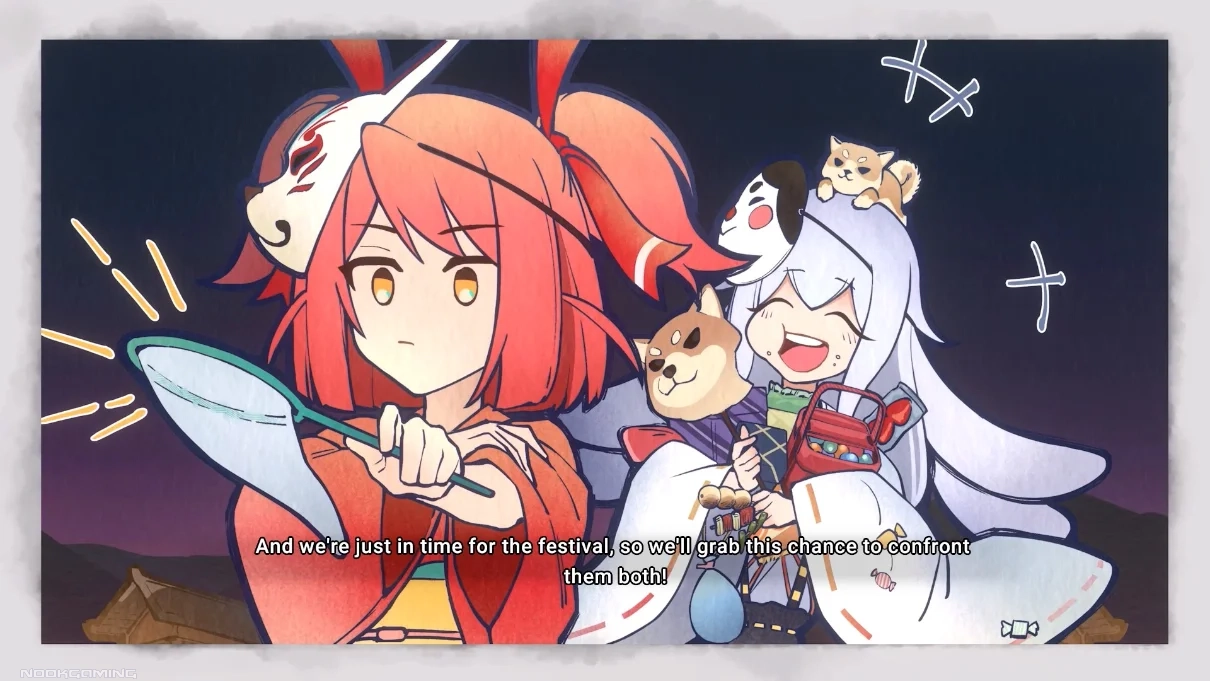
Homura Hime at the very least gets most of its presentation components right. While the game definitely looks like the product of a fairly small studio developing in Unity, it’s still a pleasant sight nonetheless. The use of stylized Japanese architecture and fantasy is well executed, depicting realms resembling those of older Japanese paintings and artistry with colorful vibrance and striking imagery. Combat animations are polished, and the cutscenes are well-animated and well-choreographed. Each character has a memorable enough design, and the portraits are fairly expressive.
Sound is also very well handled for the most part. The music typically captures the feel of the visual style as well as the general pace of combat and the mood of given scenes. While there’s plenty of classic stings and woodwind sound to fit the look, there are some tracks that get really adventurous in a way that comes out of nowhere but is not an unwelcome surprise. For example, one mini-boss theme goes full Eurobeat. The game has Japanese voice acting throughout, with some pretty accomplished voice actors in the cast. Homura Hime and Ann are voiced by Tomori Kusunoki and Manaka Iwami respectively, both of whom are modern mainstays of anime and games. There are some quirks to the sound design, such as how falling into bottomless pits lacks an accompanying vocal sound, but most of the time they get it right.
Verdict
I want to like Homura Hime a lot more than I actually do. It doesn’t have the type of patently obvious mistakes that the bad sorts of action games have, and I can tell the creators were genuinely trying to make a game that can stand next to the greats of the character action subgenre. It gets a lot of the important macro details right with its presentation and overall feel. It just misses on a lot of the finer and subtler elements that take enough away from the game to make it harder to recommend. The platforming doesn’t do enough to keep the repetitious enemy mob encounters from feeling stagnant, and the misused parry system dampens the impact of what should have made for significantly more fun bosses. The story never really elevates the game due to direction and writing choices that don’t really stick the landing on the game’s twists or emotional components.
There’s a modest amount of enjoyment to be had with this game, and it’s certainly competent, but it never quite graduates from adequate into the realm of standout.
WAIT FOR SALE ON HOMURA HIME

If you are looking for another hack and slash title, check out Warriors: Abyss.
Many thanks go to Playism for a PC review code for Homura Hime.
Been playing games since my papa gave me an NES controller in the early 90’s. I play games of almost all genres, but especially focus role-playing, action, and puzzle-platform games. Also an enjoyer of many niche things ranging from speedrunning to obscure music from all over the world.